
Prime Minister of Solomon Islands facts for kids
Quick facts for kids Prime Minister of Solomon Islands |
|
|---|---|
| Praem Minista blo Solomon Aelan (Pijin) | |

Coat of Arms of Solomon Islands
|
|
.jpg) |
|
| Residence | Red House, Honiara |
| Appointer | Elected by the members of Parliament |
| Term length | Until next election |
| Inaugural holder | Peter Kenilorea |
| Formation | 7 July 1978 |
| Salary | 143,000 SBD/US$ 17,439 annually |
Script error: No such module "Check for conflicting parameters".
The Prime Minister of Solomon Islands is a very important leader in the Solomon Islands. Think of them as the main boss of the government, chosen by the people's representatives in the National Parliament. Their job is to lead the country and make sure things run smoothly for everyone.
Currently, Matthew Wale is the Prime Minister of the Solomon Islands. He started this important role in May 2026.
The Solomon Islands is also part of the Commonwealth realm. This means they share a connection with the British Monarchy. However, the daily duties of the head of state are handled by the Governor-General. The Governor-General is chosen by the Parliament to represent the monarch.
The Prime Minister lives in a special official home called Red House, located in the capital city, Honiara.
Contents
How the Prime Minister is Chosen and Works
The country's rulebook explains how the Prime Minister is chosen. Members of the National Parliament vote to elect the Prime Minister. Once the Prime Minister is chosen, they then suggest other people to become government ministers. The Governor-General officially appoints these ministers.
A Prime Minister can be removed from their job if the National Parliament votes that they no longer have their trust. This is called a no-confidence motion. The Prime Minister also leaves office if they decide to resign, if they are no longer a member of Parliament, or if they become the Speaker or Deputy Speaker of Parliament. If the position becomes empty, the Governor-General will choose a temporary Prime Minister until a new one can be properly elected.
The election process for the Prime Minister is very fair. Any member of Parliament can be suggested for the job, but they need at least four other members to support their nomination. The election happens through a secret ballot, meaning no one knows who voted for whom. The Governor-General oversees this process. If no candidate wins more than half the votes right away, they keep voting. In each new round, the candidate with the fewest votes is removed until someone wins a clear majority.
Leaders of the Solomon Islands: A List of Prime Ministers
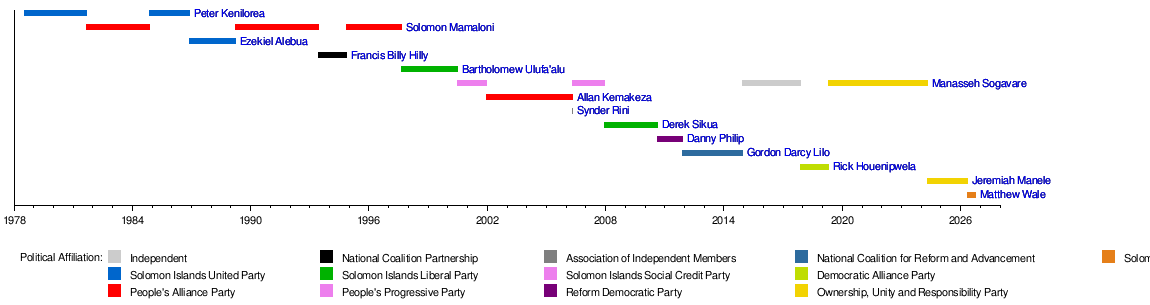
Here is a list of all the people who have served as Prime Minister of the Solomon Islands since the country became independent. Each Prime Minister played a role in shaping the nation's history. The colors next to their names in the timeline below show which political party they belonged to.
Solomon Islands United Party (UP) People's Alliance Party (PAP) Independent Group for National Unity and Reconciliation (GNUR) Solomon Islands Liberal Party (SILP) People's Progressive Party (PPP) Association of Independent Members (AIM) Solomon Islands Social Credit Party (Socreds) Reform Democratic Party (RDPSI) Solomon Islands Party for Rural Advancement (SIPRA) Democratic Alliance Party (DAP) Ownership, Unity and Responsibility Party (OUR Party) Solomon Islands Democratic Party (SIDP)
| No. | Picture | Name (Born–Died) |
Election Year | Time in Office | Political Party (Coalition) |
||
|---|---|---|---|---|---|---|---|
| Started | Ended | Total Time | |||||
| 1 | .jpg) |
Peter Kenilorea (1943–2016) |
1980 | 7 July 1978 | 31 August 1981 | 3 years, 55 days | UP |
| 2 |  |
Solomon Mamaloni (1943–2000) |
— | 31 August 1981 | 19 November 1984 | 3 years, 80 days | PAP |
| (1) | |
Sir Peter Kenilorea (1943–2016) |
1984 | 19 November 1984 | 1 December 1986 | 2 years, 12 days | UP |
| 3 | |
Ezekiel Alebua (1947–2022) |
— | 1 December 1986 | 28 March 1989 | 2 years, 117 days | UP |
| (2) | |
Solomon Mamaloni (1943–2000) |
1989 | 28 March 1989 | 18 June 1993 | 4 years, 82 days | PAP (GNUR) |
| 4 | |
Sir Francis Billy Hilly (1948–2025) |
1993 | 18 June 1993 | 7 November 1994 | 1 year, 142 days | Independent (NCP) |
| (2) | |
Solomon Mamaloni (1943–2000) |
— | 7 November 1994 | 27 August 1997 | 2 years, 293 days | GNUR |
| 5 | .jpg) |
Bartholomew Ulufa'alu (1950–2007) |
1997 | 27 August 1997 | 30 June 2000 | 2 years, 308 days | SILP (SIAC) |
| 6 | .jpg) |
Manasseh Sogavare (born 1955) |
— | 30 June 2000 | 17 December 2001 | 1 year, 170 days | PPP |
| 7 |  |
Allan Kemakeza (born 1950) |
2001 | 17 December 2001 | 20 April 2006 | 4 years, 124 days | PAP |
| 8 |  |
Snyder Rini (1948–2025) |
2006 | 20 April 2006 | 4 May 2006 | 14 days | AIM |
| (6) | |
Manasseh Sogavare (born 1955) |
— | 4 May 2006 | 20 December 2007 | 1 year, 230 days | Socreds |
| 9 | .jpg) |
Derek Sikua (born 1959) |
— | 20 December 2007 | 25 August 2010 | 2 years, 248 days | SILP |
| 10 | .jpg) |
Danny Philip (born 1953) |
2010 | 25 August 2010 | 16 November 2011 | 1 year, 83 days | RDPSI |
| 11 |  |
Gordon Darcy Lilo (born 1965) |
— | 16 November 2011 | 9 December 2014 | 3 years, 23 days | SIPRA |
| (6) | |
Manasseh Sogavare (born 1955) |
2014 | 9 December 2014 | 15 November 2017 | 2 years, 341 days | Independent |
| 12 | .jpg) |
Rick Houenipwela (born 1958) |
— | 15 November 2017 | 24 April 2019 | 1 year, 160 days | DAP |
| (6) | |
Manasseh Sogavare (born 1955) |
2019 |
24 April 2019 | 2 May 2024 | 5 years, 8 days | OUR Party |
| 13 | .jpg) |
Jeremiah Manele (born 1968) |
2024 | 2 May 2024 | 15 May 2026 | 2 years, 13 days | OUR Party |
| 14 | |
Matthew Wale (born 1968) |
— | 15 May 2026 | Incumbent | 149 days | SIDP |
Timeline of Prime Ministers
More About Solomon Islands Government
 In Spanish: Primer Ministro de las Islas Salomón para niños
- Deputy Prime Minister of Solomon Islands: This is the second-in-command to the Prime Minister.
- Governor-General of Solomon Islands: This person represents the King or Queen of the Commonwealth in the Solomon Islands.
- Leader of the Opposition (Solomon Islands): This is the leader of the main political party that is not in power.
- Leader of the Independent Members: This person leads the members of Parliament who do not belong to a specific political party.
