
Remembrances of the Mountain Meadows Massacre facts for kids
The Mountain Meadows Massacre was a very sad event that happened in September 1857. Many people have worked hard to remember the victims and teach others about what happened. This includes building monuments, placing markers, and forming groups to protect the massacre site and graves.
Contents
- Markers and Monuments: Remembering the Past
- Utah's Memorials: Honoring the Victims
- Arkansas Memorials: Remembering from Afar
- Other Markers: Honoring the Survivors
- Commemorative Observances: Remembering Together
- Associations and Groups: Keeping the Memory Alive
- Images for kids
Markers and Monuments: Remembering the Past
Utah's Memorials: Honoring the Victims
Early Markers: The First Steps to Remembrance
Southern Gravesite: The First Cairn

In May 1859, Major James H. Carleton of the U.S. Army arrived at Mountain Meadows. His job was to bury the people who had died in the massacre. After searching, the remains of 34 victims were buried in a ditch. This ditch was a trench the travelers had dug to defend themselves.
Around this grave, soldiers built a simple monument from loose granite stones. It was shaped like a cone, about 50 feet around at the bottom and 12 feet tall. A cross made of red cedar wood stood on top, making the monument 24 feet tall in total. On the cross, facing north, these words were carved:
Vengeance is mine: I will repay, saith the Lord.
A rough granite slab at the base of the monument had these words:
Here 120 men, women, and children were killed in a terrible event early in September, 1857. They were from Arkansas.
In May 1861, Brigham Young and other church members visited the site. After seeing the cross, the cross was taken down and the stones of the monument were scattered.
Rebuilding the Memorials
In May 1864, Captain George F. Price and his Cavalry found the 1859 monument damaged. The monument was torn down, the cross was gone, and the stones were spread out. The grave underneath was also disturbed.
Captain Price and his soldiers immediately repaired the grave and rebuilt the monument. The new stone structure was 12 feet square at the base and 4 feet high. A pyramid-shaped column rose 7 feet from the square base. A cedar pole with a crossbar on top made the monument 14 feet tall. On the east side of the cross, it read:

Vengeance is mine, I will repay saith the Lord
Mountain Meadow massacre, September 1857
On the other side, it said:
Erected by the officers and men of Company M, 2d California Cavalry, May 24th and 25th, 1864.
The grave was fixed by filling it with earth and covering it with protective stones. This monument was also damaged and rebuilt again in 1870.
Northern Gravesites: Lost and Found
Before Major Carleton's monument was built, assistant surgeon Charles Brewer buried 26 victims in three mass graves in 1859. These graves were about one and a half miles north of where Carleton built his monument. Each grave was marked with a pile of stones. Unlike the southern grave, the exact location of these northern graves was lost for many years.
In 2014, archaeologist Everett Bassett found rock piles he thinks are these northern graves. These possible grave sites are on private land, not on the land owned by the LDS Church. Some groups hope these sites will be protected as national monuments.
1932 Memorial: A New Wall for Protection
Because the first monument was often damaged, people in southern Utah decided to do more. On August 20, 1932, 73 men began building a new wall around the remains of the 1859 monument. This wall was about 30 by 35 feet and 4 feet high. Steps on the west side allowed visitors to see the old monument inside. The Utah Pioneer Trails and Landmarks Association placed a bronze plaque near the steps. It explained the history of the massacre and the monument.
The dedication of this new wall and plaque happened on September 10, 1932. About 400 people attended.
In April 1965, the land (2.5 acres) with the 1859 monument and 1932 wall was given to the Church of Jesus Christ of Latter-day Saints (LDS Church). The Church later replaced the 1932 plaque with a new one in September 1990. The 1932 stone wall was removed when the 1999 monument was built.
1990 Monument: Overlooking the Meadows


On September 15, 1990, a new monument was dedicated to the victims. This was done with help from the LDS Church and the State of Utah. The monument was built on Dan Sill Hill, which overlooks the meadows. It is made of granite, and the names of the victims and survivors are carved on it. A small message in the middle explains:
IN MEMORIAM
In the valley below between September 7 and 11, 1857, a group of more than 120 Arkansas travelers led by Capt. John T. Baker And Capt. Alexander Fancher was attacked while traveling to California. This event is known as the Mountain Meadows Massacre.
More than 2,000 people attended a memorial service at Southern Utah University for the dedication. Leaders from the victims' families, the Paiute tribe, and the LDS Church spoke.
In 1998, the monument was damaged by frost and a small earthquake. Today, the Utah State Division of Parks and Recreation takes care of it.
1999 Monument: A New Cairn and Discovery

After a visit by Church President Gordon B. Hinckley in 1998, the Church planned to improve its property. This included replacing the 1859 monument and 1932 wall. Work began in May 1999.
This new monument was dedicated on September 11, 1999, the 142nd anniversary of the massacre. About 1,000 people attended.
The new monument included a rebuilt stone cairn surrounded by a rock wall, a small plaza, and a black iron fence. To make sure the walls would last, workers dug deep foundations. On August 3, 1999, a backhoe digging for the foundations uncovered many human bones. Digging stopped immediately. Experts had checked the area before and thought it was clear.
The bones were taken for study. Many descendants were upset and asked for the study to stop and the remains to be reburied. On September 8, Utah Governor Michael Leavitt ordered all remains to be reburied in two days. The study was quickly finished.

On September 10, the remains were placed into four oak boxes by family members. A small memorial service was held, and the boxes were buried in a special vault under the new 1999 monument. Family members brought dirt from Arkansas to add to the vault.
In 2017, the skull of a child, found by Major Carleton's soldiers in 1859, was also buried in the vault. Also in 2017, granite markers with the names of all known victims were placed around the 1999 monument.
New Monuments in the 2010s


In May 2009, the LDS Church bought 16 more acres of land in the Meadows. This land is thought to be where the men and boys of the wagon train were killed. On September 10, 2011, a new memorial was dedicated on this land. It honors the men and boys who died. The memorial includes a large polished stone monument, a rock with a cross etched into it, and two stone benches.
On September 11, 2014, two more monuments were dedicated. The first, sometimes called the "Monument to the 10," overlooks the siege site. It honors those killed in the first attack. A walking trail connects it to the 1999 monument. The second monument honors the women, children, and wounded who were killed. This monument is believed to be near where these individuals died.
Also in September 2014, a "Remembrance and Reconciliation Quilt" was shown in St. George, Utah. A similar quilt is in Arkansas.
2017: New Interpretive Signs
In 2017, 19 new signs were added to all monument sites. These signs provide information about the massacre. They were written by a committee with members from descendant groups and the LDS Church. The new signs give a clear and consistent history of the event.
Historic Site Status: National Recognition
Most of the Mountain Meadows massacre site is listed on the National Register of Historic Places since 1975. It was also named a National Historic Landmark in 2011. The LDS Church worked to get this landmark status after requests from descendant groups. On June 30, 2011, the site was officially named a National Historic Landmark.
In 2015, the landmark area was made larger to include a third piece of land. This area is believed to be where the women, children, and wounded were killed.

Arkansas Memorials: Remembering from Afar
1936 Marker: The Journey's Start
A small metal marker was placed near Milum Spring in Arkansas. This is where some of the travelers began their journey to California. The marker says:
Boone County – Caravan Spring
Near this spring, in September 1857, gathered a group of 150 men, women, and children. They began their journey to California here. All but 17 small children were killed at Mountain Meadows, Utah, by a group of white men and Indians.
1955 Monument: A Town's Tribute

To remember the massacre, a monument was placed in the town square of Harrison, Arkansas. It was shown for the first time during a Fancher Family reunion on September 4, 1955. One side of the monument has a map and a short summary of the massacre. The other side lists the names of the victims.
2005 Replica: A Link to the Survivors

In 2005, permission was given to build a copy of the 1859 stone monument in Carrollton, Arkansas. This copy was built near a cemetery and the Old Yell Lodge. This lodge was where the children who survived the massacre were returned to their families in 1859. The Mountain Meadows Monument Foundation and a local Veterans of Foreign Wars group have restored the lodge. It now has displays and information about the massacre and the surviving children.
The replica was dedicated on September 25, 2005. Many descendants of the victims attended. This replica is smaller than the original. It has a large cross facing west, towards Utah, with the words "Vengeance is mine; I will repay, saith the Lord" carved into it. A large sign next to it explains the massacre and the return of the children.
Today, this monument is often a place for descendant gatherings.
Other Markers: Honoring the Survivors
The Mountain Meadows Monument Foundation has also helped make sure that the graves of all the surviving children have special plaques telling their stories.
Commemorative Observances: Remembering Together
150th Anniversary of the Massacre
On September 11, 2007, about 400 people gathered to remember the 150th anniversary of the massacre. Elder Henry B. Eyring of the LDS Church expressed deep regret for the actions of local church leaders. He said, "What was done here long ago by members of our church represents a terrible and inexcusable departure from Christian teachings and conduct. We cannot change what happened, but we can remember and honor those who were killed here."
150th Anniversary of the Return of the Children
To celebrate when the surviving children were returned to their families in Arkansas, a special event was held at the Mountain Meadows massacre site on May 30, 2009. A similar event was held in Arkansas on September 15, 2009, to celebrate "The Return of the Children."
Other Events
Other smaller events, family reunions, and group gatherings happen regularly to remember the massacre.
Associations and Groups: Keeping the Memory Alive
Mountain Meadows Association
The Mountain Meadows Association (MMA) was formed in 1988. Its goal is to protect the site and ensure the massacre is properly remembered. The MMA works with the LDS Church and the State of Utah. Today, the MMA helps connect the LDS Church with many descendants of the victims.
Mountain Meadows Massacre Descendants
The Mountain Meadows Massacre Descendants (MMMD) group helps victims' descendants stay in touch. They also work with other groups to protect the massacre site and ensure proper remembrance.
Mountain Meadows Monument Foundation
In 1999, some members of the MMA formed their own group, The Mountain Meadows Monument Foundation, Inc. (MMMF). A main goal of the MMMF is for the U.S. Federal Government to control the massacre site instead of the LDS Church. The MMMF has helped mark the graves of all surviving children with special plaques. They also gather books about the massacre to donate to libraries.
Images for kids
-
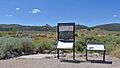
Interpretive signage at the massacre site, with the 1999 monument seen in the background

