
Samuel Hall House facts for kids
Quick facts for kids |
|
|
Samuel Hall House
|
|

Samuel Hall House
|
|
| Location | 924 Hillside Rd., Albion, Dane County, Wisconsin |
|---|---|
| Area | 5 acres (2.0 ha) |
| Built | 1856/1867 |
| Architectural style | Greek Revival |
| NRHP reference No. | 93001445 |
| Added to NRHP | December 23, 1993 |
The Samuel Hall House is a beautiful old farmhouse built in 1856. It is located in Albion, Dane County, Wisconsin. The house was designed in the Greek Revival style, which was very popular back then.
Because of its history and special design, the Samuel Hall House was added to both the State and the National Register of Historic Places in 1993. This means it's an important building worth protecting!
Contents
Who Was Samuel Hall?
Samuel Hall was born in 1818 in a place called Derbyshire, England. He worked as a farmer there for some time. In 1844, he decided to move to America with his brother George.
They first arrived in Milwaukee, Wisconsin. There, they met other English immigrants, also from Derbyshire. Together, they traveled to Albion Prairie. This area had only been settled by white people three years before they arrived.
Building a Community
Many of these English newcomers settled close to each other. Some of them were skilled at working with stone, called masonry. In 1847, they used their skills to build a brick church. This church was for their Primitive Methodist group.
Samuel Hall was a member of this church. He helped with the building project, showing his dedication to his new community.
The Hall Family Farm
When Samuel first arrived, he, his wife Sara, and his brother George lived with a man named Isaac Bunting on his farm. In 1854, Samuel and George bought the farm from Isaac. It was a large piece of land, about 233 acres!
After buying the farm, George and Samuel decided to split it. Samuel received 100 acres for his own farm.
Building a New Home
By 1856, Samuel Hall was doing well enough to build a big, strong house. The main part of the house you see today is the original building. It's a simple, rectangular shape and has two stories. The walls are made of carefully cut limestone blocks.
The house shows off the Greek Revival style. You can see this in its low-pitched roof and the way the roof corners turn back, called cornice returns. The windows and doors are placed evenly, making the house look balanced. Inside, there's a main staircase in the middle, which was common for this style.
The first floor has a special room called a parlor. This room has fancy baseboards and window frames. The rest of the house has simpler decorations. When it was first built, the house also had a small, one-story wooden building attached. This was called a "summer kitchen."
Family Life and Changes
Samuel's first wife, Sarah, passed away in 1865. The next year, Samuel hired a helper named Ann Wright. They fell in love and got married. Samuel and Ann later had three children together.
In 1867, Samuel made some changes to his house. He took down the old wooden summer kitchen. In its place, he built a new, two-story stone addition. This new part matched the original house's stone walls but had a simpler design. An open porch was also added along the side of this new wing. At the same time, a one-story kitchen wing was built.
Fun Times at the Farm
The Primitive Methodist Church often held special events at Samuel Hall's farm. One fun event was their Sunday School Anniversary and Picnic. This picnic took place on July 4th in Samuel's grove of trees.
In 1877, the local newspaper, The Edgerton Independent, announced the picnic. It described a day full of singing and speaking starting at 9:30 a.m. After that, everyone would enjoy a picnic lunch provided by the ladies of the prairie. People were encouraged to bring their own pies and cakes to share!
Picnic Games and Sports
The newspaper promised lots of fun games and sports after dinner. These included foot races, wheel-barrow races, and sack races. They also played games like dropping the handkerchief and "duck under the water kit." The announcement ended by saying that the people of Albion Prairie knew how to have a good time!
Farm Buildings and Legacy
The Samuel Hall farm wasn't just about the house. It also had several important buildings for farming. A 30-foot pig barn, made of limestone, was built at the same time as the house in 1856. It's still standing today!
There's also a large 90-foot wooden dairy barn and a concrete silo. These were built before the 1930s. Northeast of the barn, you can find an 80-foot tobacco shed. The farm also had a poultry barn for chickens and other smaller sheds.
Samuel Hall passed away in 1888 from pneumonia. His son, George, was only 18 years old at the time. George stopped school to take over the farm. He ended up inheriting both his father's and his uncle's farms. George grew crops like tobacco, grain, and hay. He also raised special kinds of animals, including pure-bred short-horned cattle and Polish China hogs.
Samuel Hall's family continued to farm the land until 1951. After that, the farm was rented out to other farmers.
Images for kids
-
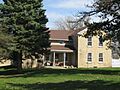
Samuel Hall House
