
Swamp bluet facts for kids
Quick facts for kids Swamp bluet |
|
|---|---|
 |
|
| Male | |
| Conservation status | |
Scientific classification  |
|
| Kingdom: | Animalia |
| Phylum: | Arthropoda |
| Class: | Insecta |
| Order: | Odonata |
| Suborder: | Zygoptera |
| Family: | Coenagrionidae |
| Genus: | Coenagrion |
| Species: |
C. lyelli
|
| Binomial name | |
| Coenagrion lyelli (Tillyard, 1913)
|
|
 |
|
| Script error: The function "autoWithCaption" does not exist. | |

Script error: No such module "Check for conflicting parameters".
The swamp bluet (scientific name: 'Coenagrion lyelli') is a fascinating insect. It is a type of damselfly, which are often confused with dragonflies. This medium-sized damselfly belongs to the family Coenagrionidae.
Male swamp bluets are easy to spot. They have a bright blue body with black markings. These beautiful insects were first described in 1913 by Robert John Tillyard.
Contents
About Damselflies
Damselflies are amazing insects with two pairs of wings. Their wings are usually clear and have many veins. When they rest, most damselflies hold their wings together over their back. This is one way to tell them apart from dragonflies, which usually hold their wings out flat.
Damselflies are also known for their large eyes. These eyes help them see very well. They are predators, meaning they hunt other small insects.
Where Swamp Bluets Live
Swamp bluets are found only in south-eastern Australia. They love to live near water. You can find them around streams, calm pools, and lakes. These watery places are important for them to find food and lay their eggs.
They need clean water to survive. The plants around these water bodies also provide good places for them to rest and hide.
What They Look Like
The male swamp bluet is quite striking. It has a bright blue body with black patterns. These patterns can help identify them.
Female swamp bluets look a bit different. They are often less brightly colored than the males. They might be greenish or brownish. Both males and females have long, slender bodies. Their wings are clear and delicate.
Life Cycle of a Damselfly
The life of a swamp bluet, like other damselflies, starts in the water.
Eggs
Female damselflies lay their eggs in or near water. They often place them on underwater plants. The eggs are very tiny.
Nymphs
When the eggs hatch, tiny creatures called nymphs emerge. These nymphs live underwater. They breathe using gills, which are like tiny feathery structures. Nymphs are also predators. They hunt small water insects and even tiny tadpoles. They grow by shedding their skin several times. This process is called molting.
Adults
When a nymph is ready, it crawls out of the water. It climbs onto a plant stem or rock. Then, its skin splits open, and the adult damselfly emerges. This is a truly amazing transformation! The adult damselfly then flies away. Adult damselflies live for only a few weeks or months. During this time, they find a mate and lay eggs, starting the cycle all over again.
Gallery
-
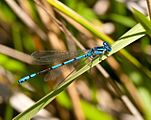
Male
-
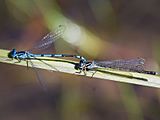
Mating pair, male in front holding the female with the tip of his tail
-
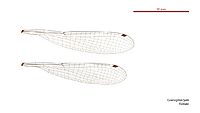
Female wings
-
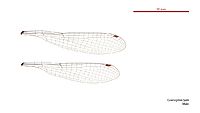
Male wings


.jpg)
.jpg)
