
Thaeng yuak facts for kids
.jpg)
Thai banana stalk carving, also known as thaeng yuak (แทงหยวก), is a special art from Thailand. The name thaeng yuak comes from "Tang," meaning "stab" or "carve," and "Yuak," meaning "banana stalk." This art uses fresh banana stalks to create beautiful, temporary decorations.
People use thaeng yuak for important events like funerals, religious ceremonies, and ordination ceremonies. It's part of the "fresh material carving" group, which is one of the 10 main Thai art skills. Even though it's a traditional art, not many thaeng yuak artists exist today compared to other art forms.
This carving art was very popular in central Thailand, especially in Phetchaburi and Ayutthaya. Most of what we know about thaeng yuak comes from the Phetchaburi area. The main goal of this art is to decorate funeral stands and the areas around them. Only very skilled artists, or people who want to show great respect for the person who passed away, create thaeng yuak. It's often used for royal funerals, as well as for famous monks and important people. However, this art is less common now as new traditions become more popular with young people.
Contents
History of Thaeng Yuak

The exact beginning of thaeng yuak is a bit of a mystery. We don't know the exact date or place where it started. However, we can find clues in old writings. For example, the Thai poem called Khun Chang Khun Phaen mentions thaeng yuak. This epic poem was written during the Ayutthaya period, around the mid-17th century. In the poem, thaeng yuak is used to decorate the funeral of Wan Tong, a character in the story.
By the 19th century, thaeng yuak was a common art form in many parts of Thailand. Records show that many high-ranking monks in Phetchaburi could create thaeng yuak art. They used it for Buddhist festivals. An interesting fact about banana stalks is that they are naturally resistant to fire. Banana plants hold a lot of water inside their stems. People in the past discovered this and used the stalks to help protect funeral stands from fire. Over time, this practical use turned into a beautiful art form.
Thaeng yuak also made funeral events look more special and attractive. It was used to decorate shelters and stands for funeral biers, called "Mae Ru". A Mae Ru is a decorated stand or shelter for a funeral bier, usually used for very important funerals. While Mae Ru were often found in the capital city, they became a special tradition in rural areas like Phetchaburi. The Mae Ru in Phetchaburi are unique because they are made on a grand scale and are beautifully decorated with thaeng yuak. The edges and corners of the funeral bier itself are also decorated with these delicate carvings. Because of its beauty, King Rama IV (who ruled from 1851 to 1868 AD) declared thaeng yuak a national treasure.
In the past, it was hard to find books or pictures about thaeng yuak. Masters of this art often kept their techniques secret, teaching them only to their students through hands-on practice. This is why some parts of its history are missing. However, new generations of thaeng yuak artists are now sharing their knowledge more openly. They want to help preserve this unique culture and art. Older masters also support these new artists, guiding them and sharing original techniques. This helps fill in the missing pieces of thaeng yuak's history.
Tools and Equipment for Carving
To create thaeng yuak, artists need specific tools. The most important ones are sharp carving knives, a hammer, and nails. Different knives are used for different parts of the carving process.
- Thaeng yuak knife (มีดแทงหยวก) – This knife has a blade that is about 5 to 6 inches long. It has a rounded, sharp tip and a round handle. The blade is flexible, which helps artists create smooth curves. It's very important to keep this knife super sharp for clean cuts.
- Lae laai Knife (มีดแรลาย) – This knife has a shorter blade. It's used to add color to the carved lines, making them stand out more.
- Saw and Cable cutter – These are used to cut the banana tree itself.
-
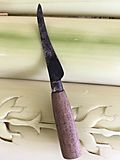
The Thaeng yuak knife.
-
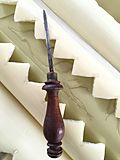
The Lae Laai knife.


Here are the four main things artists need for thaeng yuak:
- Banana stalk – The best banana stalks come from adult banana trees that are about 3 meters tall and haven't grown any bananas yet. The stalk should be around 20 centimeters wide. Artists often use stalks from a "Tania banana tree" because they last longer in different weather conditions. A Tania banana stalk can stay fresh for about 24 hours, while a regular banana stalk might rot in about 10 hours.
- Colored aluminium foil paper – This shiny paper makes the carved patterns look more striking. It also helps the colors last longer and is resistant to water.
- Food colour – Artists usually use red, blue, and yellow food colors.
- The bamboo strips – These strips are used to tie banana stalks together or attach them to other objects. They are usually about 60 centimeters long and 1 to 1.5 centimeters wide.
-
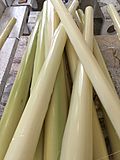
A banana stalk, ready for carving.
-
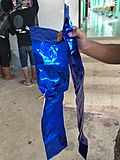
Blue aluminum foil paper.
-
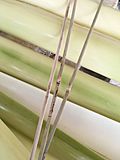
Bamboo strips used to tie banana stalks.


Thaeng Yuak Pattern Styles
Thaeng yuak is an art deeply connected to people's daily lives and religious events. This connection has led to unique carving patterns. These patterns are often inspired by traditional Thai art styles, like the Kranok pattern (ลายกระหนก). While some old patterns have been lost, many have been saved by tradition and new artists. The patterns are similar to traditional Thai designs but might have less fine detail. Since thaeng yuak uses fresh plants, the carvings must be finished quickly, usually within a day, before the material rots.
There are seven main patterns in thaeng yuak:
1. 1st Herringbone pattern or "Fun Nung pattern (ลายฟันหนึ่ง)" – This is a basic pattern, often taught to beginners. "Fun" means herringbone, and "Nung" means one. 2. 3rd Herringbone pattern or "Fun Sarm pattern (ลายฟันสาม)" – This is a very common pattern used by most thaeng yuak artists. "Sarm" means three. 3. 5th Herringbone pattern or "Fun Ha pattern (ลายฟันห้า)" – This pattern is larger than the 3rd Herringbone. It cannot be split into two equal pieces, so it often includes extra decorations. "Ha" means five. * The Mixing pattern – The 1st, 3rd, and 5th Herringbone patterns can be combined to create two layers of patterns. Usually, only two styles are combined. For example, the 1st Herringbone might be the front layer with the 3rd Herringbone behind it. 4. Tiger calf pattern ("ลายน่องสิงห์", Nong Sing pattern) – "Nong" means calf, and "Sing" means tiger. This basic pattern is used on the poles or edges of a funeral bier or Mae Ru. 5. Na Kra Darn pattern (ลายหน้ากระดาน) or front board pattern – "Na" means front, and "Kra Darn" means board. This pattern is used on the top, middle, and bottom parts of a funeral bier. 6. Sao pattern (ลายเสา) or pole pattern – "Sao" means pole. This is a very important pattern because it's a freestyle area where artists can create their own designs. The pattern can be any shape or picture the artist chooses. 7. Kra Jung pattern (ลายกระจัง) – This is an extra decorative part. It's used to decorate the 1st and 3rd herringbone patterns, usually on the top and middle parts of a funeral bier, as the pattern points downward.
-
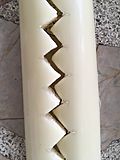
The 1st herringbone pattern.
-
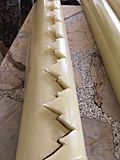
The 3rd herringbone pattern.
-
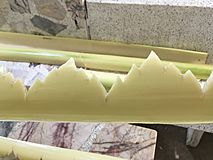
The 5th herringbone pattern.
-
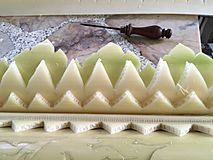
A combination of patterns.
-
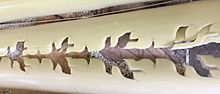
The Tiger Calf pattern.
-
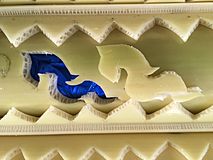
A close-up of banana stalk carving.
-
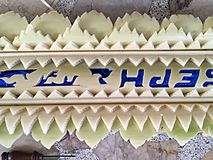
The Sao pattern.
-
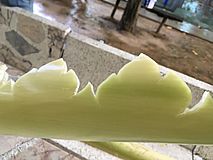
The Kra Jung pattern.


How Thaeng Yuak is Made
Creating thaeng yuak requires:
- Being very precise
- Working quickly
- Managing time well
Because the banana stalks are fresh and will rot, artists have to work fast. This means they need to find ways to make beautiful carvings without wasting time on unnecessary steps or too many tiny details.
There are four main steps to making banana stalk carvings:
1. Carving the 1st herringbone pattern. 2. Carving the 3rd and 5th herringbone patterns on other banana stalks. 3. Carving the Na Kra Darn pattern and Sao pattern on still more banana stalks. 4. (Lae laai step) After carving the herringbone patterns, artists gently carve the inner surface with the Lae laai knife and add color.
