
The Merry Muses of Caledonia facts for kids
The Merry Muses of Caledonia is a collection of poems and songs. These were gathered for the private use of the famous Scottish poet Robert Burns and his friends. They were part of a group called the Crochallan Fencibles, an 18th-century club in Edinburgh, Scotland. This club met at a public house called the Anchor Close.
Robert Burns joined the club through his friend William Smellie. Smellie was a printer who was working on an Edinburgh edition of Burns's poems. The songs in this collection were meant to be sung during fun social gatherings.
Contents
About the Original Book
It's not fully known who first printed The Merry Muses of Caledonia. However, it's agreed that it was first made for the Crochallan Fencibles club. Some people think the printer might have been Alexander Smellie. He was the son of William Smellie, who was a friend of Robert Burns. Another possible printer was Peter Hill, who was also a member of the club.
The book was published in 1799, three years after Robert Burns passed away. His name was not on the book as the author at that time. The original handwritten copy of the book no longer exists today.
Surviving Copies
Today, there are believed to be two copies of the original 1799 book. One copy is often called the 'Rosebery copy'. The other is part of the G. Ross Roy Collection. This collection is found at the University of South Carolina in the United States.
The 'Rosebery copy' was owned by the Earl of Rosebery in 1959. This copy is damaged and does not have a printing date on its title page. However, experts have looked at the paper's Watermark and believe it was printed in 1799. You can find a special microform copy of it at the National Library of Scotland.
The copy in the G. Ross Roy Collection is special because it has a complete title page. This page includes a short quote, known as an epigraph.
Different Versions of the Book
Over the years, The Merry Muses of Caledonia has been printed many times. Each new version, called an edition, can be a bit different in what it includes.
The first edition printed after the original was made in Dublin around 1804. It was called The merry muses: a choice collection of favourite songs.
In 1806, a collection known as "Giblet Pye" was printed. This book included some songs and poems from The Merry Muses. It also had other old songs called ballads.
Later, in 1823, a book titled The Songs and Ballads of Robert Burns was printed in London. This book included ten songs from The Merry Muses that had not been published before.
An edition often called the '1827' version was actually published in 1872. It was printed for John Hotten in London. The numbers in the publication date were switched around. This might have been done on purpose to make it harder for people who checked books for inappropriate content to find it.
In 1911, the Burns Federation printed a new edition. Its title page read: The Merry Muses of Caledonia; A Collection of Favourite Scots Songs Ancient and Modern; Selected for Use of the Crochallan Fencibles. This edition also had an essay. The essay tried to explain Robert Burns's connection to the book. It also tried to figure out who wrote some of the poems.
Another edition of the poems was published in 1959. This version was put together by James Barke and Sydney Goodsir Smith. It also included notes and some real Burns texts from John DeLancey Ferguson. Like the 1911 edition, this one helped explain the poems better. The Merry Muses was meant to be sung with music. The 1959 edition was planned to include the music, but it was not finished because James Barke passed away.
In 1965, a version called The Merry Muses of Caledonia. Collected and in part written by Robert Burns was edited by G Legman.
More recently, in 2009, Luath Press published an edition. It included an extra essay by Valentina Bold and drawings by a cartoonist named Bob Dewar.
How the Songs Were Performed
Many artists have recorded songs from The Merry Muses of Caledonia. Here are some examples:
- Ewan MacColl sang Songs from Robert Burns's Merry Muses of Caledonia in 1962.
- Gill Bowman, Tich Frier, and others recorded Robert Burns - The Merry Muse in 1996.
- Jean Redpath sang Songs of Robert Burns in a series of seven albums from 1976 to 1990.
- A large collection called Robert Burns. The Complete Songs was released in 12 volumes from 1995 to 2002. Many different artists sang on these albums.
Images for kids
-
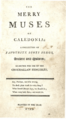
Merry Muses of Caledonia 1799 from The G Ross Roy Collection
-
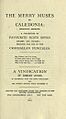
Title Page of The Merry Muses of Caledonia published by The Burns Federation in 1911


