Timeline of tuition fees in the United Kingdom facts for kids
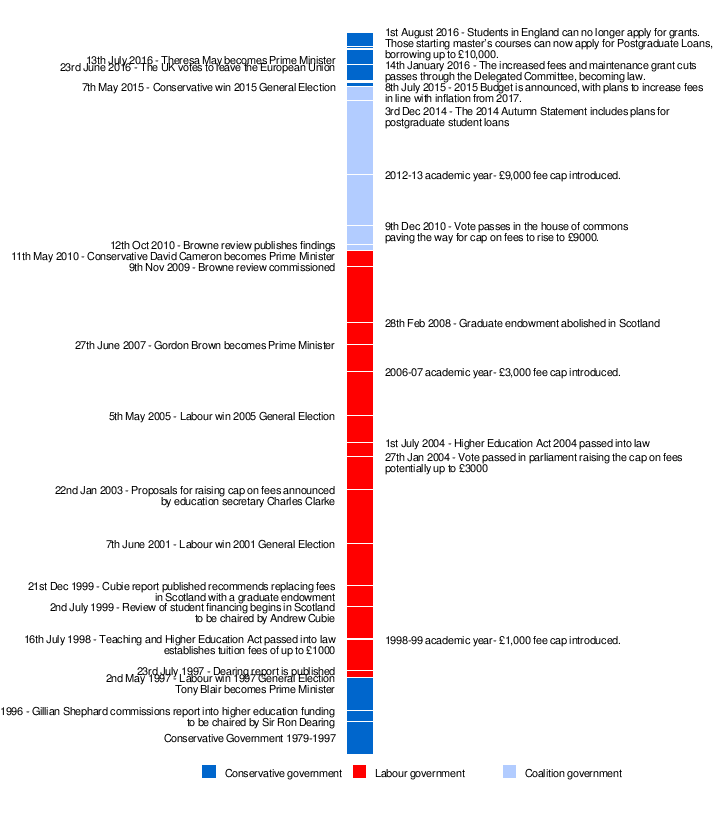
Tuition fees in the United Kingdom are payments students make to universities for their courses. These fees were brought back in 1998 for students living in the UK who were studying full-time for their first university degree. Since then, the rules around these fees have changed many times. For example, the maximum amount universities could charge went up to £9,000 a year for the 2012-13 school year.
Contents
How it Started
Before 1962
Before 1962, universities in the UK did charge fees. These fees usually made up about a third of a university's money. The government and other sources helped with the rest.
From 1962 to 1998
In 1962, a new law called the Education Act changed things. It meant that full-time students living in the UK did not have to pay university tuition fees. This law also introduced grants to help students with living costs, based on their family's income. Fees still applied to part-time students and those from other countries. This system stayed in place until 1998.
The Dearing Report
In 1996, the government asked Sir Ron Dearing to study how to pay for higher education in Britain for the next 20 years. His report, published in 1997, said that billions more pounds would be needed to help more students go to university and improve facilities.
The report suggested that students should help pay for their education. It looked at ideas like loans or a special tax after they graduated. The report thought it was a good idea for students to contribute to their tuition costs.
It recommended that students pay about 25% of the cost of their university tuition. It also suggested that grants for living costs should continue, based on how much money a family earned.
After this report, the government proposed a new law in 1997. This law would bring back tuition fees from September 1998. It also said that student grants for living costs would be replaced by student loans. The government planned to set the annual tuition fee at £1,000. This was about a quarter of the average course cost. Students from lower-income families would not have to pay. Other students would pay up to £1,000, depending on their parents' income.

Fees Are Introduced: The 1998 Act
The law to introduce tuition fees was passed on 16 July 1998. This law also set up teaching councils in England and Wales. It also gave some young workers time off for study.
Before the law was passed, there was a debate about Scottish students. A typical university degree in Scotland took four years, while in the rest of the UK it took three. This meant Scottish students might pay an extra year of fees. A review looked into this. It suggested that students from other parts of the UK studying in Scotland should get a fee reduction in their final year. The Scottish government agreed to this.
How Students Paid
The 1998 law introduced a system where how much a student paid depended on their family's income.
- Families earning less than £23,000 a year did not pay any fees.
- Families earning between £23,000 and £35,000 paid a part of the fees.
- Families earning over £35,000 paid the full £1,000 a year.
The maximum fee increased with inflation, reaching £1,225 by 2007-08. From 1999-2000, grants for living costs were replaced by loans. Students would pay back these loans once they earned over £10,000 a year. All loans were funded by the government and managed by the Student Loans Company.
What People Thought
Bringing back tuition fees meant the end of free university education. Some members of the Labour Party were worried. Some felt it removed a chance for people from poorer backgrounds to go to university.
However, some top universities wanted to charge even higher fees. They wanted to be able to compete with universities around the world. They argued for a system like in the United States, where universities could charge what they felt was fair. Universities said that any new money from fees should help poorer students.

Changes in Different UK Countries
After 1998, the UK government gave more power to Scotland and Wales to make their own laws. This led to different rules for university fees in each country.
Scotland
In 1999, the Scottish Parliament was formed. It could make its own laws, including those about student fees.
The Cubie Report
When the Labour Party and Liberal Democrats formed a government in Scotland, student funding became a big issue. The Liberal Democrats had promised to get rid of tuition fees. So, a committee led by Andrew Cubie was set up to find a solution.
Cubie Report Ideas
The Cubie report suggested replacing tuition fees with an "endowment scheme." The Scottish government would pay the fees upfront. Students would only pay back £3,000 once they earned £25,000 a year. Poorer students would also get a bursary, which was like the old maintenance grant.
In the end, the government decided students would pay back £2,000 of their fees. This payment would start when they earned £10,000 a year.
The Graduate Endowment and Its End
A law in 2001 created the "graduate endowment." Scottish students and EU students studying in Scotland for their first degree after August 2001 had to pay this. After finishing their degree, students would pay a fixed amount, starting at £2,000. This could be paid with a loan or in one go.
Not all students had to pay. For example, those taking courses below degree level, older students over 25, and single parents were exempt. Students who dropped out also didn't have to pay.
In 2007, the Scottish government proposed to get rid of the graduate endowment. This meant no future students would pay it. On 28 February 2008, this was approved, bringing back free higher education in Scotland. The Scottish education secretary, Fiona Hyslop, said that access to education should be based on ability, not on how much money you have.
Wales
The Welsh Assembly also gained some power to change laws. In 2007-08, the maximum tuition fee Welsh universities could charge went up to £3,000. This was the same as in England and Northern Ireland. However, until 2010-11, the Welsh Assembly gave all Welsh students studying in Wales a grant of £1,890 towards their fees.
Maintenance Grants in Wales
In 2002, the Welsh Assembly brought back maintenance grants of up to £1,500. This was different from the UK government, which still preferred student loans. The Welsh education secretary, Jane Davidson, said this money would help less well-off families. Welsh students studying anywhere in the UK could get these grants. Students from other parts of the UK or the EU studying in Wales could not get help from the Welsh Assembly.
The National Union of Students welcomed this, saying it was a big win for Welsh students. The maximum maintenance grant in Wales has since gone up to over £5,000.
England
Variable Tuition Fees Introduced
In 2003, the government proposed allowing universities to set their own tuition fees, up to £3,000 a year. This was controversial because the Labour Party had promised not to introduce "top-up fees" in their 2001 election plan. The new fees would only be repaid once a graduate earned over £15,000 a year.
After much debate and some changes to the plan, the vote passed in Parliament in January 2004. The changes included more money for poorer students through grants and a promise to review the £3,000 fee cap later.

Higher Education Act 2004
On 1 July 2004, the law allowing variable tuition fees was passed. This meant universities in England could charge up to £3,000 a year for students starting courses from 2006-07. This was also introduced in Northern Ireland in 2006-07 and in Wales in 2007-08. By 2009-10, the cap rose to £3,225 due to inflation. Students from the European Union paid the same fees as UK students. Students from outside the EU paid fees set by each university.
To cover the fees, UK and EU students could take out a tuition fee loan. This loan was paid directly to the university, so students didn't have to pay upfront.
The law also created the Office for Fair Access (OFFA). Its job was to make sure that higher fees did not stop people from going to university because of money. It also aimed to increase the number of students from less represented groups. These fees became known as "top-up fees" because they helped universities cover funding shortfalls.
Calls for Review
In 2009, a report by Universities UK said that almost all universities charged the full £3,000 fee. It also said that this fee level didn't make universities compete on price. The report suggested that raising fees to £5,000 a year would just keep things the same. It claimed students didn't really care about fees below this amount.
Wendy Piatt from the Russell Group, which represents many British universities, said that universities needed more money. She said that without more investment, UK universities might not stay world-leading. She suggested that increasing tuition fees should be an option, as the 2006 increase didn't stop students from applying.
The Browne Review

In November 2009, the government announced another review of university funding in England. It was led by John Browne, a former head of BP. The review looked at funding for both full-time and part-time students. It considered tuition fees and other ideas, like a "graduate tax" (where graduates pay a percentage of their income).
The National Union of Students was worried this review would lead to much higher fees. They feared it would make it harder for poorer students to attend better universities. However, the Russell Group argued that the current funding was not enough.
Political Situation Before the Report
After the 2010 General Election, no single party won enough seats to form a government alone. So, the Conservative and Liberal Democrat parties formed a coalition government. The agreement between them said that decisions on university funding would wait until the Browne report was published.
This was a problem for the Liberal Democrats. Many of their politicians had promised to get rid of tuition fees and not vote for any increase. Because of this, the agreement allowed Liberal Democrats to not vote on any fee increases.
What People Thought of the Browne Report
The Browne report suggested removing the cap on tuition fees, which was very controversial. Lord Browne thought that few universities would raise fees very high.
The report caused big arguments within the Liberal Democrat party. Many of their MPs had promised not to raise fees. Some Liberal Democrat politicians supported the ideas, while others strongly opposed them.
Newspapers had mixed reactions. Some called it a "radical document" that would change higher education. Others worried it would make it harder for poorer students to attend top universities. Nick Clegg, the Liberal Democrat leader, defended the report. He said it aimed for fair funding and a system where students didn't pay upfront. He also said that students would only pay back when they could afford it.
Labour's shadow Business Secretary, John Denham, said the report needed careful study. He agreed that students should contribute, but worried about graduates being stuck with debt for most of their lives.

Parliament Votes
On 9 December 2010, politicians voted to approve raising the cap on tuition fees. The government won the vote, but many Liberal Democrat and some Conservative politicians voted against it. Some even resigned from their junior government roles to vote against the plan.
Vince Cable, the Business Secretary, said it was a "difficult test" for the government. He said the job now was to explain the policy to the country. Universities Minister David Willetts said the plan was fair for students and affordable for the country. However, some politicians argued that fees of up to £9,000 were not the fairest way to fund higher education.
Court Review
In 2012, there was a court challenge to the fee increase, but it was not successful.
Changes in 2015
In July 2015, the government announced that tuition fees, which had been £9,000 since 2012, would increase with inflation from the 2017-18 school year. They also announced that maintenance grants would be stopped from September 2016. These changes were not voted on by all politicians in Parliament. Instead, they were approved by a smaller committee, which meant they automatically became law.
The government also proposed freezing the point at which students start repaying their loans at £21,000. This figure was previously set to increase with average earnings. These changes would affect all student loans taken out from 2012 onwards.
2016 Fee Increase Proposal
A proposal was set for a vote in autumn 2016 to increase the cap on fees again. Some universities were already advertising fees of £9,250 for the 2017-18 academic year.
Timeline