
Triceps facts for kids
Quick facts for kids Triceps |
|
|---|---|
 |
|
| Right-sided triceps brachii seen from behind. (After Testut's Anatony.) | |
 |
|
| Triceps brachii seen from behind. | |
| Latin | musculus triceps brachii |
| Artery | Deep brachial artery, posterior circumflex humeral artery (long head only) |
| Nerve | Radial nerve |

The triceps, also known as the triceps brachii, is a big muscle located at the back of your upper arm. Its name comes from Latin and means "three-headed muscle of the arm" because it has three main parts, or "heads." These are called the medial, lateral, and long heads. All three heads help move your elbow. The long head also helps move your shoulder. The triceps muscle is super important for straightening your arm at the elbow, like when you throw a ball or push something away.
Contents
How Your Triceps Is Built
Your triceps muscle is made up of three distinct parts, or "heads," that work together.
The Three Heads of the Triceps
- The long head starts from a part of your scapula (shoulder blade) called the infraglenoid tubercle. It runs down your arm, passing between two other muscles.
- The medial head begins higher up on your humerus (the bone in your upper arm). It's mostly hidden by the other two heads and can only be seen closer to your elbow.
- The lateral head also starts from the back of your humerus, a bit higher and to the side of where the medial head begins.
These three heads join together into a strong cord-like tissue called a tendon. This tendon attaches to the olecranon process, which is the pointy part of your ulna (one of the bones in your forearm) that forms the tip of your elbow. This connection allows your triceps to pull on your forearm and straighten your arm.

How Nerves Connect to Your Triceps
All three parts of your triceps muscle are usually controlled by the radial nerve. This nerve sends signals from your brain to your muscle, telling it when to move. Sometimes, the long head might also get signals from another nerve called the axillary nerve.
Interesting Variations
Sometimes, the long head of the triceps can start from slightly different places on the shoulder blade or even from the shoulder joint's capsule. These are just natural differences that can occur in people.
What Your Triceps Does
The main job of your triceps is to straighten your arm at the elbow. Think about pushing a door open or doing a push-up – that's your triceps at work! It's the opposite of your biceps muscle, which bends your arm.
Your triceps also helps with more delicate movements. For example, when you're writing or drawing, your triceps helps keep your elbow steady so your hand can make precise movements.
Each head of the triceps has slightly different roles:
- The long head is used for movements that need steady strength, or when your shoulder and elbow need to work together. It also helps move your arm backward and closer to your body, and keeps your shoulder joint stable.
- The lateral head is great for quick bursts of strong force.
- The medial head is used for more controlled, lighter movements.
Keeping Your Triceps Strong
You can make your triceps stronger with different exercises! These exercises either focus just on the triceps or make it work with other muscles.
Exercises for Your Triceps
- Isolation exercises focus mainly on the triceps. Examples include pushing down on a cable machine or extending your arms behind your back.
- Compound exercises involve your triceps along with other muscles. These include push ups, bench presses (pushing weights while lying down), and dips (lowering and raising your body using parallel bars). When you do pressing exercises, using a closer grip with your hands often makes your triceps work harder.
- Static exercises involve holding your arm straight against resistance. These can also help strengthen your triceps.
It's very rare for the triceps muscle to tear or rupture.
Your Triceps and Your Health
Your triceps muscle is important for doctors to check your nerve health.
The Triceps Reflex
Doctors can test something called the triceps reflex. They gently tap the tendon of your triceps with a small Reflex hammer near your elbow. If your arm twitches, it shows that the nerves in your arm, especially those from your spinal cord (C6 and C7), are working correctly. It's a quick way to see if your nervous system is sending signals properly.
Triceps Tendinitis
Sometimes, if the triceps muscle is used too much or overworked, it can lead to a condition called triceps tendinitis. This means the tendon connecting the triceps to your elbow becomes inflamed and causes pain at the back of your elbow. This pain usually gets worse when you straighten your arm. It's often seen in athletes who do a lot of throwing. Doctors usually recommend rest and pain relief to help it heal.
A Look Back at the Triceps
Where the Name Comes From
The name triceps comes from Latin. "Tri" means three, and "ceps" comes from "caput," which means head. So, "triceps" literally means "three-headed." This makes perfect sense because the muscle has three distinct parts that come together at your elbow! Even though there's another muscle called the "triceps surae" in your lower leg, when people say "triceps," they usually mean the one in your arm.
It's interesting to know that a long time ago, people used to say "tricipites" when talking about more than one triceps muscle. But today, we just use "triceps" for both one muscle and many muscles.
Triceps in Other Animals
Did you know that many animals also have triceps muscles?
- In horses, the long head of the triceps is the largest part, making up most of the muscle's weight.
- Some mammals, like dogs, cows, and pigs, actually have a fourth head to their triceps muscle! This extra part is called the accessory head.
- In humans, a small muscle near the elbow called the anconeus is sometimes jokingly referred to as "the fourth head of the triceps."
Additional images
-
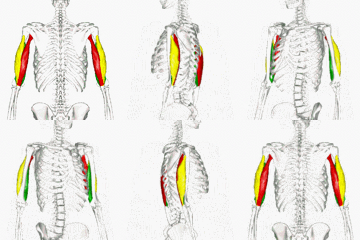
Animation. Close up. Long head. Lateral head. Medial head.
-
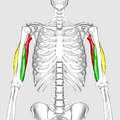
Still image. Anterior view.
-
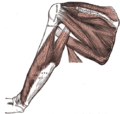
Muscles on the dorsum of the scapula, and the triceps brachii.
-
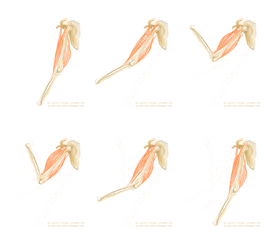
Movement of biceps and triceps when the arm is flexing
-
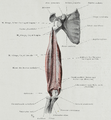
Inner surface of the Musculus triceps brachii after the humerus was taken away. Note the atypical insertion of the Caput mediale at the Epicondylus medialis humeri.


See also
