
Wahnes's parotia facts for kids
Quick facts for kids Wahnes's parotia |
|
|---|---|
 |
|
| Male, with female behind | |
| Conservation status | |
Scientific classification  |
|
| Kingdom: | Animalia |
| Phylum: | Chordata |
| Class: | Aves |
| Order: | Passeriformes |
| Family: | Paradisaeidae |
| Genus: | Parotia |
| Species: |
P. wahnesi
|
| Binomial name | |
| Parotia wahnesi Rothschild, 1906
|
|
| Script error: The function "autoWithCaption" does not exist. | |
Script error: No such module "Check for conflicting parameters".
The Wahnes's parotia (Parotia wahnesi) is a beautiful bird from the bird-of-paradise family. It is a medium-sized passerine bird, which means it's a type of perching bird. This special bird lives only in the mountain forests of the Huon Peninsula and Adelbert Mountains in northeast Papua New Guinea. It mainly eats fruits and small creatures like insects, which are called arthropods.
This bird was named after a German naturalist, Carl Wahnes, who explored and collected specimens in New Guinea.
Contents
What is a Wahnes's Parotia?
The Wahnes's parotia is about 43 centimeters (17 inches) long. The male and female birds look quite different.
Male Wahnes's Parotia
The male bird is very striking. It has a bright, shiny yellow-green patch on its chest. It also has long, black feathers that stick out, and three unique, spoon-shaped wires behind each eye. These wires can stand up! The male also has coppery-bronze feathers near its nose and a long, wedge-shaped tail.
Female Wahnes's Parotia
The female bird is a rich brown color. Its head is a bit darker, almost blackish. It does not have the fancy decorations that the male has.
Life Cycle and Habits
Scientists do not know much about the daily life and habits of the Wahnes's parotia.
Reproduction and Courtship
The male Wahnes's parotia is polygamous. This means one male mates with several females. To attract a female, the male performs a spectacular courtship dance on the forest floor.
The female probably lays one, or sometimes two, eggs. These eggs are about 40 by 26 millimeters (1.6 by 1 inch) in size. They have a pale cream color as a base. The eggs are covered with streaks and dots. These marks are thickest at the larger end of the egg and become very few at the smaller end. The markings are made of a gray layer with a tan layer on top.
Conservation Status
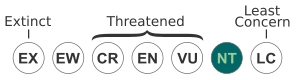
The Wahnes's parotia is considered a Vulnerable species by the IUCN Red List of Threatened Species. This means it faces a high risk of becoming extinct in the wild.
It is also listed on Appendix II of CITES. This is an international agreement to protect endangered plants and animals. The bird's threat level is called C2a(1). This means there are likely fewer than 10,000 adult birds left. These birds live in small groups, with each group having fewer than 1,000 birds. Their numbers are probably going down.
