
Yemeni mouse-tailed bat facts for kids
Quick facts for kids Yemeni mouse-tailed bat |
|
|---|---|
| Conservation status | |
Scientific classification  |
|
| Kingdom: | Animalia |
| Phylum: | Chordata |
| Class: | Mammalia |
| Order: | Chiroptera |
| Family: | Rhinopomatidae |
| Genus: | Rhinopoma |
| Species: |
R. hadramauticum
|
| Binomial name | |
| Rhinopoma hadramauticum Benda, Reiter, Al-Jumaily, Nasher & Hulva, 2009
|
|
| Script error: The function "autoWithCaption" does not exist. | |
Script error: No such module "Check for conflicting parameters".
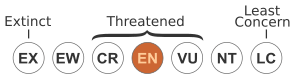
The Yemeni mouse-tailed bat (Rhinopoma hadramauticum) is a special kind of bat. It lives in Yemen and is an endangered animal. This means there are very few of them left. Scientists only know about one place where these bats live. There are only about 150 of these bats in the world.
Contents
Discovering the Yemeni Mouse-Tailed Bat
How Scientists Found This New Species
For a long time, people thought only one type of mouse-tailed bat lived in Yemen. This was the lesser mouse-tailed bat. But in 2001, scientists found another kind. They thought it was the small mouse-tailed bat.
However, in 2007, scientists looked closely at the bats' DNA. They found a big difference between the bats in Yemen and the small mouse-tailed bats from Iran. Their DNA was 8-9% different. This showed they were not the same. Scientists believe these two groups separated about 10 million years ago.
Naming the Yemeni Mouse-Tailed Bat
Because of these big DNA differences, the bats in Yemen were named a brand new species in 2009. Its scientific name is Rhinopoma hadramauticum. The "hadramauticum" part comes from "Hadramaut." This is the place in Yemen where the first bat of this new species was found.
What Does the Yemeni Mouse-Tailed Bat Look Like?
Physical Features of This Unique Bat
This bat is a medium-sized bat for its group. It has a special nose-leaf on its face. This nose-leaf is shaped like a trapezoid. Its ear has a part called a tragus. This tragus is wide and has two points. The edges of the tragus have small notches.
The fur on its back and belly is gray or grayish-brown. Around its neck, the fur is yellowish-brown. This makes it look like it has a collar. The skin on its face, ears, and belly is light gray. Its wing membranes, fingers, and tail are also gray. Its forearm is about 52 to 55.7 millimeters (about 2 inches) long. Its tail is about 54 to 62 millimeters (about 2.1 to 2.4 inches) long.
Where Do Yemeni Mouse-Tailed Bats Live?
Habitat and Roosting Spots
As of 2007, scientists only know of one group of these bats. They live in a newly built house in a village called Ash Shahar. This house was empty. The bats' home is about 65 meters (213 feet) above sea level.
The area around this house is very dry. It is an arid or semi-desert climate. This is where the bats likely fly to find food.
Protecting the Yemeni Mouse-Tailed Bat
Why This Bat Is Endangered
The IUCN says this bat is an endangered animal. This is because we only know of one place where they live. Also, there are only about 150 of them left in the world.
The biggest danger to these bats is if their only known home is disturbed. Scientists who first described this bat said it might be one of the most endangered bats in the Middle East, or even the world. Protecting their home is very important to help them survive.
