
Airborne Forces Experimental Establishment facts for kids
Quick facts for kids Airborne Forces Experimental Establishment |
|
|---|---|
| Active | 15 February 1942 to 14 September 1950 |
| Country | United Kingdom |
| Type | Research establishment |
| Role | Research into Airborne Forces deployment / equipment |
| Part of | Air Ministry |
| Disbanded | 14 September 1950 |
The Airborne Forces Experimental Establishment (AFEE) was a special group in the British Air Ministry. From 1942 to 1950, they worked on new ways to use aircraft for military purposes. This included testing gliders, early helicopters, and how to drop soldiers and equipment using parachutes. Their main goal was to make airborne operations safer and more effective.
Contents
How it Started (1942)
The AFEE was officially created on February 15, 1942. It was a new version of an older group called the Airborne Forces Establishment. This group had started even earlier as the Central Landing Establishment. AFEE began its work at RAF Ringway, an air base.
At Ringway, one interesting project was the Hafner Rotachute. This was a special kind of unpowered aircraft, like a small helicopter kite. The idea was to deliver a single armed soldier to a battlefield very precisely. Before 1942, they had already tested small models of the Rotachute from the ground and dropped them from planes.
Wartime Tests (1942–1944)

In early 1942, real pilots started testing the Rotachute. They first towed it behind vehicles on the ground. Then, they towed it behind aircraft in the air. It was tricky to make it safe and stable. However, these flights helped them learn more about how such aircraft flew. This knowledge was useful for a new project, the Hafner Rotabuggy. This was a land vehicle that could be towed by a plane and then fly like a helicopter.
On July 1, 1942, AFEE moved to RAF Sherburn-in-Elmet. This was because Ringway was very busy. Most of the Rotabuggy tests happened in 1943. But eventually, large gliders became more important for carrying heavy loads. Between 1942 and 1944, AFEE tested many different types of aircraft. They worked on helicopters and parachutes at various airfields. They used many different planes to help with their tests. These planes included the Dakota, Halifax, and Stirling. They also tested gliders like the Hamilcar and Horsa. AFEE even tested captured enemy aircraft, such as the German Focke-Achgelis Fa 330 "kite" helicopter.
Moving to Beaulieu (1945)
On January 4, 1945, the entire AFEE moved to RAF Beaulieu. This air base had been used by American bomber planes. AFEE joined some of its own teams that were already there. They used a nearby old airfield at East Boldre as a special dropping zone.
At Beaulieu, AFEE also trained pilots for helicopters and gliders. They tested new gliders like the AW.52 and the Waco CG-13. They also tested helicopters such as the Bristol Sycamore and Sikorsky Hoverfly. They continued to use many support aircraft like the Lancaster and Valetta.
Some of the most exciting tests at Beaulieu involved captured German helicopters. These included a Flettner Fl 282 and a Focke-Achgelis Fa 223. The Fa 223 was special because it was the first helicopter to fly across the English Channel. This happened on September 6, 1945.
Closing Down (1950)
On September 14, 1950, the AFEE was officially closed. Most of its equipment and staff moved to another important testing center. This was the Aeroplane and Armament Experimental Establishment at RAF Boscombe Down. The helicopter training part of AFEE moved to RAF Andover.
Images for kids
-
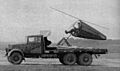
A Rotachute III being tested on the ground at Ringway in 1942.
