
Baltoro Glacier facts for kids

The Baltoro Glacier is a massive river of ice. It is found in the Shigar District of Gilgit-Baltistan. This is a beautiful region in Pakistan-administered Kashmir. The name "Baltoro" comes from a local language. It means "Bone breaker." This glacier is a true wonder of nature.
It lies within the mighty Karakoram mountain range. This area is home to some of the tallest mountains on Earth. Imagine, K2, the second highest mountain in the world, is right here! K2 stands at 8,611 meters (28,251 feet) tall. There are also three other peaks over 8,000 meters tall nearby.
Scientists studied the Baltoro Glacier between 2001 and 2011. They saw some changes, especially where it meets the Godwin-Austen Glacier. This meeting point is at 4,600 meters (15,100 feet). Even though some snow and ice seemed to lessen, the glacier itself was not shrinking. Instead, it was moving and flowing into other glaciers. This is a natural process called "surging."
Contents
Where in the World is Baltoro?

The Baltoro Glacier winds its way through the Karakoram mountains. It is bordered by tall mountain ranges. To the north and east is the Baltoro Muztagh. To the south are the Masherbrum Mountains. A high pass called Conway Saddle separates it from the Siachen Glacier to the northeast.
This glacier is very important. It is the start of the Braldu River. The Braldu River then joins the Shigar River. Finally, the Shigar River flows into the mighty Indus River. Many smaller glaciers feed into the Baltoro. These are called tributary glaciers. They include the Godwin-Austen Glacier from K2. The Abruzzi and Gasherbrum Glaciers come from the Gasherbrum peaks. The Vigne Glacier comes from Chogolisa. The Yermandendu Glacier flows from Masherbrum.
A special place called Concordia is where the Baltoro and Godwin-Austen Glaciers meet. It is a famous spot for trekkers. The K2 Base Camp is also a popular trekking destination. The glacier's main path is very wide. Smaller valley glaciers create dramatic icefalls where they join the main glacier.
The sides of the glacier's path show marks from the moving ice. These are called striations. The glacier's movement also creates dips in the ground. These dips often fill with water, forming many beautiful lakes. You can reach the glacier from Skardu. Skardu is a town in Baltistan. It is the main starting point for exploring the Karakoram.
Protecting This Icy Giant
More roads have made it easier for people to visit the Baltoro Glacier. This has brought more tourists. However, more visitors also mean more challenges for the environment. Sadly, some trekking routes have become messy with litter and animal waste. This is partly because there are not enough porters. Many supplies are carried by mules.
In the past, groups like the Mountain and Glacier Protection Organisation (MGPO) tried to help. In the 1990s and 2000s, they set up campsites and portable toilets. They also had plans to collect waste. But over time, conditions declined. This happened under the management of the Central Karakoram National Park.
Today, there is a lot of trash. Local communities don't always have reasons to help clean up. Also, waste disposal methods are not always effective. Good news! New projects are working to fix this. The United Nations Development Programme (UNDP) has a project called GLOF II. It is supported by the Green Climate Fund. This project aims to make the area clean again. Local people also want regular cleanups every year. They believe one group should be in charge of this important work.
Giants of the Karakoram: Nearby Peaks
The Baltoro Glacier is surrounded by many incredible mountains. Here are some of the famous peaks close to or next to the glacier:
- Biarchedi, 6,781 meters (22,247 feet)
- Broad Peak, the 12th highest in the world at 8,047 meters (26,401 feet)
- Chogolisa, the 36th highest in the world at 7,665 meters (25,148 feet)
- Gasherbrum III, 7,946 meters (26,070 feet) (Often seen as a smaller peak of Gasherbrum II)
- Gasherbrum II, the 13th highest in the world at 8,035 meters (26,362 feet)
- Gasherbrum IV, the 17th highest in the world at 7,932 meters (26,024 feet)
- Gasherbrum I, the 11th highest in the world at 8,080 meters (26,509 feet)
- K2, the 2nd highest in the world at 8,611 meters (28,251 feet)
- Masherbrum (K1), the 22nd highest in the world at 7,821 meters (25,659 feet)
- Mitre Peak, 6,010 meters (19,718 feet)
- Muztagh Tower, 7,273 meters (23,862 feet)
- Snow Dome, 7,160 meters (23,491 feet)
- Trango Towers, 6,286 meters (20,623 feet) (These have some of the world's tallest vertical rock faces!)
- Uli Biaho Tower, 6,417 meters (21,053 feet)
Image Gallery
-
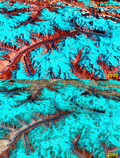
Looking NE towards K2, at top centre
-
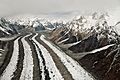
Close-up photo of the glacier
-
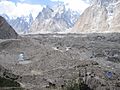
View of the Baltoro Glacier from Urdukas campsite
-
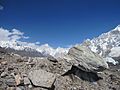
A glacial mushroom on Baltoro Glacier


More to Explore
 In Spanish: Glaciar Baltoro para niños
- Baltoro Muztagh
- Biafo Glacier
- Trango Glacier
- Hainablak Glacier
- Sarpo Laggo Glacier
- Eight-thousander
- List of glaciers
- List of highest mountains
- Northern Areas
