
Cryptic chameleon facts for kids
Quick facts for kids Cryptic chameleon |
|
|---|---|
_male_Ranomafana.jpg) |
|
| Male | |
_female_Ranomafana.jpg) |
|
| Female | |
| Conservation status | |
| Scientific classification | |
| Genus: |
Calumma
|
| Species: |
crypticum
|
 |
|

The cryptic chameleon (Calumma crypticum), also known as the blue-legged chameleon, is a special kind of chameleon. You can find it living in the eastern parts of Madagascar, an island country off the coast of Africa.
Contents
Discovering the Cryptic Chameleon
This chameleon was first officially described in 2006. Scientists Raxworthy and Nussbaum named it Calumma crypticum. It was one of six new species found in Madagascar's mountain regions.
For a while, people thought it was the same as the short-horned chameleon. But in 2007, other scientists confirmed it was a different species. They looked at its DNA to be sure.
What Does the Cryptic Chameleon Look Like?
This chameleon can grow to be about 12 cm (5 in) long. That's about the length of a pen! It has big, flap-like parts at the back of its head.
Males and Females Look Different
Male and female cryptic chameleons do not look exactly alike. This is called sexual dimorphism. Males have a longer snout with a horn-like bump on top. Females do not have this horn.
Changing Colors
Like other chameleons, its color can change a lot. The color depends on its surroundings, how warm it is, and how bright the light is. But this chameleon is usually very colorful. It often has rich browns, blues, and greens. Its legs are often marked with blue, which is why it's also called the blue-legged chameleon.
Where Do Cryptic Chameleons Live?
The cryptic chameleon lives only in eastern Madagascar. This means it is endemic to that area. It prefers to live at mid-altitudes, between 1,050 and 1,850 m (3,445 and 6,070 ft) above sea level.
Their Home in the Trees
These chameleons live in trees, mostly in humid forests. Their home range goes from the Tsaratanana Massif to the Ivakoany Massif. Their distribution is a bit scattered. This is because forests have been cleared in the central highlands. However, you can still find a group of them near Ambohitantely in the central west of the island.
How Are Cryptic Chameleons Doing?
The cryptic chameleon lives in many places and in several protected areas. This is good news for the species. However, some of their forest homes are being cut down for farming. This causes their numbers to slowly go down.
But the International Union for Conservation of Nature (IUCN) has looked at its situation. They decided its conservation status is "least concern." This means it is not currently in danger of disappearing.
Images for kids
-
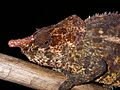
Male, Ranomafana
-
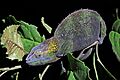
Female, Ranomafana

_female_2_Ranomafana.jpg)
