
Coast jepsonia facts for kids
Quick facts for kids Coast jepsonia |
|
|---|---|
 |
|
Scientific classification  |
|
| Kingdom: | Plantae |
| Clade: | Tracheophytes |
| Clade: | Angiosperms |
| Clade: | Eudicots |
| Order: | Saxifragales |
| Family: | Saxifragaceae |
| Genus: | Jepsonia |
| Species: |
J. parryi
|
| Binomial name | |
| Jepsonia parryi (Torr.) Small
|
|
| Script error: The function "autoWithCaption" does not exist. | |
Script error: No such module "Check for conflicting parameters".
Jepsonia parryi is a special kind of flowering plant. People often call it the coast jepsonia or Parry's jepsonia. It belongs to the saxifrage family. This plant grows naturally in the coastal areas and hills of southern California and Baja California. It likes places called chaparral, which are dry shrublands.
What is Jepsonia Parryi?
Jepsonia parryi is a small plant that lives for many years. It usually grows just one leaf from a thick, underground stem called a caudex. This leaf looks round or like a kidney. Its edges are wavy and have small rounded parts, like ruffles.
Flowers and Fruit
This plant blooms in the fall. It grows a bare, brown stem, called a peduncle, that holds a small group of flowers. This group of flowers is called an inflorescence. There are usually fewer than four flowers in each group.
The tiny flowers have petals that are about half a centimeter long. They have pretty purplish lines on them. After the flowers, the plant grows a fruit. This fruit is a small capsule, which is like a tiny seed pod. It can be green or tan with brown stripes.
Images for kids
-
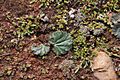
The leaves growing with Selaginella
-
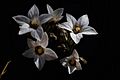
A frontal view of the flowers
-
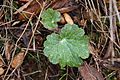
Two leaves emerged from the ground
-
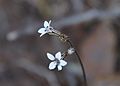
The flowers and inflorescence


