
Cuban small-eared toad facts for kids
Quick facts for kids Cuban small-eared toad |
|
|---|---|
 |
|
| Conservation status | |
Scientific classification  |
|
| Kingdom: | Animalia |
| Phylum: | Chordata |
| Class: | Amphibia |
| Order: | Anura |
| Family: | Bufonidae |
| Genus: | Peltophryne |
| Species: |
P. empusa
|
| Binomial name | |
| Peltophryne empusa Cope, 1862
|
|
| Script error: The function "autoWithCaption" does not exist. | |
| Synonyms | |
|
|
Script error: No such module "Check for conflicting parameters".
The Cuban small-eared toad (Peltophryne empusa) is a special kind of toad that lives only in Cuba and the Isla de Juventud. It's also known as the Cuban toad or Cope's Caribbean toad. This toad is part of the Bufonidae family, which includes many different types of toads.
Contents
What Does the Cuban Toad Look Like?
The Cuban small-eared toad has some unique features. It has noticeable ridges above its eyes. There are also bumps behind its eyes and above its ears. Its snout is pointed and slopes downwards.
Its mouth area is slanted when you look at it from the front. The edge of its lips forms a thick rim. This rim is especially thick at the back. It has two small bumps on each side of its head, near the back.
The toad's eardrum, called the tympanum, is quite small. It's about one-fourth or one-third the size of its eyelid. The toad also has small, rounded glands on its sides, behind its eyes. These are called paratoid glands.
Its back is covered with many small bumps, especially near its head. Its sides, legs, and throat also have smaller bumps. The belly of the toad has a bumpy, uneven texture.
On its front feet, it has one large, flat bump. There's also a big bump at the base of its inner finger. On its back feet, it has two bumps. The inner one is longer, sharper, and dark brown. It also has a short, thick fold of skin on the inside of its ankle. Its toes are about half-webbed, and its palms are slightly rough.
The head of the Cuban toad is brown. The rest of its body is brownish-yellow. Its neck and sides often have dark brown patterns, like marble. These patterns can look a bit slanted. Its legs have brown bands across them.
Where Do Cuban Toads Live?
The Cuban small-eared toad lives in many places across Cuba and the Isla de Juventud. It prefers dry and moist lowland forests, as well as savannas. These areas are usually less than 70 m (230 ft) above sea level.
This toad is quite shy and spends most of its time underground. Because of this, you don't often see it. However, during the breeding season, many toads come out. They are known as "explosive breeders." This means they all breed at the same time, very quickly. Males call out from flooded ditches and large temporary pools of rainwater. The females lay their eggs in still water.
Protecting the Cuban Toad
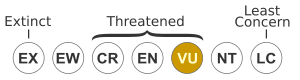
The Cuban small-eared toad is considered a vulnerable species. This means it faces a risk of becoming endangered. Its living area is getting smaller and is broken up into many tiny pieces.
The main problems for these toads are:
- Habitat loss: Their homes are being destroyed.
- Agriculture: Farming activities can take over their land.
- Pollution: Pesticides and other chemicals can harm them.
- Invasive plants: A plant called Dichrostachys cinerea is spreading and taking over their natural habitat.
Even with these challenges, the Cuban toad does live in several protected areas. These areas help keep them safe.
See also
 In Spanish: Sapo de concha para niños
