
Downtown Aledo Historic District facts for kids
Quick facts for kids |
|
|
Downtown Aledo Historic District
|
|

Downtown Aledo Historic District, Aledo, Illinois.
|
|

 Location in Illinois

Location in the United States
|
|
| Location | 100-200 blocks N. College, 100, 200, 300 blocks S. College, 100 blk. NW. 2nd, 200 blk. SW. 2nd Aves., Aledo, Illinois |
|---|---|
| NRHP reference No. | 16000328 |
| Added to NRHP | June 7, 2016 |
The Downtown Aledo Historic District is a special area in downtown Aledo, Illinois. It's like a time capsule showing how the town grew! This district has 75 important buildings and a park. Most buildings are shops and businesses. But it also includes the old train station and the main government buildings for the city and Mercer County.
Building started here in the 1850s. Some of the oldest buildings you see today are from the 1860s. The district shows off many cool American building styles. You'll see Classical Revival, Romanesque Revival, and Italianate styles most often. This historic district was added to the National Register of Historic Places on June 7, 2016. Two buildings here, the Mercer County Courthouse and Mercer County Jail, are so special they are listed on their own!
Contents
Explore Aledo's Historic Buildings
Amazing Architecture Styles
The Downtown Aledo Historic District is a great place to see many different building styles. Each style tells a story about when it was built and what was popular then.
Italianate Style


There are eleven buildings in the district that show the Italianate style. These buildings often have tall, narrow windows and decorative brackets under the roof. Some examples are the Detwiler Bros. Hardware Store and the Marquis Bros. Building. This style was popular in Aledo from 1880 to 1913.
Romanesque Revival Style
Thirteen buildings in the district are in the Romanesque Revival style. This style often uses round arches and heavy stone or brick. The Union Hall Building is a good example. This style was popular here from 1870 to 1907.
Second Empire Style


The Button House at 101 N College Ave is the only building in the district built in the Second Empire style. It was built in 1868. This style often has a special kind of roof called a mansard roof.
Stick Style

The Chicago, Burlington, & Quincy Railroad Depot is the only example of Stick Style in the district. It was built in 1869. This style uses wooden "sticks" or boards to create patterns on the outside of the building.
Italian Renaissance Style
Two buildings in the district are in the Italian Renaissance style. These are service stations built between 1928 and 1940. This style often looks grand and balanced, like buildings from the Italian Renaissance period.
Classical Revival Style

The Classical Revival style is very common here, with 25 buildings. This style often uses elements from ancient Greek and Roman buildings, like columns. The Mercer Carnegie Library and the Wallen Block are good examples. Early Classical Revival was popular from 1875-1880, and Late Classical Revival from 1889-1938.
Jacobethan Style

The Mercer County Jail is the only building in the district with the Jacobethan style. It was built in 1909. This style mixes elements from Elizabethan and Jacobean architecture, often seen in large, grand buildings.
Neoclassical Style

The Farmers National Bank is the only building in the Neoclassical style. It was built in 1917. This style is similar to Classical Revival but often more formal and grand.
Art Deco Style
The Mercer County Farm Bureau is the only building in the district in the Art Deco style. It was built in 1940. Art Deco buildings often have sleek lines, geometric shapes, and decorative patterns.
Moderne Style
Four buildings in the district are in the Moderne style. This style was popular around 1940. It's a simpler, more streamlined version of Art Deco, often with smooth surfaces and rounded corners.
New Traditional Style
The McCreedy Building is the only example of the New Traditional style. It was built in 1938 and is still popular today. This style often blends traditional looks with modern ideas.
Contemporary Style
Five buildings in the district are considered Contemporary. This style was popular from 1950-1995. It includes buildings like the Tastee-Freez. Also, eleven buildings have "false-fronts" in this style, meaning their front looks newer than the rest of the building.
Types of Buildings You'll See
Besides different styles, buildings in the district also have different shapes and purposes.
Commercial Blocks
Many buildings are "Commercial Blocks." These are usually two or more stories tall. They are designed for businesses on the ground floor and sometimes offices or apartments above. You can see many of these on E Main St and S College Ave.
Temple-Front Buildings
The Farmers National Bank is the only "Temple-Front" building. These buildings look like ancient Greek or Roman temples. They often have large columns at the front.
False-Front Buildings
False-Front buildings have a front wall that extends above the roof. This makes the building look taller or more impressive from the street. Eleven buildings in the district have false-fronts.
Freestanding Buildings
Six buildings in the district are "Freestanding." This means they stand alone and have interesting designs on two or more sides. The National Bank of Aledo is an example.
Road-Related Buildings
There are ten "road-related" buildings, like old gas stations and auto garages. These buildings were built to serve cars and travelers. They often have simple designs.
Images for kids
-

The Davis Building.
-

Inside The Palace Drug Store.
-

Inside the Knights of Pythias Hall.
-

Standard Oil Station.
-

A commercial building on W Main St.
-

The Aledo Opera House.
-
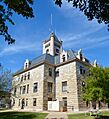
The Mercer County Courthouse.


