
Dysphania pusilla facts for kids
Quick facts for kids Dysphania pusilla |
|
|---|---|
 |
|
| Conservation status | |
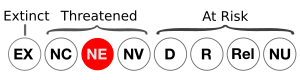 Nationally Endangered (NZ TCS) |
|
Scientific classification  |
|
| Kingdom: | Plantae |
| Clade: | Tracheophytes |
| Clade: | Angiosperms |
| Clade: | Eudicots |
| Order: | Caryophyllales |
| Family: | Amaranthaceae |
| Genus: | Dysphania |
| Species: |
D. pusilla
|
| Binomial name | |
| Dysphania pusilla Mosyakin & Clemants
|
|
| Script error: The function "autoWithCaption" does not exist. | |
| Synonyms | |
|
|
Script error: No such module "Check for conflicting parameters".
The Dysphania pusilla, also known as pygmy goosefoot or parahia in Māori, is a tiny plant. It grows flat on the ground. This plant is endemic to the north-eastern parts of the South Island of New Zealand. This means it is found naturally only in that area. People thought it was extinct (had died out) for 56 years. But in 2015, it was found again!
Contents
What Does Pygmy Goosefoot Look Like?
The pygmy goosefoot (Dysphania pusilla) is a small plant. It grows for one year, then dies. It can grow up to 20 centimetres (8 in) long. Often, it forms a soft, cushion-like mat. You can find it growing on surfaces like clay and rocks.
How to Spot This Plant
You can tell this plant apart from similar ones. It has slightly smaller seeds. It also has a different number of tepals. Tepals are like petals and sepals combined in a flower. Its leaves also grow very close together.
Colors and Flowers
Pygmy goosefoot plants can be green or brown. They produce small green and yellow flowers. These flowers appear during the warmer months of the year.
What Does Its Name Mean?
The name pusilla comes from the Latin word pusilla. This word means 'very small'. It's a perfect name for this tiny plant!
Where Does Pygmy Goosefoot Live?
The pygmy goosefoot is a plant that only grows in New Zealand. It is usually found in the north-eastern part of the South Island. A botanist named Harry Allan wrote in 1961 that it does not grow south of a certain line (43°30'S).
Its Favorite Places to Grow
This plant likes dry, open areas with not many other plants. This includes places like wetlands that dry up sometimes. But it has also been found in cities. It can grow in railway yards and on farms.
The History of Pygmy Goosefoot
The pygmy goosefoot was first written about in 1864. It was called Chenopodium pusillum back then. This was done by a scientist named Joseph Dalton Hooker.
An Old Māori Proverb
Even before that, in 1855, a missionary named Richard Taylor wrote about it. He recorded a Māori proverb:
|
Tena te ringa tango parahia. |
That is a hand which roots out the parahia. |
| —Māori proverb | —Richard Taylor's translation |
This saying was used for a hard-working farmer. The parahia was described as a small type of spinach. It would grow all over their crops.
Changing Names and Disappearing
In 1879, botanist William Colenso identified the plant as Ctenopodium pusillum. Later, in 2008, two botanists, Sergei Leonidovich Mosyakin and Steven Earl Clemants, changed its scientific name. They moved it to the genus Dysphania.
The plant was common until 1959. The last known plant was found near a railway in Christchurch. Even though it was once common in Māori gardens, it was not listed as a weed on farms. By 1999, scientists did not have enough information about it.
Declared Extinct, Then Found Again!
In 2012, after many searches, Dysphania pusilla was thought to be extinct. This meant scientists believed it had completely disappeared.
But in January 2015, something amazing happened! A botanist named Shannel Courtney found a lot of the plants. He found them near the Clarence River. Soon after, more plants were found in the Ruataniwha wetlands. A third discovery happened in March in the Heron Basin.
Scientists think the seeds of Dysphania pusilla can sleep for a very long time. They wait for the right conditions to grow.
Still Under Threat
Even though it was rediscovered, the plant is still in danger. Its natural homes are being lost. This is due to new plant species and changes in how land is used for farming and cattle. Because of this, in both 2017 and 2018, it was called "Threatened - Nationally Endangered."
