
Ethiopian forest brush-furred rat facts for kids
Quick facts for kids Ethiopian forest brush-furred rat |
|
|---|---|
| Conservation status | |
Scientific classification  |
|
| Kingdom: | Animalia |
| Phylum: | Chordata |
| Class: | Mammalia |
| Order: | Rodentia |
| Family: | Muridae |
| Genus: | Lophuromys |
| Species: |
L. chrysopus
|
| Binomial name | |
| Lophuromys chrysopus Osgood, 1936
|
|
| Script error: The function "autoWithCaption" does not exist. | |
Script error: No such module "Check for conflicting parameters".
The Ethiopian forest brush-furred rat, also called the golden-footed brush-furred rat, is a type of rodent (a group of mammals that includes rats and mice). Its scientific name is Lophuromys chrysopus. This special rat lives only in Ethiopia. It makes its home in wet, cool mountain forests. Sadly, it is losing its home because of habitat loss.
Contents
About the Ethiopian Forest Rat
This rat is quite small. Its body and head together are about 11.5 centimeters (4.5 inches) long. Its tail adds another 8 centimeters (3 inches).
What Does It Look Like?
The fur on its back is a dark brownish-black. It is long, thick, and a bit stiff. Each hair has different colors: a reddish-brown base, a wide black band, a thinner yellowish band, and a black tip. This mix gives it a unique look.
Its belly is a creamy-grey color with small dark spots. The front feet have blackish fur on top. The back feet are greyish-red, with black toes and light-colored claws.
The tail has two colors. The top side has dark scales and blackish hairs. The underside has light scales and grey hairs with white tips.
Color Differences
Rats living on different sides of the Great Rift Valley can look a bit different. Those to the east have a more reddish-brown color on their backs. Their bellies are also more yellow.
Unique Features
Scientists can tell this rat apart from others by looking at its chromosomes. The Ethiopian forest brush-furred rat has 54 chromosomes. Another similar rat, the short-tailed brush-furred rat, has 68 chromosomes. This difference helps scientists identify them.
Where It Lives and Its Home
The Ethiopian forest brush-furred rat lives only in Ethiopia. It is an endemic species, meaning it is found nowhere else in the world. There are two separate groups of these rats in Ethiopia. They are separated by the Great Rift Valley.
Its Natural Home
These rats live in moist, evergreen rainforests. These forests are found on the sides of mountains and on high plateaus. They live at altitudes from about 1,200 to 2,760 meters (3,900 to 9,000 feet) above sea level.
Conservation Status
The Ethiopian forest brush-furred rat is one of the most common rodents in Ethiopia's mountain forests. Only the Ethiopian white-footed mouse is found in greater numbers. The white-footed mouse lives in both forests and shrublands.
Protection Efforts
These rats live in the Bale Mountains National Park. Here, they are protected from harm. However, outside the park, their biggest threat is the ongoing loss of forest land. Forests are being cut down, which means less home for these rats.
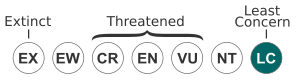
The International Union for Conservation of Nature (IUCN) studies animals around the world. They have listed the Ethiopian forest brush-furred rat as a species of "least concern". This means they are not currently in great danger of disappearing. Still, protecting their forest homes is important for their future.
