
Falcon 9 facts for kids
 |
|

Falcon 9 B1058 lifting off from Kennedy LC-39A, carrying Demo-2
|
|
| Function | Medium-lift launch vehicle |
|---|---|
| Manufacturer | SpaceX |
| Country of origin | United States |
| Cost per launch | US$74 million (2026) |
| Size | |
| Height |
|
| Diameter | 3.7 m (12 ft) |
| Mass |
|
| Stages | 2 |
| Capacity | |
| Payload to LEO | 22,800 kg (50,300 lb) |
| Associated rockets | |
| Derivatives | Falcon Heavy |
| Launch history | |
| Status | Active |
| Launch sites |
|
Falcon 9 is a tall, powerful rocket built in the United States by the company SpaceX. It is a medium-lift launch vehicle designed to carry satellites, science gear, and even astronauts into orbit. The rocket gets its name because its first stage uses nine Merlin engines. It was also named after the famous fictional spaceship, the Millennium Falcon, from the Star Wars movies.
The very first Falcon 9 blasted off on June 4, 2010. Two years later, it delivered cargo to the International Space Station through the Commercial Resupply Services program. In 2020, on a mission called Crew Dragon Demo-2, Falcon 9 became the first commercial rocket to take people into space. SpaceX made Falcon 9 special by making parts of it reusable, which helps lower the cost of space travel.
Contents
How the Falcon 9 Rocket Works and Flies
Falcon 9 is a two-stage-to-orbit rocket, which means it uses two main sections to get its job done. The bottom section is a giant rocket booster. This first stage pushes the rocket through the thick air of Earth and carries it very high into the sky. Once it runs out of fuel, it detaches and falls away.
The smaller second stage then lights its own single Merlin 1D Vacuum engine. It pushes the payload the rest of the way into low Earth orbit or toward a higher geosynchronous transfer orbit. Both stages burn a mix of chilled liquid oxygen and special rocket fuel called kerosene.
Landing and Reusing the Booster Stage
In the past, rocket parts fell into the ocean and were thrown away after only one launch. Falcon 9 changed space travel by landing vertically back on Earth. The booster turns around in space, relights its engines to slow down, and steers through the air using special metal grid fins.
As it nears the ground, it opens four sturdy carbon-fiber landing legs. It can touch down on land pads or on a robotic boat called an autonomous spaceport drone ship. One famous ship used for landings is named Of Course I Still Love You. After landing, technicians inspect the booster so it can launch again on future missions.
Catching the Protective Nose Cone
The top of the rocket has a large shell called a payload fairing. This protective nose cone shields fragile satellites from extreme heat and wind during liftoff. Once the rocket reaches space, the fairing splits into two pieces and drops away.
SpaceX designed these fairing halves to drift back down to the ocean using steerable parachutes. Fast recovery ships pull the floating shells out of the water. Engineers then dry, clean, and test them so they can protect satellites on another flight.
Exploring the Main Falcon 9 Versions

SpaceX improved the Falcon 9 several times to make it taller, stronger, and easier to reuse.
The Early Falcon 9 Models
The first model was Falcon 9 v1.0. It launched five times between 2010 and 2013, carrying the early SpaceX Dragon capsule into space. Its nine Merlin 1C engines were arranged in a square grid of three rows of three.
Next came the Falcon 9 v1.1 in 2013, which was much taller and held more propellant. It introduced a circular engine pattern called the Octaweb. This version also made the first test attempts to slow down over the water for landing.
The Modern Full Thrust and Block 5
In late 2015, SpaceX introduced the Falcon 9 Full Thrust version. On its first flight, called Falcon 9 flight 20, the booster achieved history's first successful vertical landing on land. In March 2017, booster B1021 became the first orbital booster to fly into space a second time.
The ultimate version is the Falcon 9 Block 5, which began flying in 2018. It features tough titanium fins that can survive searing heat, stronger landing legs, and more powerful engines. A single Block 5 booster can fly dozens of times with simple checkups between flights.
Important Flights and Space Records
Falcon 9 has launched hundreds of successful missions, setting several world records along the way.
- First Space Station Cargo: The Dragon C2+ mission sent the first commercial spacecraft to dock with the ISS.
- First Ocean Platform Landing: On flight CRS-8, the booster landed safely on a sea-going drone ship.
- Riding with Many Satellites: During the Transporter-1 mission, Falcon 9 launched 143 satellites on a single flight, setting a world record.
- Flying Private Citizens: The Inspiration4 mission launched the first all-civilian crew into orbit around Earth.
- Planetary Defense: Falcon 9 launched NASA's DART spacecraft to test nudging an asteroid off course.
- Exploring the Universe: Falcon 9 launched telescopes like the Euclid space observatory to map distant galaxies.
Launch Sites and Displays

Falcon 9 launches from several spaceports in the United States. In Florida, it lifts off from Launch Complex 40 and Launch Complex 39A. For satellites heading over Earth's poles, it launches from Space Launch Complex 4E in California.
Because these rockets made history, some retired boosters are on public display for visitors to see up close. A booster named B1019 stands outside SpaceX headquarters in California. Another booster that flew twice rests at Space Center Houston in Texas, letting kids and families walk right underneath its massive engines.
Images for kids
-

Falcon 9 landing safely on a ground pad in 2015
-
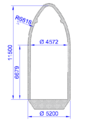
Diagram of the rocket nose cone that protects spacecraft
-

An early Falcon 9 launching towards space
-
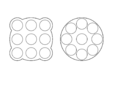
Comparing the two engine layouts
-

Falcon 9 lifting off from California
-

Tough titanium grid fins used for steering during descent
-
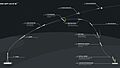
Illustration showing how the booster returns to Earth
-

Booster touching down on an ocean drone ship
-
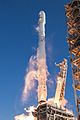
The first time a used booster flew back to space
-
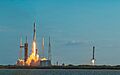
Rocket launch and landing shown together
-
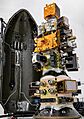
Dozens of small satellites stacked before launch


See also
 In Spanish: Falcon 9 para niños
- Falcon Heavy
- Falcon 1
- SpaceX Dragon
- SpaceX Starlink
