
Filopaludina martensi facts for kids
Quick facts for kids Filopaludina martensi |
|
|---|---|
 |
|
| Drawing of an apertural view of a shell of Filopaludina martensi | |
 |
|
| Abapertural view of a shell | |
| Conservation status | |
| Scientific classification | |
| Kingdom: | |
| Phylum: | |
| Class: | |
| (unranked): |
clade Caenogastropoda
informal group Architaenioglossa |
| Superfamily: |
Viviparoidea
|
| Family: |
Viviparidae
|
| Genus: |
Filopaludina
|
| Subgenus: |
Siamopaludina
|
| Species: |
F. martensi
|
| Binomial name | |
| Filopaludina martensi (Frauenfeld, 1864)
|
|
| Synonyms | |
|
|

Filopaludina martensi is a type of large freshwater snail. It lives in water and has a special breathing part called a gill. It also has a lid called an operculum that closes its shell. This snail is a mollusk and belongs to a family of snails called Viviparidae.
Contents
What Does Filopaludina martensi Look Like?
The shell of this snail looks like an oval cone. The very top, called the apex, is sharp and has a dark purple-black color. The small hole at the bottom of the shell, called the umbilicus, is very narrow.
There are thin lines spiraling around the shell. The shell can be green or a dark brown-black color. It has 6 to 7 rounded sections called whorls. Some of these whorls have faint patterns. The last whorl, which is the largest, looks swollen.
Shell Opening and Lid
The opening of the shell, called the aperture, is slanted and round. It is a light blue-white color. The upper part of the opening is not sharp. The edge of the opening, called the peristome, is straight and thick. It is often blackish on the outside.
The shell can be up to 31 millimeters (about 1.2 inches) wide. It can be up to 55 millimeters (about 2.2 inches) tall. The opening itself can be up to 21 millimeters (about 0.8 inches) long.
The snail's lid, or operculum, looks like a wide oval. It has a shiny golden-horn color. You can see lines on the operculum that go in circles.
-
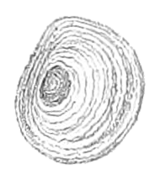
Outer side of an operculum
-
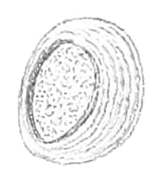
Inner side of an operculum


How Filopaludina martensi Got Its Name
This snail was first described in 1860 by Eduard von Martens. He named it Paludina cingulata. He studied a snail collected by Henri Mouhot.
Later, in 1864, Georg Ritter von Frauenfeld gave it a new name, Vivipara martensi. This was because the name Vivipara cingulata was already used for a fossil snail. So, a new name was needed to avoid confusion.
Different Types of Filopaludina martensi
Scientists recognize three main types, or subspecies, of this snail. However, they are still studying them to make sure these classifications are correct.
- Filopaludina martensi cambodiensis
- Filopaludina martensi martensi
- Filopaludina martensi munensis
Where Filopaludina martensi Lives
You can find Filopaludina martensi in several countries in Southeast Asia. These include Cambodia, Indonesia, Laos, Malaysia, Thailand, and Vietnam.
The first snail of this species that was studied came from a place called "Siam" (which is now Thailand). The exact spot was not written down.
Filopaludina martensi Life and Habitat
Filopaludina martensi snails live in canals and ponds. They are filter feeders, which means they get their food by filtering tiny bits of food from the water.
Reproduction and Young Snails
Female snails carry their young in a special pouch. They can have between 0 and 14 young snails at a time. The female snails usually give birth to their young mainly at night.
Snail Parasites
Like many animals, these snails can have parasites. Parasites are small organisms that live on or inside another animal and get their food from it. For Filopaludina martensi martensi, some parasites include:
- Paragonimus siamensis, which uses the snail as its first intermediate host (a place where it lives for part of its life).
- At least three types of Echinostomatidae, which are also parasites.
Another parasite found in Filopaludina martensi is a type of trematode called Multicotyle purvisi.
How People Use Filopaludina martensi
In some places, like Thailand, Filopaludina martensi is used as a food. It is part of the cuisine of Thailand.
