
Violet-capped hummingbird facts for kids
Quick facts for kids Violet-capped hummingbird |
|
|---|---|
 |
|
| Conservation status | |
| Scientific classification | |
| Genus: |
Goldmania
|
| Species: |
violiceps
|
 |
|
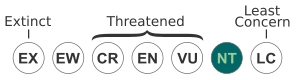
The violet-capped hummingbird (Goldmania violiceps) is a tiny, colorful bird. It is a type of hummingbird found in Panama and the northwestern part of Colombia. This species is currently considered Near Threatened, which means its population could be at risk in the future.
Contents
What is a Violet-Capped Hummingbird?
How is this Hummingbird Classified?
The violet-capped hummingbird belongs to a group of hummingbirds called "emeralds." It is the only species in its specific group, or genus, called Goldmania. This means it's quite unique! Another hummingbird, the Pirre hummingbird, is also in the same Goldmania genus.
What Does a Violet-Capped Hummingbird Look Like?
These small birds are about 8.5 to 9.5 cm (3.3 to 3.7 in) long. That's about the length of a crayon! Males are a bit heavier, weighing 3.8 to 4.4 g (0.13 to 0.16 oz), while females weigh 3.4 to 3.9 g (0.12 to 0.14 oz).
Both male and female violet-capped hummingbirds have a straight beak. Most of their beak is black, but the bottom part near their face is pink.
Male Hummingbirds
Male violet-capped hummingbirds are very striking. They have a bright, shiny violet-blue cap on their head. The rest of their body is a metallic green color, which shimmers in the light. Their tail is slightly forked, like a "V" shape, and is a deep maroon color with wide white edges on the feathers.
Female Hummingbirds
Female violet-capped hummingbirds look a bit different. Their upper body is green, and their belly is whitish. They have gray spots on their throat and green spots along their sides. Their tail feathers are maroon, just like the males, but they have white tips.
Where Do Violet-Capped Hummingbirds Live?
Habitat and Location
You can find the violet-capped hummingbird in several mountain areas. These areas are in central and eastern Panama, and also in the very northwestern part of Colombia. They like to live in humid forests, both inside the forest and along its edges.
These birds prefer to live at elevations between 600 and 1,200 m (2,000 and 3,900 ft) above sea level. They are most commonly seen around 900 m (3,000 ft).
How Do Violet-Capped Hummingbirds Behave?
Movement and Migration
The violet-capped hummingbird stays in the same area all year long. It does not migrate, meaning it doesn't travel to different places for different seasons.
What Do Violet-Capped Hummingbirds Eat?
These hummingbirds mainly drink nectar from flowers. They look for nectar in thick plants close to the ground. They especially like low-growing flowering shrubs such as Salvia, Pachystachis, Palicourea, and Psammisia.
Reproduction and Life Cycle
We know that violet-capped hummingbirds seem to breed from December to April. However, not much else is known about their breeding habits. Scientists have not yet described what their nests look like.
How Do Violet-Capped Hummingbirds Communicate?
The song of the violet-capped hummingbird is described as "a low, rapid chirping." They also make a call, which sounds like "a series of irregularly repeated, very nasal and fairly low-pitched notes, 'kyek...kyek-kyek-kyek...kyek...'" They often make this call while hovering in the air or when they are feeding.
What is the Status of This Hummingbird?
Conservation Status
The IUCN (International Union for Conservation of Nature) first thought the violet-capped hummingbird was of "Least Concern." But since 2017, they have changed its status to "Near Threatened." This means that while it's not in immediate danger, its population could become threatened in the future.
The hummingbird lives in a small area, and its population size is not fully known. However, it is believed that their numbers are decreasing. One reason for this decline might be slow deforestation, which is when forests are cut down. Even though some of their habitat is still safe, it's important to protect these beautiful birds. They are considered fairly common in some places, and locally common in others.
Images for kids
-
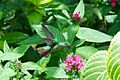
A male violet-capped hummingbird showing its bright colors.
-

Map showing where the violet-capped hummingbird lives.
See also
 In Spanish: Colibrí de Goldman para niños
