
HMS Sidon (P259) facts for kids

HMS Sidon
|
|
Quick facts for kids History |
|
|---|---|
 United Kingdom United Kingdom |
|
| Name | HMS Sidon |
| Builder | Cammell Laird Shipyard - Birkenhead |
| Laid down | 7 July 1943 |
| Launched | 4 September 1944 |
| Commissioned | 23 November 1944 |
| Fate |
|
| Badge |  |
| General characteristics | |
| Class and type | S-class submarine |
| Displacement |
|
| Length | 217 ft (66 m) |
| Beam | 23 ft 6 in (7.16 m) |
| Draught | 11 ft (3.4 m) |
| Speed |
|
| Complement | 48 officers and men |
| Armament |
|
HMS Sidon was a submarine of the Royal Navy, launched in September 1944. It was one of the S-class submarines built by Cammell Laird in Birkenhead, England. The submarine was named after the naval attack on Sidon in 1840. Sadly, an explosion caused by a faulty torpedo sank her in Portland Harbour, leading to the loss of 13 lives.
Contents
HMS Sidon was a special type of underwater ship called a submarine. It was built for the Royal Navy, which is the United Kingdom's navy. The submarine was launched in September 1944, during World War II. It was part of a group of submarines known as the S-class. These submarines were designed to be strong and effective underwater.
Building and Features
Sidon was built by Cammell Laird & Co Limited, a famous shipyard in Birkenhead. It was 217 feet (about 66 meters) long. When it was on the surface of the water, it weighed between 814 and 872 tons. Underwater, it weighed 990 tons. The submarine could travel at 14.75 knots (about 27 km/h) on the surface and 8 knots (about 15 km/h) when submerged. It had a crew of 48 officers and sailors.
Sidon was equipped with several weapons. It had six torpedo tubes at the front and one at the back, carrying a total of 13 torpedoes. It also had a 3-inch gun, a 20 mm cannon, and three machine guns for defense.
The Tragic Accident of HMS Sidon
On 16 June 1955, a very sad event happened to HMS Sidon. The submarine was in Portland Harbour when one of its own torpedoes exploded. This was a new type of torpedo that used a special fuel called High-Test Peroxide (HTP). The explosion caused the submarine to sink.
Rescue Efforts and Lives Lost
After the explosion, rescue teams quickly tried to help. Many people were trapped inside the submarine. Sadly, 13 crew members lost their lives in the accident. This was a very difficult time for the Royal Navy and the families of those who died.
What Happened Next
After the accident, HMS Sidon was refloated, meaning it was brought back to the surface of the water. However, it was too damaged to be used again. So, on 14 June 1957, about two years after the explosion, HMS Sidon was sunk on purpose. It was used for target practice by other naval ships. This meant the submarine served one last purpose before resting at the bottom of the sea.
Images for kids
-
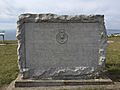
The Sidon Memorial on Portland

