
Jamaican spindalis facts for kids
Quick facts for kids Jamaican spindalis |
|
|---|---|
 |
|
| Male | |
| Conservation status | |
Scientific classification  |
|
| Kingdom: | Animalia |
| Phylum: | Chordata |
| Class: | Aves |
| Order: | Passeriformes |
| Family: | Spindalidae |
| Genus: | Spindalis |
| Species: |
S. nigricephala
|
| Binomial name | |
| Spindalis nigricephala (Jameson, 1835)
|
|
 |
|
| Script error: The function "autoWithCaption" does not exist. | |

Script error: No such module "Check for conflicting parameters".
The Jamaican spindalis (Spindalis nigricephala) is a colorful bird found only on the island of Jamaica. It is one of four types of spindalis birds in the family Spindalidae.
Contents
About the Jamaican Spindalis
How Scientists Name Birds
For a long time, scientists thought the Jamaican spindalis was part of a larger group of birds called tanagers. They even thought it was just one type of a bird called the stripe-headed tanager.
But then, around 1997, experts looked closer. They noticed differences in how the birds looked and the sounds they made. Because of these differences, the Jamaican spindalis and a few other birds got their own special species names.
Later, in 2017, scientists decided these four spindalis birds were so unique they needed their own family! This new family is called Spindalidae. It shows how special these birds are, as they are not closely related to tanagers after all.
What Does It Look Like?
The Jamaican spindalis is about 18 centimeters (7 inches) long. It weighs between 38 and 65 grams (1.3 to 2.3 ounces). That's about as much as a small candy bar!
Male birds are very striking. They have a black head with bright white stripes above their eyes and a white "mustache." Their back is yellowish-green, and their chest is a bright orange-yellow. Their tail and wings are black with white edges.
Female birds look a bit different. They have a grayish-green head and back. Their chest is a pale orange-yellow, and their belly is light yellow. Young birds look similar to females but are not as brightly colored.
Where Does It Live?
The Jamaican spindalis lives all over Jamaica. You might see more of them in the higher, hilly areas. They prefer forests, woodlands, and bushy places. These areas are usually full of trees and shrubs that grow tasty fruits.
How Does It Behave?
Daily Life and Movement
These birds live in Jamaica all year round. They don't fly away for winter like some birds do. However, they might move to different parts of the island. This depends on where they can find the most fruit to eat.
What Does It Eat?
The Jamaican spindalis loves to eat fruits and berries! They enjoy many different kinds of fruits from both native and introduced plants. They also munch on small amounts of leaves and blossoms.
You'll often see them feeding in pairs or small family groups. Sometimes, if there's a tree with lots of fruit, you might see about 10 birds gathered together. They are very acrobatic eaters. They can hang upside down from branches to reach the juiciest berries!
Reproduction and Life Cycle
The breeding season for the Jamaican spindalis is from April to July. During this time, they build a loose, cup-shaped nest. They use materials like grass and small roots.
Female birds usually lay two or three eggs. Scientists are still learning more about how these birds raise their young.
What Does It Sound Like?
The Jamaican spindalis is generally a quiet bird. It doesn't make a lot of noise. Sometimes, you might hear a soft, whispering song. It sounds like "chu wheet, chee see whee see, chu wheet." When they are feeding in groups, they might make a fast, high-pitched "chi-chi-chi-chi-chi" sound.
Is the Jamaican Spindalis Safe?
The IUCN (International Union for Conservation of Nature) has listed the Jamaican spindalis as a species of "Least Concern." This means they are not currently at risk of disappearing.
Even though they live in a small area, their population seems to be stable. No big threats have been found for them. They are common and can live in different types of habitats, including areas where new plants are growing. This helps keep them safe for the future.
Images for kids
-
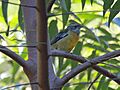
Female Jamaican Spindalis

