
Jasminum officinale facts for kids
Quick facts for kids Jasminum officinale |
|
|---|---|
 |
|
| Botanical illustration | |
Scientific classification  |
|
| Kingdom: | Plantae |
| Clade: | Tracheophytes |
| Clade: | Angiosperms |
| Clade: | Eudicots |
| Clade: | Asterids |
| Order: | Lamiales |
| Family: | Oleaceae |
| Genus: | Jasminum |
| Species: |
J. officinale
|
| Binomial name | |
| Jasminum officinale |
|
| Script error: The function "autoWithCaption" does not exist. | |
Script error: No such module "Check for conflicting parameters".


Jasminum officinale, widely known as common jasmine or poet's jasmine, is a famous flowering climbing plant. It belongs to the olive family, known scientifically as Oleaceae. People around the world admire this plant for its starry white flowers and sweet fragrance.
Gardeners have grown common jasmine for thousands of years. It climbs across fences, walls, and trellises throughout summer and autumn. In addition to garden beauty, the plant has high cultural importance. It serves as the official National flower of Pakistan.
Contents
- Understanding the Biology of Common Jasmine
- Scientific Classification and Naming
- Natural Habitat and Global Distribution
- History of Cultivation and Cultural Meaning
- Chemical Composition and Essential Oils
- Growing and Caring for Common Jasmine
- Uses and Everyday Applications
- Comparing Common Jasmine to Other Species
- Summary Facts About Common Jasmine
- Images for kids
- See also
Understanding the Biology of Common Jasmine
Common jasmine is a vigorous perennial climber. It is deciduous in colder zones, dropping its leaves every autumn. In warm climates, it can remain semi-evergreen throughout the whole year.
Plant Structure and Growth Habits
The vines of Jasminum officinale climb by twining around nearby objects. Stems wrap around trellises, wires, or surrounding shrubs. The plant can reach heights between 5 to 10 meters (16 to 33 feet) under ideal conditions.
Leaves and Stems
The leaves are arranged opposite each other along the green stems. Each leaf is pinnate, meaning it is divided into smaller leaflets along a central stalk.
- Leaves usually feature 5 to 9 leaflets.
- The individual leaflets are oval or lance-shaped with sharp tips.
- The terminal leaflet at the very tip is larger than the side leaflets.
- Foliage provides a rich, dark green background that highlights the pale flowers.
Flowers and Scent
The flowers appear from early summer through early autumn. They grow in small clusters called cymes at the ends of branches.
- Each flower has five pure white, star-like petals spreading outward.
- The base of the petals fuses into a slender floral tube.
- The flowers release their strongest perfume during dusk and early evening.
- Special volatile compounds produce this intense, sweet aroma.
Life Cycle and Reproduction
Common jasmine follows a multi-stage life cycle adapted to seasonal changes. It reproduces naturally through flowers and seeds, as well as through vegetative propagation.
Pollination and Fertilizers
Pollination occurs primarily during warm summer evenings. Because flowers release heavy scents at night, they attract nocturnal pollinators like moths and hawkmoths.
- Insects insert long proboscises into the floral tube to drink nectar.
- Pollen grains stick to the insect's body and transfer to neighboring flowers.
- Successful fertilization leads to small, round, fleshy berries.
- The berries turn purple-black when they fully ripen in autumn.
Propagation Methods
Gardeners rarely rely on seeds to grow new jasmine plants. Instead, vegetative propagation provides faster and more reliable results.
- Stem cuttings taken in late spring root easily in moist soil.
- Layering involves bending a low stem to the ground until it grows roots.
- Root division allows large root clumps to be separated into independent plants.
Scientific Classification and Naming
Scientists use a naming system called binomial nomenclature to identify living organisms. This prevents confusion across different languages and regions.
Taxonomy Breakdown
Botanists classify common jasmine based on shared evolutionary traits:
- Kingdom: Plantae (all true plants)
- Order: Lamiales (flowering plants with opposite leaves)
- Family: Oleaceae (the olive family, including lilacs and ash trees)
- Genus: Jasminum (around 200 species of fragrant shrubs and vines)
- Species: Jasminum officinale
Origin of the Scientific Name
The name Jasminum comes from the Persian word yasmin, which translates directly to "gift from God" or "sweet-smelling flower."
The specific epithet officinale comes from the Latin word officina. In medieval monasteries and towns, an officina was the storeroom where medicines, herbs, and perfumes were prepared. Giving a plant this title meant it had recognized, practical value in traditional medicine and commerce.
Natural Habitat and Global Distribution
Jasminum officinale is native to high-altitude regions and valleys across Central and South Asia. Over centuries of trade, humans carried it to nearly every continent.
Native Range Across Asia
The plant originated across a vast belt stretching from the Caucasus Mountains into the Far East.
- It grows wild across northern Iran, Afghanistan, and Pakistan.
- Wild populations thrive throughout the rugged Himalayan mountain range.
- Native stands extend through northern India, Nepal, and Tajikistan.
- In China, it grows naturally in western provinces including Sichuan, Yunnan, Guizhou, and Xizang (Tibet).
Worldwide Naturalization
Because humans planted it so widely, common jasmine has escaped gardens and established wild populations elsewhere. This process is called naturalization.
- In southern Europe, it thrives in Spain, Portugal, France, and Italy.
- It grows wild across the Balkan Peninsula, including Croatia, Serbia, and Montenegro.
- In North America, naturalized patches appear in warm states like Florida.
- It is also widely naturalized in parts of North Africa and the West Indies.
History of Cultivation and Cultural Meaning
Common jasmine has a rich history entwined with ancient trade routes, poetry, and art. People have appreciated both its scent and appearance across many civilizations.
Ancient and Medieval Garden History
Historical records show that gardeners have treasured jasmine for millennia. Ancient records from third-century China describe common jasmine as a prized import from western lands.
- Ninth-century Chinese documents recorded that the plant arrived through trade with Byzantium.
- Arab traders and travelers helped spread the vine across the Mediterranean basin.
- Arab-Norman culture introduced the plant to the island of Sicily during the Middle Ages.
- By the 14th century, Italian writer Boccaccio described shaded jasmine walkways in his famous work, the Decameron.
Renaissance to Modern Botany
During the Renaissance, botanists across Europe began cataloging foreign species. English naturalist William Turner recorded common jasmine growing in London gardens in his 1548 book, Names of Herbes.
By the 18th century, famous Swedish botanist Carl Linnaeus described the species scientifically. Because it was already growing wild across Swiss hillsides, Linnaeus initially thought it was native to Switzerland.
National Symbol of Pakistan
Common jasmine holds a place of honor as the National flower of Pakistan, where it is known locally as Chambeli.
- Its white petals symbolize peace, purity, and modesty.
- The flower features prominently in the official Coat of arms of Pakistan.
- Jasmine blossoms are woven into garlands for weddings, national celebrations, and welcoming ceremonies.
Chemical Composition and Essential Oils
Scientists have studied the chemical makeup of common jasmine to understand its strong fragrance and biological properties.
Natural Chemical Compounds
Leaves, stems, and flowers contain many organic compounds:
- Flavonoids and anthocyanins: Natural plant pigments that protect cells from solar radiation.
- Tannins: Bitter plant compounds that defend against plant-eating insects.
- Terpenoids: Aromatic hydrocarbons that produce distinct floral scents.
- Glycosides and saponins: Molecules that assist in internal plant chemistry and pest defense.
Harvesting Jasmine Absolute
Extracting fragrance from jasmine requires careful timing and skilled labor. The delicate petals cannot withstand hot steam distillation.

Night Harvesting Process
Workers must harvest the flowers at very specific times:
- Flowers open fully at dusk, releasing peak fragrance levels at night.
- Pickers harvest blossoms by hand before sunrise.
- Heat from the midday sun destroys the delicate aromatic oils inside the petals.
Solvent Extraction
To capture the scent without destroying it, perfumers use solvent extraction:
- Fresh blossoms are placed in special solvents that dissolve the natural waxes and oils.
- The solvent evaporates, leaving a thick fragrant wax called "jasmine concrete."
- Alcohol purification separates pure fragrance oil, known as "jasmine absolute."
- It takes thousands of fresh blossoms to make a single milliliter of pure jasmine absolute, making it one of the world's most expensive perfume ingredients.
Growing and Caring for Common Jasmine
Common jasmine is an adaptable garden plant. Gardeners value it because it grows rapidly and requires straightforward maintenance.
Ideal Soil and Sunlight Conditions
For the healthiest growth and maximum flower production, gardeners provide specific environmental conditions:
- Sunlight: Full sun to partial shade. The plant requires at least six hours of direct sunlight daily to produce abundant flowers.
- Soil: Fertile, well-draining soil rich in organic matter. Wet, waterlogged roots will rot.
- Watering: Regular watering during the active summer growing season. Once established, plants tolerate brief dry periods.
- Temperature: Common jasmine is hardy down to around -10°C (14°F). In colder regions, it needs sheltered wall positions or winter mulch.
Popular Garden Cultivars
Horticulturists have selected unique forms of common jasmine, called cultivars:
- ‘Argenteovariegatum’ features striking green leaves edged with creamy white markings. It earned the Royal Horticultural Society's Award of Garden Merit.
- ‘Aureum’ produces bright, golden-yellow foliage that contrasts with white blossoms.
- ‘Fiona Sunrise’ displays vibrant chartreuse-yellow leaves during spring and summer.
- ‘Clotted Cream’ features larger flowers with softer, cream-colored petals and an even stronger scent.
Pruning and Garden Maintenance
Regular pruning prevents common jasmine from becoming an unmanageable tangle of bare stems.
- Pruning should take place immediately after flowering finishes in late summer or early autumn.
- Gardeners trim back dead, weak, or overcrowded branches.
- Removing old wood encourages vigorous new shoots that will carry next year's blooms.
Uses and Everyday Applications
Beyond ornamental garden displays, common jasmine serves several functional uses in daily life.
Perfumery and Aromatherapy
Jasmine absolute remains a cornerstone of high-end perfumery. It acts as a "middle note," blending different scents together to create smooth, long-lasting fragrances. In aromatherapy, the soothing scent of jasmine is used to create calming and uplifting atmospheres in living spaces.
Culinary and Herbal Uses
Jasmine has a long history in herbal preparations and teas.
- Dried jasmine blossoms are frequently mixed with green tea leaves to make traditional jasmine tea.
- The U.S. Food and Drug Administration (FDA) categorizes jasmine as "generally recognized as safe" (GRAS) for use as a food flavoring.
- Some people experience mild allergic reactions to the pollen or concentrated oils, so sensitive individuals handle it with care.
Comparing Common Jasmine to Other Species
The genus Jasminum contains over 200 species, and several are often confused with common jasmine.
| Common Name | Scientific Name | Flower Color | Growth Habit | Main Feature |
|---|---|---|---|---|
| Common Jasmine | Jasminum officinale | White | Twining deciduous vine | Highly fragrant summer blooms |
| Arabian Jasmine | Jasminum sambac | White | Evergreen bushy shrub | Used for making traditional jasmine tea |
| Winter Jasmine | Jasminum nudiflorum | Yellow | Arching deciduous shrub | Blooms on bare stems in winter; no scent |
| Star Jasmine | Trachelospermum jasminoides | White | Evergreen woody vine | Not a true jasmine, but shares a similar fragrance |
Summary Facts About Common Jasmine
- Common jasmine is a vigorous climbing vine belonging to the olive family, Oleaceae.
- The species name officinale indicates its historical role as a useful plant in traditional herbal storerooms.
- It is native to mountainous regions stretching from the Caucasus through the Himalayas to China.
- The white, starry flowers open and release their strongest perfume at dusk.
- It serves as the official national flower of Pakistan, symbolizing purity and peace.
- Jasmine absolute is a rare, expensive aromatic extract used worldwide in fine perfumes.
Images for kids
-
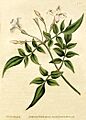
Botanical illustration from 1787
-
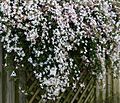
Clusters of white flowers on a climbing vine
-
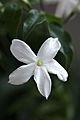
Close view showing five-lobed white petals
-

Official coat of arms featuring a jasmine wreath
-

Extracted essential oil used in perfumery
See also
 In Spanish: Jazmín morisco para niños
