
Killarney Provincial Park Observatory facts for kids
| Location | Killarney, Ontario |
|---|
The Killarney Provincial Park Observatory is a special place where you can look at the stars and planets. It's an astronomical observatory located in the George Lake Campground of Killarney Provincial Park. This park is about a 420 km drive north of Toronto or 100 km southwest of Sudbury.
Ontario Parks runs the Observatory, which has two main buildings. The first building has a 10-inch telescope. It's great for looking at the night sky and even the Sun during the day with a special filter! The second, newer building (built in 2018) has a much bigger 16-inch telescope. It also has a smaller 5-inch telescope. This setup is perfect for studying space, taking amazing photos of stars, and for everyone to use. Both telescopes are part of "Discovery programs" and can even be signed out for private use by visitors who are interested.
Contents
Exploring Stars at Killarney Park
Learning about astronomy in Killarney Provincial Park started way back in 1985. Bruce Waters from the McLaughlin Planetarium began offering programs. People loved these "Discovery Programs" (which used to be called Natural Heritage Education or NHE programs). Sometimes, more than 200 people would show up each night! Over time, other astronomy teachers like Bill Gardner and staff from Science North also started giving talks.
Today, astronomy education is still a big part of the park. You can learn about both Western constellations and Indigenous (Anishinaabek) star stories. There are even workshops where you can make your own comets! Music is also used to help visitors connect with the amazing mysteries of the stars.
History of the Observatory Buildings
Waasa Debaabing: The First Observatory

In 2010, after 25 years of astronomy programs by Bruce Waters, they decided to build a permanent observatory. This new building and telescope system had a few important goals:
- It needed to be used all year round.
- Park staff could use it to run their own programs.
- Visitors could sign it out and use it themselves.
The first observatory, with its 10-inch telescope, opened to the public on July 17, 2010. It was the very first public-use observatory in any provincial park! This setup offered great views of space. In 2011, the telescope was upgraded to make it easier for staff and visitors to use. The observatory sits on a deck with two ramps, which were kindly donated by the Friends of Killarney Park.
Anishinaabemowin Name
On September 28, 2019, at the "Stars over Killarney" event, this observatory got its official name: Waasa Debaabing. This name, in the Anishinaabemowin language, means "seeing far (as the eye can see)" or "the far in the distance seeing." It was chosen to honor the Indigenous astronomy theme of the event.
You can hear the name in Anishinaabemowin by clicking here.
Kchi Waasa Debaabing: The Bigger Observatory

After eight years, it was clear that the observatory could be even better. So, in 2017, plans began for a second, larger observatory. This new building and its equipment needed to meet six key goals:
- Offer amazing views of space.
- Be great for taking wide-field and close-up photos of stars.
- Be easy for both Discovery program staff and visitors to use.
- Have more space inside for public programs.
- Be easy for park staff to maintain (protected from moisture, bugs, etc.).
- Be very strong against accidental damage.
Experts and experienced users helped decide what was needed. They looked at feedback from places like the Hyde Memorial Observatory.

In 2018, the new, larger observatory opened. It holds a 16-inch telescope, which is perfect for looking at planets and deep sky objects. It also has a 5-inch telescope on top for wider views. All of this equipment sits on a strong, permanent base to keep it stable. This observatory uses a special dome that has a "slide-off" roof, giving more room inside. Like the first observatory, it also has a deck with ramps, donated by the Friends of Killarney Park.
First Views from the 16-inch Telescope
The second observatory was finished in June 2018. The first time they used the new telescopes was on June 9, 2018. People saw incredible "space-walk" views of star clusters like M13 and M11, and nebulae like M8 and M20. People celebrating the opening included astronomers, park interpreters, and staff from Science North.
Anishinaabemowin Name
On September 28, 2019, during the "Stars over Killarney" event, this larger observatory also received its official name: Kchi Waasa Debaabing. In Anishinaabemowin, this means "seeing very far (as far the eye can see)" or "the very far in the distance seeing." This name also honored the Indigenous astronomy theme of the event.
You can hear this name in Anishinaabemowin by clicking here.
Astronomy Programs at the Park
Dark-Sky Preserve

Killarney Provincial Park is a special "Wilderness Class" park in Ontario. This means it's protected to keep its natural beauty. Because of this, the park makes sure its lighting doesn't spoil the night sky. On February 28, 2018, Killarney Provincial Park was officially named a Dark-sky preserve by the Royal Astronomical Society of Canada. This means it's one of the best places to see the stars without light pollution. The park also teaches visitors about how to use lighting properly to protect the night sky.
Self-Use Sign-out Program
While the Observatory is used for big public events with many people, it's also designed for visitors to use on their own. This program, available from July through September, lets anyone visiting the park use a research-level observatory for free! You just need some basic training from the park staff beforehand. Killarney Provincial Park Observatory was the first free, public, self-use observatory in North America.
Astronomer in Residence Program
Since 2012, Killarney Provincial Park has had an "Astronomer in Residence" program. Experienced guest astronomers come to the park and share their knowledge every day. These astronomers help with the park's education programs. They offer daily observatory training, solar viewing (looking at the Sun), night sky viewing, and other programs about astronomy and how it connects to the Killarney Provincial Park experience.
Meteorite Display
Besides the programs, visitors can also see a small collection of meteorites inside the Park office during opening hours. This collection includes a piece of an iron meteorite, a special slice of meteorite showing unique patterns called Widmanstätten patterns, and a very rare Allende meteorite that contains tiny grains older than our Sun!
Astrophotography
The 16-inch telescope at the Killarney Provincial Park Observatory is amazing for taking photos of space, called astrophotography. This is because it can gather a lot of light, has a special design, and is located in a Dark-Sky Preserve where the sky is very dark. Using modern technology, you can take incredible pictures of distant galaxies and nebulae. Many of the images below were taken with the observatory's telescopes.


Images for kids
-
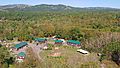
Killarney Provincial Park Observatory as seen against the backdrop of the La Cloche Mountain Range

See also
 In Spanish: Observatorio del Parque Provincial Killarney para niños
