
Large riverdamsel facts for kids
Quick facts for kids Large riverdamsel |
|
|---|---|
| Conservation status | |
Scientific classification  |
|
| Kingdom: | Animalia |
| Phylum: | Arthropoda |
| Class: | Insecta |
| Order: | Odonata |
| Suborder: | Zygoptera |
| Family: | Coenagrionidae |
| Genus: | Caliagrion Tillyard, 1913 |
| Species: |
C. billinghursti
|
| Binomial name | |
| Caliagrion billinghursti Martin, 1901
|
|
 |
|
| Script error: The function "autoWithCaption" does not exist. | |

Script error: No such module "Check for conflicting parameters".
A large riverdamsel (scientific name: Caliagrion billinghursti) is a type of damselfly. It's the only species in its group, called a genus (Caliagrion). These damselflies are part of a larger insect family known as Coenagrionidae.
You can only find large riverdamsels in south-eastern Australia. This means they are endemic to that area, living nowhere else in the world. They like to live near slow-moving rivers and calm ponds.
Large riverdamsels are quite big for a damselfly. The males are a bright blue color with black markings. The females, however, are yellow and black.
Contents
What is a Damselfly?
Damselflies are amazing insects that look a lot like dragonflies. Both belong to an order of insects called Odonata. Damselflies are usually smaller and more slender than dragonflies.
How to Tell Them Apart
There are a few easy ways to tell a damselfly from a dragonfly. When a damselfly rests, it usually holds its wings together over its back. Dragonflies, on the other hand, often hold their wings out flat to the sides. Also, damselflies have eyes that are usually separated, while dragonflies' eyes often touch each other.
Habitat and Where They Live
The large riverdamsel lives in south-eastern Australia. This includes parts of states like New South Wales and Victoria. They prefer places with fresh water that isn't moving too fast.
Ideal Homes for Riverdamsels
You can often spot these damselflies near slow-flowing rivers. They also like quiet ponds and wetlands. These watery places provide the perfect environment for them to hunt for food and lay their eggs.
Life Cycle of a Damselfly
Like many insects, damselflies go through several stages in their life. This is called metamorphosis. They start as eggs, then become nymphs, and finally turn into adult damselflies.
From Egg to Nymph
Female damselflies lay their eggs in or near water. Often, they place them on water plants. Once the eggs hatch, tiny creatures called nymphs emerge. These nymphs live underwater. They breathe using special gills and are skilled hunters, eating small water insects.
Growing Up and Becoming an Adult
Damselfly nymphs can live underwater for months or even years. They grow by shedding their skin many times. When a nymph is ready to become an adult, it crawls out of the water onto a plant stem or rock. Its skin then splits open, and the adult damselfly emerges. It takes some time for its wings to dry and harden before it can fly away.
Gallery
-
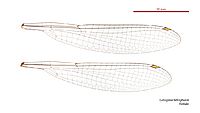
Female Caliagrion billinghursti wings
-
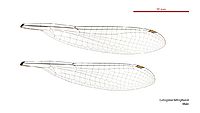
Male Caliagrion billinghursti wings
.jpg)
.jpg)
See also
 In Spanish: Caliagrion para niños
