
Lesser omentum facts for kids
Quick facts for kids Lesser omentum |
|
|---|---|
 |
|
| Latin | omentum minus |
The lesser omentum (also called the small omentum or gastrohepatic omentum) is a thin, double-layered sheet of tissue inside your belly. It acts like a bridge, connecting your liver to the smaller curve of your stomach and the first part of your duodenum (which is the very beginning of your small intestine). This special tissue helps hold these important organs in place.
What is the Lesser Omentum?
The lesser omentum is extremely thin, almost like a transparent film. It's made from two layers of peritoneum, which is the smooth lining inside your abdomen. These layers cover the front and back surfaces of your stomach and the first part of your duodenum.
Where these two layers meet at the smaller curve of the stomach and the upper part of the duodenum, they join together. They then go up as a double fold to a specific area on the liver called the porta hepatis.
On the right side of the lesser omentum, these two layers come together to form a free edge. This edge creates the front border of a small opening called the omental foramen. This opening leads to a space behind the stomach.
Its Different Parts
The lesser omentum isn't just one solid sheet; it's divided into different parts, often called ligaments. Each part connects to the liver on one side, which is why their names often start with "hepato" (meaning liver).
The two main parts are:
- Hepatogastric ligament: This part connects the liver to the smaller curve of the stomach.
- Hepatoduodenal ligament: This part connects the liver to the duodenum.
Sometimes, other smaller connections are also considered part of the lesser omentum. These include parts connecting to the thoracic diaphragm (hepatophrenic ligament), the esophagus (hepatoesophageal ligament), or even the colon (hepatocolic ligament).
What's Inside?
Even though the lesser omentum is thin, it's not empty! Between its two layers, especially near its right edge, you'll find some very important structures. These include:
- The hepatic artery proper, which carries oxygen-rich blood to the liver.
- The common bile duct, which carries bile from the liver and gallbladder to the small intestine.
- The portal vein, which brings nutrient-rich blood from the digestive organs to the liver.
- Tiny tubes called lymphatics, which are part of your immune system.
- A network of nerves called the hepatic plexus, which helps control the liver's functions.
All these vital structures are protected by a tough, fibrous covering. Also, where the lesser omentum attaches to the stomach, you'll find the right and left gastric arteries and gastric veins, which supply blood to the stomach.
Images for kids
-
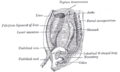
The primitive mesentery of a six weeks’ human embryo.
-
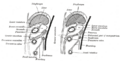
Diagrams showing the development of the greater omentum and transverse mesocolon.
-
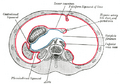
Horizontal view of the peritoneum in the upper part of the abdomen.


Learn More
- Omental bursa (Lesser sac)
- Greater sac
- Omental foramen (Epiploic foramen, Foramen of Winslow)
- Greater omentum
- Peritoneum
