
Greater omentum facts for kids
Quick facts for kids Greater omentum |
|
|---|---|
 |
|
| The greater omentum and corresponding vasculature is visible covering the intestines (dissection image with liver held out of the way). Label at bottom. |
|
| Latin | omentum majus |
| Artery | Right gastroepiploic artery |
| Precursor | Dorsal mesentery |
Imagine a large, apron-like curtain inside your belly. That's kind of what the greater omentum is! It's a big, fatty sheet of tissue that hangs down from your stomach. It covers your small intestines like a protective blanket. This important part of your body is larger than the lesser omentum, which is another tissue sheet near your liver. The word "epiploic" comes from an old Greek word meaning "to float on," because the greater omentum seems to float over your intestines. It's often the first thing doctors see when they look inside the abdominal cavity from the front.
Contents
How is the Greater Omentum Built?

The greater omentum is the bigger of two special folds of tissue called peritoneum. It's made of four layers of this tissue, folded over on itself.
These layers start from the lower curve of your stomach. They then drape down in front of your small intestines. Sometimes they reach as low as your pelvis. After that, they turn back up towards your transverse colon, which is part of your large intestine.
In young people, you can see its different layers clearly. As we get older, these layers often blend together. The greater omentum is usually thin and can look like it has small holes. It contains some fat (adipose tissue), which can increase in people who are obese. It also has many blood vessels, meaning it gets a lot of blood flow.
Blood Supply
The greater omentum gets its blood from two main arteries. These are the right and left gastroepiploic arteries. They are like highways bringing blood to this important tissue. Both of these arteries come from a larger artery called the celiac trunk. The right one branches off from the gastroduodenal artery. The left one is the biggest branch of the splenic artery. These two gastroepiploic arteries connect with each other along the lower curve of the stomach.
How it Develops

The greater omentum starts to form when you are still developing inside your mother. It grows from a fold of tissue behind the stomach. As the stomach rotates during development, this tissue folds and grows. It eventually forms a large pouch that hangs down. This pouch grows to cover most of your small and large intestines.
What Does the Greater Omentum Do?
The greater omentum has several important jobs in your body:
- Storing Fat: It holds different amounts of fat. This fat can be used for energy.
- Helping Your Immune System: It has special areas called "milky spots." These spots contain cells that act like tiny guards. They help your body fight off germs and infections.
- Protecting from Infections and Helping with Healing: It can physically limit the spread of infections inside your belly. The greater omentum often wraps itself around areas that are infected or injured. This helps to wall off the problem and protect other organs.
The Greater Omentum in Medicine
Doctors sometimes work with the greater omentum to help people.
When Surgery is Needed
Sometimes, doctors need to remove the greater omentum in an operation. This procedure is called an omentectomy. It might be done if there's a concern about certain illnesses spreading to this tissue. For example, if there are issues with the ovaries, uterus, intestines, or appendix. This surgery is usually done when the main problem area is also being treated.
Helping Other Body Parts
Doctors can also use a piece of the greater omentum, called an omental flap. This flap can help repair other parts of the body, like the thoracic wall (your chest wall). Scientists are even exploring its use to help repair heart tissue.
Aiding Brain Recovery
In some special brain surgeries, a part of the greater omentum can be used. It helps bring more blood flow to brain tissue. This can be especially helpful after someone has had a stroke.
A Bit of History
The greater omentum has had many names over time. Some of these include the great omentum, omentum majus, gastrocolic omentum, epiploon, and caul.
A long time ago, in 1906, a surgeon named James Rutherford Morison called the greater omentum the "abdominal policeman." He gave it this name because it acts like a watchful guard inside your belly. It helps find and cover areas where there might be an infection. It walls off these areas with its special immune cells to protect you.
Images for kids
-
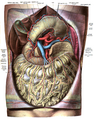
The greater omentum is attached to the lower portion of the stomach (here the attachment is cut and the stomach is lifted up).
-
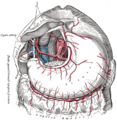
The celiac artery and its branches; the liver has been raised, and the lesser omentum and anterior layer of the greater omentum removed.
-
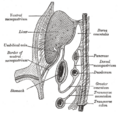
Schematic figure of the bursa omentalis, etc. Human embryo of eight weeks.
-
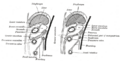
Diagrams to illustrate the development of the greater omentum and transverse mesocolon.


See also
- Caul fat
- Omental cake
- Omental infarction
- Right gastroepiploic vein
- Omental bursa (Lesser sac)
- Greater sac
- Omental foramen (Epiploic foramen, Foramen of Winslow)
- Lesser omentum
- Peritoneum
