
Liberian mongoose facts for kids
Quick facts for kids Liberian mongoose |
|
|---|---|
| Conservation status | |
Scientific classification  |
|
| Kingdom: | Animalia |
| Phylum: | Chordata |
| Class: | Mammalia |
| Order: | Carnivora |
| Suborder: | Feliformia |
| Family: | Herpestidae |
| Genus: | Liberiictis Hayman, 1958 |
| Species: |
L. kuhni
|
| Binomial name | |
| Liberiictis kuhni Hayman, 1958
|
|
 |
|
| Range of the Liberian mongoose | |
| Script error: The function "autoWithCaption" does not exist. | |
Script error: No such module "Check for conflicting parameters".
The Liberian mongoose (scientific name: Liberiictis kuhni) is a type of mongoose. It lives in the countries of Liberia and Ivory Coast in West Africa. This special animal is the only species in its group, called Liberiictis. Scientists have studied its family tree and found that it is closely related to other small mongooses. Its closest relative is the banded mongoose.
Contents
About the Liberian Mongoose
What it Looks Like
The Liberian mongoose has a dark brown body. It has a darker stripe on its neck and shoulders. This stripe has smaller white stripes along its edges. Compared to other mongooses, it has long claws. It also has a long snout and small teeth for the size of its head. Its tail is bushy and gets thinner towards the end. The tail is less than half the length of its head and body.
What it Eats and Where it Lives
Experts think the Liberian mongoose mainly eats insects. Its long claws and snout help it find food. One mongoose seen alive was found in a burrow near a termite nest. This suggests it likes to be close to insects. Its tail might also be special for eating earthworms.
Some people who have seen this mongoose in the wild say it lives mostly in tree trunks. Other types of mongooses also live in trees during the rainy season. They might only use burrows when the weather is hotter.
Reproduction and Life Cycle
Scientists have found young mongooses at the end of July. They also found a mother mongoose feeding her babies in early August. This suggests that Liberian mongooses have their babies during the rainy season. This is when there is more food available for them.
Life in the Wild
Discovery and Behavior
The Liberian mongoose was first discovered in Liberia in 1958. For a long time, not much was known about it. Most information came from local people. These mongooses usually look for food in groups of 3 to 8 animals. Sometimes, even larger groups have been seen. Their diet includes earthworms and different kinds of insects.
Where They Live
We don't know exactly how far the Liberian mongoose lives. It might live from Sierra Leone all the way to Côte d'Ivoire. But we only have confirmed sightings in forests in Liberia. They have also been seen in the Tai National Park in Côte d'Ivoire.
Sadly, human activities have pushed the Liberian mongoose out of some areas. These activities include mining, farming, hunting, and cutting down trees. A live mongoose was once shown at the Toronto Zoo. However, difficult conditions in Liberia have made it hard to study them more.
Impact on the Forest
As these mongooses search for food, they dig through leaves and soil. It's thought that they can turn over the entire forest floor in about 8 months. This digging changes the environment for seeds. It can affect how seeds are eaten or how they grow. The Liberian mongoose can also host a type of chewing louse called Felicola liberiae.
Protecting the Liberian Mongoose
Why They Need Help
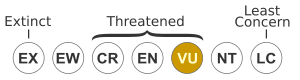
The Liberian mongoose is listed as Vulnerable on the IUCN Red List. This means it is at risk of becoming endangered. The main threats to these mongooses are humans destroying their homes and hunting them.
They are very rare animals. They were not fully described until 1958. The first complete animals were only found in 1974. In 1988, scientists tried to study them but only found one animal that had already been killed by a hunter. The mongoose that lived at the Toronto Zoo has also passed away.
Their Role in the Ecosystem
Because they are so rare, we don't know much about how they interact with other parts of the forest. However, recent studies show they might be "ecosystem engineers." This means they help keep the forest floor healthy and diverse. Scientists followed a group of mongooses for three months. They recorded where the mongooses foraged. This helped them understand how the mongooses change the forest floor.
