
List of New York State Historic Markers in Franklin County, New York facts for kids
New York State Historic Markers are special signs that tell us about important places, people, or events in history. These markers help us learn about the past and remember what happened in different areas.
This article shares some of the interesting historic markers you can find in Franklin County, New York. These markers tell stories about early settlers, important buildings, and even famous people who lived there.
Contents
What are Historic Markers?
Historic markers are like outdoor history books! They are usually metal signs, often blue or green, placed in special spots. Each marker has a short message explaining why that location is important. They help people passing by to quickly learn about the history of the area.
Why are Historic Markers Important?
These markers are super important for a few reasons:
- Learning History: They teach us about local history, from the first homes built to big events like wars.
- Preserving the Past: They make sure important stories and places are not forgotten.
- Tourism: They can guide visitors to interesting historical sites, making history fun to explore.
Early Settlers and First Buildings
Many markers in Franklin County celebrate the very first people who settled there and the first buildings they constructed. These stories show how towns began and grew.
First Homes and Churches
Imagine being the first person to build a home in a new place!
- Bangor's First Settler: One marker in Bangor tells us about Joseph Plumb. He was a soldier in the American Revolutionary War. He came to this area from Vermont with his oxen pulling a sled. He was the very first settler in Bangor.
- First School in Moira: In the town of Moira, you can find a marker for the first school building. It was made of logs around 1807. Can you imagine going to school in a log cabin?
- First Churches: Several markers point out the sites of the first churches. For example, Fort Covington had its First Baptist Church organized in 1821. In Bombay, the first Catholic Church in Franklin County was built in 1834. These churches were important community centers.
Early Businesses and Factories
Markers also highlight the start of businesses that helped towns grow.
- First Store in Burke: Near Chateaugay, a marker shows where the first store in Burke was built. Daniel Mitchell ran this store. Sadly, it was destroyed by a tornado in 1856.
- First Starch Factory: In Moira, a marker tells about the first starch factory. It was built in 1851 by Col. C.A. Stone and Capt. Wm. A. Tupper. Factories like this helped create jobs and products for the community.
Important Roads and Transportation
Before cars, roads were vital for travel and trade. Several markers tell us about old roads that connected different parts of New York.
Old Military Turnpike
- Plattsburgh to Hopkinton: You'll find markers for the "Old Military Turnpike" in places like Bangor, Dickinson, and Malone. This important road connected Plattsburgh to Hopkinton. It was started by military workers in 1817 and finished in 1826. Imagine how long it took to build a road back then!
Northwest Bay Road
- Connecting Communities: The "Northwest Bay Road" is another old route mentioned on markers in Brighton, Duane, Harrietstown, and Santa Clara. This road began even earlier, before 1810. It stretched from Westport, through places like Lake Placid and Saranac Lake, all the way to Hopkinton. These roads were like the highways of their time!
Jennings Road
- War of 1812: A marker in Santa Clara tells us about Jennings Road. This road was used by American troops during the War of 1812. They marched along it from Lake Champlain to Lake Ontario.
Franklin County and the War of 1812
The War of 1812 was a conflict between the United States and Great Britain. Franklin County played a role in this war, and several markers remind us of those times.
Fort Covington's Role
- Blockhouse and Hospital: In Fort Covington, a marker shows where a blockhouse was built in 1812. A blockhouse was a strong, small fort. This one was used to help sick and wounded soldiers after a battle called Chrysler's Field in 1813.
- Winter Quarters: Another marker in Fort Covington points to the winter quarters of General Wilkinson's army. This was where the soldiers stayed after their defeat at Chrysler's Field.
- General Brown's Headquarters: A building on Main Street in Fort Covington was the headquarters for General Jacob Brown. He was an important American Army officer during the winter of 1813-1814.
Fort Hickory
- Single-Handed Defense: In Chateaugay, a marker tells the story of Fort Hickory. This was a blockhouse occupied by Samuel Hollenbeck during the War of 1812. The marker says he once defended it all by himself against an attack!
Man Homestead
- Soldiers' Home: In Westville, the Man Homestead marker tells about Dr. Albon and Alric Man. These brothers from Vermont settled here in 1802. Their house was built before 1810, and both brothers were officers in the War of 1812.
Notable People and Institutions
Franklin County has been home to some interesting and important people, as well as significant institutions.
Famous Residents
- "Lost Dauphin" Cottage: In Bombay, a fascinating marker tells about Eleazer Williams. He lived in a dwelling there and claimed to be the son of King Louis XVI of France, who was known as the "Lost Dauphin." Another marker shows his grave. He was an Episcopal clergyman and missionary to Native Americans.
- William Hogan: Also in Bombay, a marker points to the home of William Hogan. He was the founder of Hogansburg and even served in the United States Congress from 1831 to 1833.
- William Almon Wheeler: In Malone, a marker celebrates William Almon Wheeler. He was a lawyer, banker, and served in the state assembly and senate. Most notably, he was the Vice President of the United States from 1877 to 1881!
- Luther Bradish: In Moira, a marker tells about Luther Bradish. He was the Lieutenant Governor of New York from 1838 to 1840 and even served as a special United States Envoy to Constantinople in 1820.
Important Institutions
- Franklin Academy: In Malone, a marker tells the story of Franklin Academy. The first school class was taught there in 1806. It became Franklin Academy in 1831. The marker says that 73 men even mortgaged their farms to help pay for the school!
- Congregational Church: Also in Malone, a marker for the Congregational Church notes that it was organized in 1807. Its first church building in the county was built in 1826.
- Arsenal Green: In Malone, the "Arsenal Green" was a public parade ground deeded to the state in 1812. A stone arsenal, a place to store weapons, was built there in 1812.
Images for kids
-
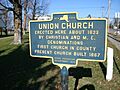
A historic marker in Moira, New York.

See also
