
List of New York State Historic Markers in Seneca County, New York facts for kids
New York State is full of special signs called historic markers. These markers are like outdoor history books! They tell us about important places, events, and people from the past. In Seneca County, New York, you can find many of these markers. They help us learn about the county's rich history, from early settlements and famous people to important events like the Sullivan Campaign during the American Revolutionary War. Let's explore some of these cool historical spots!
Contents
Historic Markers in Seneca County
Early Settlements and Buildings
Seneca County has many markers that tell us about its first towns and buildings. These places show how people lived and built communities long ago.
Old Baptist Church
In the town of Covert, there's a marker for the Old Baptist Church. This church was founded on February 16, 1803. It was the first church in Covert and was very important to the early settlers. Its first pastor was Minor Thomas. This church was also known as the "Mother Church" for many other Baptist churches in the area. You can find the old Covert Cemetery nearby.
Old School House
Also in Covert, near Interlaken, you can see a marker for the Old School House. This building was the second one used for school in Farmersville, New York. In 1845, it was known as the "Farmersville Institute," showing how important education was even in those early days.
The Beehive Tavern
Imagine a busy place where travelers could rest and meet! The marker for The Beehive in Interlaken tells us about a tavern built in 1824. Taverns were like hotels and community centers back then. The third floor of The Beehive was used for many different meetings, making it a central spot for the pioneers.
Potter Inn Farm
Near Seneca Falls, the Potter Inn Farm marker tells us about Nathaniel J. Potter. He was an innkeeper and blacksmith on the Genesee Road from 1801 to 1808. His son, Henry's Potter, lived here too. Henry became the first president of the Western Union Telegraph Company in 1851, which was a huge deal for communication at the time!
Native American History and the Sullivan Campaign
Many markers in Seneca County remember the Native American people who lived here for thousands of years. They also mark places related to the Sullivan Campaign of 1779. This was a military expedition during the American Revolutionary War. American troops, led by General John Sullivan, marched through New York to weaken the British and their Native American allies.
Burroughs Point
At Burroughs Point, about three miles north of Canoga, there's a marker for an Indian Village. This village was destroyed during the Sullivan Campaign in 1779. Troops led by Colonel Henry Dearborn camped here during their march.
Canoga and Canoga Creek
The marker for Canoga tells us about Ga-no-geh, an important Native American area. It was part of a reservation set aside by the Indian Sachem (chief) Fish-carrier in a treaty in 1795. A little north of Canoga, the Canoga Creek marker points to the site of the Indian village of Skannayutenate. This is a very special place because Red Jacket, a famous Native American orator (speaker), was born here.
Cayuga Lake and Early Missions
Cayuga Lake is a beautiful and historic spot. A marker here tells us that Moravian missionaries, David Zeisberger and John F. Cammerhoff, landed here on June 27, 1750. Missionaries were people who traveled to spread their religious beliefs.
Indian Villages and the Sullivan Campaign
Several markers point to sites of Native American villages that were destroyed during the Sullivan Campaign in 1779:
- Canoga Landing: Located on the shore of Cayuga Lake, this was another Indian village destroyed by Sullivan's troops.
- Dean's Cove (Swah-ya-wa-nah): In Romulus, this Indian village was destroyed by parts of Sullivan's army on September 22, 1779.
- Ken-Dai-A: This Indian village in Romulus was destroyed by Sullivan's army on September 17, 1779.
- Gar-non-de-yo: Near Canoga, this Indian village was also destroyed during the Sullivan Campaign on September 21, 1779.
Sullivan Trail
The Sullivan Trail marker in Ovid shows where Colonel Henry Dearborn of the Sullivan Expedition viewed Cayuga Lake on September 22, 1779. This was before white settlers arrived in the area.
Military Route
Near Waterloo, a marker shows the Military Route of the Sullivan-Clinton Army. This army marched through here on its campaign against the British and Native Americans in Western New York in 1779.
Important People and Innovations
Seneca County is also home to markers honoring people who made a difference.
Elizabeth Cady Stanton
In Seneca Falls, a marker for Elizabeth Cady Stanton tells us about a very important woman in American history. She was a leader in the movement for women's rights and lived here. The first Woman's Rights Convention was held right across the river from her home in 1848. This convention was a huge step in the fight for equal rights for women.
Thomas R. Lounsbury
In the village of Ovid, a marker honors Thomas R. Lounsbury. He was born here in 1835 and later became a famous professor at Yale University. He was a student at Ovid Academy, showing the importance of local education.
Isaac Philips Roberts
The Birthplace of Isaac Philips Roberts is marked near East Varick. Born on July 24, 1833, he became a very important figure for American farmers, known for his work in agriculture.
Degory Prowtt
In Romulus, a marker tells the story of Degory Prowtt. He was a drummer boy in the American Revolution from 1776 to 1783. He was at important events like the Siege of Fort Stanwix, the Sullivan Expedition, and the surrender of Cornwallis. He lived about a mile west of this marker.
Gary V. Sackett
In Seneca Falls, a marker points to the Home of Gary V. Sackett. He lived from 1790 to 1885. He was a judge in the Court of Common Pleas and was a big supporter of building the canal system, which helped transport goods and people across New York.
George Cunningham Van Cleef
The Van Cleef Lake in Seneca Falls is named after George Cunningham Van Cleef. He was one of the first white children born in Seneca County in 1797.
Transportation and Trade
Markers also highlight how people traveled and traded goods in the past.
Old Genesee Stage Route
Near Seneca Falls, the Old Genesee Stage Route marker shows an important road. This route, connected by the Cayuga Lake Bridge, was the main way to travel until the Erie Canal opened in 1822 and railways started in 1840. Stage routes were like early bus lines, carrying people and mail.
Bridgeport
The marker for Bridgeport near Seneca Falls tells us about a place formerly known as Cayuga Ferry. It was the western end of the State Line Bridge. This spot was very important when Auburn was known as "Hardenbergh's Corner," showing its role in early travel and trade.
Howland's Landing and Other Landings
Several markers point to old landings along the lakes, which were like small ports for boats:
- Howland's Landing: Formerly a landing and warehouse, it was shown on an old map from 1852.
- Canoga Landing: Another important landing site.
- Whitney's Landing: Later called Jacacks' Landing, this was a very important landing shown on the 1852 Delafield Map.
- Frisbie's Ferry: This was a hamlet (small village) with a store, mills, a distillery, a tavern, and a ferry that went to Aurora in 1796.
- Clarktown: Another extinct hamlet with a warehouse, stores, a tavern, a pottery, and a ferry that crossed the lake to Levanna.
Other Interesting Sites
Canoga Spring
Near Canoga, the Canoga Spring marker tells us about a special spring. In 1850, a survey of Seneca County by John Delafield mentioned that this spring was "bubbling pure Nitrogen Gas."
Kingdom Cemetery
Near Waterloo, the Kingdom Cemetery marker tells us about a place that was once a bustling center. Until 1856, this area had mills, distilleries, taverns, a school, a justice court, a Masonic Lodge, and even a race track!
Crusoe Island
In the town of Tyre, the Crusoe Island marker points to the site of the Crusoe Post Office until 1852. It was also the home of Senator David H. Evans (1837–1920) and had barns for relaying stages (where horses were changed for stagecoaches).
These historic markers are like clues to the past, helping us imagine what life was like in Seneca County many years ago!
Images for kids
-
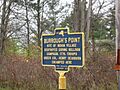
A historic marker for Burroughs Point.
-
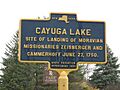
A historic marker for Cayuga Lake.
-
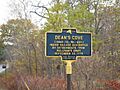
A historic marker for Dean's Cove.
-
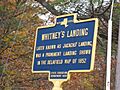
A historic marker for Whitney's Landing.
-
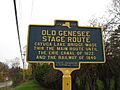
A historic marker for the Old Genesee Stage Route.
-
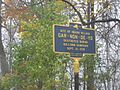
A historic marker for Gar-Non-De-Yo.
-
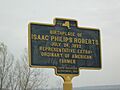
A historic marker for Isaac Philips Roberts.
-
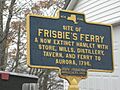
A historic marker for Frisbie's Ferry.
-
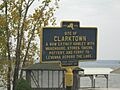
A historic marker for the Site of Clarktown.


See also
