
Major Oak facts for kids
Quick facts for kids Major Oak |
|
|---|---|

The Major Oak, c. 1890, a famous tree that sadly died in June 2026.
|
|
| Species | English oak (Quercus robur) |
| Location | Sherwood Forest, Nottinghamshire, England |
| Coordinates | 53°12′16.70″N 1°4′20.80″W / 53.2046389°N 1.0724444°W |
| Custodian | Royal Society for the Protection of Birds |
The Major Oak was a very large English oak tree (Quercus robur). It stood near Edwinstowe, in the heart of Sherwood Forest, Nottinghamshire, England. Experts believed it was between 800 and 1,200 years old. It weighed about 23 long tons (23 t) and once had a wide canopy of 92 feet (28 m). Local stories say that the legendary Robin Hood and his Merry Men used this tree as a hiding place.
In June 2026, the RSPB, which looks after Sherwood Forest, announced that the Major Oak had died. It failed to grow any leaves that year. This sad event was caused by many years of hot, dry summers. Other factors included soil becoming too hard around its roots and changes in the underground water. Even some of the ways people tried to save it contributed to its decline.
Contents
About the Major Oak
A Giant Among Trees
The Major Oak was truly a giant among trees. It weighed around 23 long tons (23 t), which is like 23 small cars! Its trunk had a huge girth of 33 feet (10 m). At its biggest, its branches spread out to create a canopy 92 feet (28 m) wide. People believed this amazing tree lived for 800 to 1,200 years.
How It Got Its Name
This famous tree was first known as the Cockpen Tree. This name came from a local activity that used to happen beneath its branches. Later, it was renamed the Major Oak. This new name honored Major Hayman Rooke. He was a soldier and a historian who wrote about the tree in 1790. He described it as a "majestic ruin" and thought it was at least a thousand years old.
A Tree Full of History

It's a bit of a mystery if the Major Oak was one single tree or several young trees that grew together. This might explain its unique and impressive shape. Many people considered it the second-largest oak tree in the UK. Only the Majesty Oak in Kent was thought to be bigger.
Robin Hood's Shelter
For a very long time, local stories connected the Major Oak to the famous outlaw Robin Hood. People said that Robin Hood and his group, the Merry Men, found shelter under its huge branches. It was a perfect hiding spot in the middle of Sherwood Forest.
Protecting a Legend
Major Hayman Rooke was the first to officially write about the tree in 1790. To help support its massive branches, chains were added in 1908. Later, in the 1970s, a special system of scaffolding was put in place. In 1974, fences were built around the tree. These fences helped protect its roots from too many visitors walking on the soil, which made it too hard.
Famous Visitors and Recognition
Around 1912, Emmeline Pankhurst and about 30 other suffragettes reportedly climbed inside the tree. Suffragettes were women who fought for the right to vote. During World War II, the Major Oak was even a symbol for the British Army's 46th Infantry Division.
In 2002, people voted the Major Oak "Britain's favourite tree" in a public survey. In 2003, 260 young oak trees, called saplings, were grown from the Major Oak's acorns. These saplings were planted in Dorset for study and to become a public park. In 2013, some of these saplings were given to famous actors like Barney Harwood, Su Pollard, and David Hasselhoff.
The tree was voted "England's Tree of the Year" in 2014 by the Woodland Trust. It also appeared on a 2005 TV show called Seven Natural Wonders. About 350,000 people visited the Major Oak every year.
The End of an Era
Why the Major Oak Died
From 2022 onwards, the Major Oak began to struggle. It suffered from very hot summers and grew fewer and fewer leaves. The RSPB, who manage Sherwood Forest, confirmed its death in June 2026. The tree had been under a lot of stress from several hot, dry summers. This caused it to stop producing leaves entirely.
The RSPB explained that the scaffolding, meant to help, actually hurt the tree. It made the tree send water to its propped-up branches instead of its main trunk. This stopped the tree from naturally shedding old branches and "growing down" as old trees often do. Other problems included the soil around its roots becoming too hard from centuries of visitors. Changes to the underground water levels from nearby coal mining also played a part.
The Major Oak is in a special protected area called a Site of Special Scientific Interest. It remains standing as a monument, rather than being cut down.
Images for kids
-
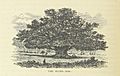
Illustration in The Illustrated Guide to Sheffield and the Surrounding District, Etc., by John Taylor of Sheffield (1879)
-
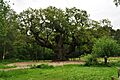
The Major Oak with the support system in place, June 2014
-
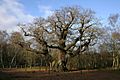
The Major Oak in December 2006
-
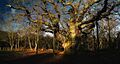
The Major Oak in 2013
-
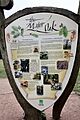
Major Oak information board, 2015
-
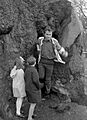
The Major Oak "entrance", May 1972
-
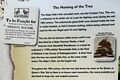
Naming of the tree
-
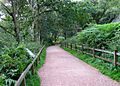
Path towards the Major Oak, 2012
-
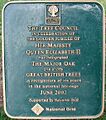
Designated as a Great British Tree

.jpg)


See also
 In Spanish: Major Oak para niños
- List of Great British Trees
- List of individual trees
- Sycamore Gap tree, also known as "Robin Hood tree"
