
Malleus facts for kids
| Bone: Malleus'' | ||
|---|---|---|
 |
||
| Left malleus. A. From behind. B. From within. | ||
 |
||
| The right eardrum with the hammer and the chorda tympani, viewed from within, from behind, and from above (malleus visible at center) | ||
| Latin | malleus | |
| Precursor | First branchial arch | |
The malleus, also known as the hammer bone, is a tiny, hammer-shaped bone found in your middle ear. It's one of three small bones called ossicles that help you hear. The malleus connects to your incus (another tiny ear bone) and is attached to the inside of your eardrum. Its name comes from Latin, meaning 'hammer'. This amazing little bone helps pass sound vibrations from your eardrum to the incus, starting the journey of sound to your brain!
Contents
How Your Hammer Bone is Built
The malleus is the first of three tiny bones in your middle ear. It is directly connected to your eardrum, also known as the tympanic membrane.
Parts of the Malleus
The malleus has several important parts:
- Head: This is the largest, rounded part at the top. It connects to the incus.
- Neck: A narrower section that connects the head to the handle.
- Handle (or Manubrium): This long, thin part attaches to the eardrum.
- Processes: These are small bumps that stick out from the bone. They help it connect to other parts of the ear.
The malleus is positioned so its head is at the top and its handle points downwards towards the eardrum.
How the Malleus Grows
During the early stages of development, the malleus forms from a special structure. This is called the first pharyngeal arch. It grows from a part known as Meckel's cartilage. This is the same area that also helps form the incus.
How the Malleus Helps You Hear
The malleus is super important for your hearing! It is one of the three ossicles in your middle ear. These three bones work together like a team. 1. When sound waves hit your eardrum, it vibrates. 2. The malleus, being attached to the eardrum, picks up these vibrations. 3. It then passes these vibrations along to the next tiny bone, the incus. This chain reaction helps send sound signals deeper into your ear. Eventually, these signals reach your brain so you can understand what you hear!
Keeping Your Malleus Healthy
Sometimes, doctors might need to examine the malleus during ear surgery. This is part of a special field called Otorhinolaryngology. This field focuses on the ear, nose, and throat. Occasionally, the malleus can become stuck in place. If this happens, it can make it harder to hear. Luckily, doctors can often fix this with more surgery. This helps to restore hearing.
Who Discovered the Malleus?
Many people believe that the anatomist and philosopher Alessandro Achillini was the first to discover the malleus. The first short written description of this bone appeared in 1521. It was written by Berengario da Carpi in his book Commentaria super anatomia Mundini. Later, Niccolo Massa described the malleus in more detail. This was in his book Liber introductorius anatomiae. He even compared the malleus and the incus to small hammers. He called them malleoli.
The Malleus in Other Animals
Did you know the malleus is only found in mammals? It has a fascinating history! Over millions of years, the malleus evolved from a bone. This bone was once part of the lower jaw in ancient animals called amniotes. This jaw bone, called the articular, still forms part of the jaw joint in animals like reptiles and birds today. This shows how different parts of animals can change and adapt over time!
Images for kids
-
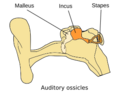
Ossicles
-
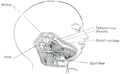
Head and neck of a human embryo eighteen weeks old, with Meckel's cartilage and hyoid bone exposed.
-
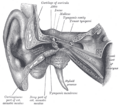
External and middle ear, opened from the front. Right side.
-
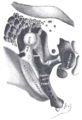
Chain of ossicles and their ligaments, seen from the front in a vertical, transverse section of the tympanum.
-
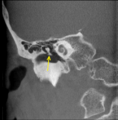
CT image of malleus
-
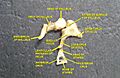
Auditory ossicles. Tympanic cavity. Deep dissection.
-
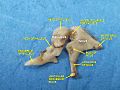
Auditory ossicles. Incus and malleus. Deep dissection.


See also
- Evolution of mammalian auditory ossicles
