
Malagasy mountain mouse facts for kids
Quick facts for kids Malagasy mountain mouse |
|
|---|---|
| Conservation status | |
| Scientific classification | |
| Genus: |
Monticolomys
|
| Species: |
koopmani
|
 |
|
| Known collection localities of Monticolomys koopmani | |
The Malagasy mountain mouse (Monticolomys koopmani) is a small rodent that lives only on the island of Madagascar. It's part of a group of rodents called Nesomyinae. This mouse is the only species in its genus Monticolomys. It is closely related to the big-footed mouse (Macrotarsomys).
You can find this mouse in the high mountain areas of eastern Madagascar. It's a small, mouse-like animal with dark brown fur on its back and dark gray fur underneath. It has small, round, furry ears and wide feet with good pads. Its long tail does not have a tuft of hair at the end.
Scientists first collected a Malagasy mountain mouse in 1929. But they didn't officially describe it until 1996. Now, we know it lives in many places. It is active at night and lives in both mountain forests and grassy areas changed by people. It eats fruits and seeds. This animal can climb trees but also lives on the ground. Even though its home is sometimes destroyed, it is listed as "Least Concern" on the IUCN Red List. This means it's not currently in danger of disappearing.
Contents
Discovering the Malagasy Mountain Mouse
A Malagasy mountain mouse was first found in 1929. This happened during a special trip to Madagascar by French, British, and American scientists. But the rodents they found were not studied in detail for a long time.
In the 1970s, two scientists named Karl Koopman and Guy Musser realized this animal was a new species. One part of the animal (its skin) was at a museum in New York. The other part (its skull) was in Paris. But Koopman and Musser never published their findings.
Then, in 1993, Steven Goodman found the species again in Madagascar. In 1996, he and Michael Carleton finally wrote an official description. They named the animal Monticolomys koopmani. It was the only member of a new genus. The name Monticolomys means "mountain-dwelling mouse." This refers to where it lives. The name koopmani honors Karl Koopman for his work with mammals. People also call it "Koopman's montane voalavo" or "Malagasy mountain mouse."
Family Tree of the Malagasy Mountain Mouse
The native rodents of Madagascar are called Nesomyinae. Before Monticolomys was found, there were seven very different groups of these rodents. They were so different that some people wondered if they were truly related.
But Monticolomys is different. It looks and is closely related to the Macrotarsomys genus. This group of mice lives in western Madagascar. Scientists Goodman and Carleton first thought they were related based on how they looked. Later, a DNA sequence study in 1999 strongly supported this idea. This study looked at a specific gene called cytochrome b.
What Does the Malagasy Mountain Mouse Look Like?
The Malagasy mountain mouse is a small, mouse-like rodent. It looks quite different from most other Nesomyinae. It has thick, soft fur. The fur on its back looks dark brown. The individual hairs are gray at the bottom, yellowish in the middle, and dark brown or black at the tip. Longer, completely black hairs are found mostly in the middle of its back.
The fur on its belly looks dark gray. It doesn't have a sharp line between the dark fur on its back and the gray fur on its belly. The hairs on its belly are also gray at the bottom. But their tips can be white or yellowish-brown. Its whiskers above its mouth are medium-sized. The mouse has short, round ears covered with grayish hairs.
Feet and Tail
Monticolomys has wide back feet. These feet have clear pads and long outer toes. There are white hairs on the top of its feet and toes. It also has long tufts of hair around the bases of its claws. The thumb on its front feet has a nail, but its other fingers have claws.
Its long tail is covered with small scales and light brown hairs. The tail does not have a distinct tuft of hair at the tip. Some other related mice, like Eliurus and Macrotarsomys, do have tail tufts.
Size of the Malagasy Mountain Mouse
- Head and body length: 84 to 101 millimeters (3.3 to 4.0 inches)
- Tail length: 116 to 143 millimeters (4.6 to 5.6 inches)
- Hindfoot length: 23 to 25 millimeters (0.9 to 1.0 inches)
- Ear length: 15 to 20 millimeters (0.6 to 0.8 inches)
- Body mass (weight): 18.5 to 27.5 grams (0.65 to 0.97 ounces)
Skull and Teeth
The skull of the Malagasy mountain mouse is small and delicate. The front part of its skull, called the rostrum, is narrow and long. The bones at the front of its nose are rounded at the front.
Its teeth are low-crowned and have clear points called cusps. The second molars are smaller than the first ones but look similar. The third molars are much smaller and look more different from the first molars. The molars do not have extra ridges. Each upper molar has three roots, and each lower molar has two roots. The molars are very similar to those of Macrotarsomys.
Where the Malagasy Mountain Mouse Lives and What It Does
The Malagasy mountain mouse lives in the mountain ranges of eastern Madagascar. You can find it from the Tsaratanana Massif in the north all the way south to Andohahela. It lives at heights from 800 to 2,200 meters (2,600 to 7,200 feet) above sea level.
It lives in montane forest (mountain forests). But it also lives in grasslands that have been changed by people. It is one of the first animals to return to these areas after fires. At a place called Ankaratra, this mouse was found in a heavily disturbed forest in 1996. It lived there with other mice and the introduced black rat.
At Andringitra, the mouse was found in high mountain forests. It lived with six other types of native rodents and the black rat. At Andohahela, Monticolomys was found in a type of forest called sclerophyllous forest. This mouse looks the same across its wide range.
Daily Life and Diet
The Malagasy mountain mouse is active at night (nocturnal). It lives alone. Females can have up to three babies at a time. This mouse is scansorial. This means it spends time both on the ground and climbing in plants.
In Andringitra, two mice were caught climbing on a vine 2 meters (6.6 feet) above the ground. Another mouse was caught on the ground. All five mice found at Andohahela were caught on the ground. The mouse caught in Ankaratra in 1996 was also found on the ground. Its diet includes fruits and seeds. When kept in captivity, it eats Agarista fruits.
Protecting the Malagasy Mountain Mouse
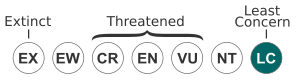
The Malagasy mountain mouse is now known to be a widespread and common species. It lives in at least one protected area, Andringitra National Park. It might also live in Ankarana Special Reserve. Because of this, it is listed as "Least Concern" on the IUCN Red List. This means it is not currently at high risk of extinction.
However, fires are a danger in mountain forests. Also, at lower elevations, its home is being turned into farmland. These activities could threaten the mouse in the future.
