
Moons of Pluto facts for kids

Pluto is a dwarf planet in our Solar System. It has five known moons. These moons orbit Pluto like a small family. They are named after figures from Greek and Roman mythology.
The moons are, in order from closest to farthest from Pluto: Charon, Styx, Nix, Kerberos, and Hydra. Charon is the biggest moon. It is so large that Pluto and Charon sometimes act like a double dwarf planet. They are also "tidally locked," meaning they always show the same face to each other.
Contents
- Pluto's Moons: A Family Portrait
- Images for kids
- See also
Pluto's Moons: A Family Portrait
Discovering Pluto's Companions

The largest moon, Charon, was found by James Christy on June 22, 1978. This was almost 50 years after Pluto itself was discovered. Finding Charon helped scientists better understand Pluto's true size. Before, they thought all the light and mass came from Pluto alone.
Two more moons were seen on May 15, 2005. Astronomers used the Hubble Space Telescope to find them. These moons were later named Nix and Hydra by the International Astronomical Union on June 21, 2006. Nix was the inner moon, and Hydra was the outer one.
Scientists found Kerberos on July 20, 2011. They were looking for rings around Pluto at the time. Styx was discovered on July 7, 2012. This discovery helped the New Horizons mission avoid any potential dangers.
Charon: Pluto's Big Partner
Charon is about half the size of Pluto. It is also quite heavy, almost one-eighth of Pluto's mass. Because of this, the center of their orbit is actually between them. This point is about 960 kilometers (596 miles) above Pluto's surface.
Pluto and Charon are "tidally locked." This means they always show the same side to each other as they orbit. Imagine two dancers always facing each other! In 2006, there was a suggestion to call Pluto and Charon a "double planet." However, this idea was not approved. Like Pluto, Charon is almost perfectly round.

The Smaller Moons: Styx, Nix, Kerberos, and Hydra
Pluto's four smaller moons orbit much farther out than Charon. They are two to four times farther from Pluto than Charon is. Styx is the closest of these, at 42,700 kilometers (26,532 miles). Hydra is the farthest, at 64,800 kilometers (40,264 miles).
These moons travel in nearly circular paths. They also orbit in the same direction and flat plane as Charon. All four are much smaller than Charon. Nix and Hydra are the largest of these, about 42 and 55 kilometers (26 and 34 miles) long. Styx and Kerberos are even smaller, about 7 and 12 kilometers (4 and 7 miles) long. All four have irregular, lumpy shapes.
How They Orbit and Look
Pluto's moon system is quite crowded close to Pluto. Even though Pluto has a large area where moons could orbit, its known moons are all packed closely together. There isn't much space for other moons to have stable orbits in this area. The New Horizons spacecraft looked very carefully. It found no other moons larger than about 4.5 kilometers (2.8 miles) orbiting far from Pluto.
All the moons travel in nearly perfect circles. Their orbits are also almost perfectly flat, like beads on a string. Scientists wondered if Pluto might have rings, like Saturn. But careful checks by the Hubble Space Telescope and New Horizons showed no rings around Pluto. Sometimes, moons can influence each other's orbits in a special way. This is called "orbital resonance." Styx, Nix, and Hydra seem to be in a rhythmic dance together. Their orbital periods are linked in a predictable pattern. This means they pass each other in a regular, repeating sequence.
Spinning in Space
Before the New Horizons mission, scientists thought the small moons might spin in a very unpredictable way. This is called "chaotic rotation" or "tumbling." Imagine a ball spinning wildly in all directions.
However, New Horizons images showed something different. The moons were not spinning chaotically. All four moons were found to be tilted quite a bit. They might have been born that way, or something might have tipped them over. Styx might still have some unpredictable wobbles in its tilt.
One scientist, Mark R. Showalter, joked about Nix. He said, "Nix can flip its entire pole." He added, "It could actually be possible to spend a day on Nix in which the sun rises in the east and sets in the north." This shows how unusual its rotation can be. Only one other moon, Saturn's moon Hyperion, is known to tumble like this.
How Pluto's Moons Formed
Scientists believe Pluto's moons were created by a huge collision. This would have been similar to the impact that formed our own Moon. A large object likely crashed into Pluto long ago. This crash would have sent a lot of material into space around Pluto.
This material then came together to form Charon and the other moons. The nearly circular orbits of the smaller moons support this idea. It suggests they formed from this debris, rather than being captured later. Their gray color is different from Pluto's reddish surface. This might be because the impact caused them to lose some icy materials.
Another idea suggests the collision was not strong enough to destroy Pluto and Charon. Instead, they might have stayed connected for hours before separating. Pluto's faster spin back then could have helped Charon break away. This process might also have created the four smaller moons.
A Closer Look at Each Moon
Here is a list of Pluto's moons, ordered by how long it takes them to orbit Pluto. Charon is highlighted because it is large enough to be round. All measurements are based on the center of the Pluto-Charon system. The average distance between Pluto and Charon's centers is 19,596 kilometers (12,176 miles).
| Label |
Name (pronunciation) |
Named after | Image | Diameter (km) |
Mass (×1019 kg) | Semi-major axis (km) |
Orbital period (days) |
Orbital resonance (relative to Charon) |
Eccentricity | Inclination (°) (to Pluto's equator) |
Visual magnitude (mean) |
Discovery year |
|
|---|---|---|---|---|---|---|---|---|---|---|---|---|---|
| Pluto | Pluto, Roman god of the underworld |
.jpg) |
2376.6±3.2 | 1305±7 | 2035 | 6.38723 | 1 : 1 | 0.0022 | 0.001 | 15.1 | 1930 | ||
| I | Charon | Charon, ferryman of the underworld in Greek mythology |
 |
1212±1 | 158.7±1.5 | 17536±3 | 6.38723 | 1 : 1 | 0.0022 | 0.080 | 16.8 | 1978 | |
| V | Styx | The mythical river Styx and its eponymous goddess | .jpg) |
16 × 9 × 8 | 0.00075 | 42656±78 | 20.16155 | 1 : 3.16 | 0.00579 | 0.81±0.16 | 27 | 2012 | |
| II | Nix | Egyptian spelling of Nyx, goddess of the night in Greek mythology |  |
49.8 × 33.2 × 31.1 | 0.005±0.004 | 48694±3 | 24.85463 | 1 : 3.89 | 0.00204 | 0.133±0.008 | 23.7 | 2005 | |
| IV | Kerberos | Greek spelling of Cerberus, the many-headed dog who guards the Greek underworld | .jpg) |
19 × 10 × 9 | 0.0016±0.0009 | 57783±19 | 32.16756 | 1 : 5.04 | 0.00328 | 0.389±0.037 | 26 | 2011 | |
| III | Hydra | The Hydra, the many-headed serpent who guards the Greek underworld |
 |
50.9 × 36.1 × 30.9 | 0.005±0.004 | 64738±3 | 38.20177 | 1 : 5.98 | 0.00586 | 0.242±0.005 | 23.3 | 2005 | |
Scale model of the Pluto system

Eclipses and Transits: Views from Pluto
Imagine standing on Pluto! Charon would look huge in the sky. It would appear about eight times wider than our Moon looks from Earth. This means Charon can cause big solar eclipses on Pluto. Because Pluto and Charon are tidally locked, only the side of Pluto that always faces Charon gets to see these eclipses.
The smaller moons also cast shadows. Nix and Hydra are big enough to cause total solar eclipses on Pluto too. Styx and Kerberos are oddly shaped. This makes their eclipses more complex. Styx can cause total eclipses, but Kerberos usually only causes partial ones.
The next time Charon will cause many eclipses will be from October 2103 to January 2117. During this time, solar eclipses will happen once every Pluto day. Each eclipse could last up to 90 minutes.
Visiting Pluto's Moons: The New Horizons Mission
The New Horizons spacecraft flew past the Pluto system in July 2015. It sent back amazing pictures of Pluto and its moons. We got very detailed images of Nix and Hydra. We also received lower-resolution pictures of Styx and Kerberos. These images helped us learn so much about these distant worlds.
Images for kids
-
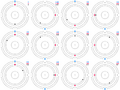
Configurations of Hydra (blue), Nix (red) and Styx (black) over one quarter of the cycle of their mutual orbital resonance. Movements are counterclockwise and orbits completed are tallied at upper right of diagrams (click on image to see the complete cycle).
-
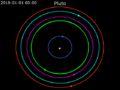
Animation of moons of Pluto. Front view
-
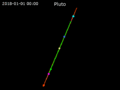
Animation of moons of Pluto. Side view
-
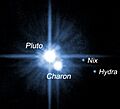
The Hubble discovery image of Nix and Hydra
-
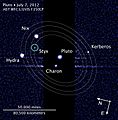
Discovery image of Styx, overlaid with orbits of the satellite system
-
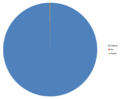
The relative masses of Pluto's moons. Charon dominates the system. Nix and Hydra are barely visible and Styx and Kerberos are invisible at this scale.
-
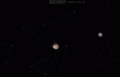
An oblique schematic view of the Pluto–Charon system showing that Pluto orbits a point outside itself. Also visible is the mutual tidal locking between the two bodies.
-
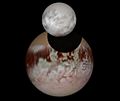
Simulated view of Charon transiting Pluto on 25 February 1989


See also
 In Spanish: Satélites de Plutón para niños
