
Orange-necked partridge facts for kids
Quick facts for kids Orange-necked partridge |
|
|---|---|
 |
|
| Conservation status | |
Scientific classification  |
|
| Kingdom: | Animalia |
| Phylum: | Chordata |
| Class: | Aves |
| Order: | Galliformes |
| Family: | Phasianidae |
| Genus: | Arborophila |
| Species: |
A. davidi
|
| Binomial name | |
| Arborophila davidi Delacour, 1927
|
|
| Script error: The function "autoWithCaption" does not exist. | |
Script error: No such module "Check for conflicting parameters".
The orange-necked partridge (Arborophila davidi) is a special type of bird. It belongs to the pheasant family. You can find this bird in the forests of eastern Cambodia and southern Vietnam. It likes to live in lowland forests, bushy areas, and even some plantations.
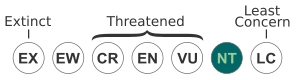
This bird was first discovered in 1927. Then, for many years, people didn't see it! It was "lost" until it was found again in 1991. Sadly, the orange-necked partridge is facing threats like losing its home. Because of this, the International Union for Conservation of Nature (IUCN) says it is a "near-threatened" species. This means it needs our help to survive.
Contents
About Its Name
This bird was first described by a person named Jean Théodore Delacour in 1927. The partridge's scientific name, davidi, comes from André David-Beaulieu. He was a French leader who collected the first example of this bird in 1927. There are no different types or subspecies of the orange-necked partridge.
What Does It Look Like?
The orange-necked partridge is about 27 cm (11 in) long. That's about the length of a school ruler! It weighs around 241 g (8.5 oz), which is about the same as a can of soda.
Let's look at its colors:
- Its forehead and the top of its head are dark.
- The back of its neck is mottled brown, like a mix of shades.
- A black stripe goes from its beak to the sides of its neck.
- A whitish stripe goes from its eye to the sides of its neck, turning orange.
- It has a black band across its chest.
- Its chin is a pale, creamy color.
- Its throat is a rusty-orange color.
- The main part of its chest is olive-brown.
- Its belly is grayish and whitish.
- The sides of its body have cool black and white patterns, like scallops.
- Its back and rump are olive-brown with dark brown stripes.
- The feathers covering its wings have black and grey bands.
- Its eyes are brown, its beak is black, and its legs are pinkish.
Where Does It Live?
The orange-necked partridge lives in southern Vietnam. You can also find it in a small area in Mondulkiri, Cambodia. It prefers to live in forests on hills. These forests are usually between 120–600 m (390–1,970 ft) high. It especially likes areas with bamboo plants.
This bird can also live in places where the forest has been changed a bit. This includes bushy areas, bamboo patches, and even forests where trees have been cut down. In Vietnam, you can find it in several national parks. A survey in 2005 found that all the birds they saw lived close to water, less than 2 km (1.2 mi) away.
How Does It Behave?
We don't know a lot about how this partridge acts. But we do know about its calls!
- When it calls to mark its territory, it makes a repeated sound like prruu. This sound gets faster and then changes to a higher-pitched pwi.
- It also makes a series of fast tu notes.
- Sometimes, two birds will sing together in a duet. The other bird will respond with tchew-tchew-tchew.
- If it senses danger, its alarm call sounds like pher or phu.
Protecting This Bird
After it was first found in 1927, the orange-necked partridge seemed to disappear. It was "lost" until it was seen again in 1991 in Cát Tiên National Park. Since then, people have found it in many places in Vietnam. This might be because they have better ways to look for birds now.
The first time it was seen in Cambodia was in 2002. This was thanks to a camera trap! All the times it has been seen in Cambodia since then have been in the same spot.
The IUCN first said this bird was "critically endangered." This is the highest level of threat. Then, in 2000, they changed it to "endangered." In 2009, they changed it again to "near threatened." This means it's still at risk, but not as much as before. Scientists believe there are nearly 10,000 of these birds left.
The orange-necked partridge is still threatened by people cutting down trees and hunting. Its numbers are going down. However, the decline is not super fast. This is because the bird seems to be okay with some changes to its forest home. So, even though there aren't many of them and they live in a small area, they are listed as "near threatened."
In the year 2000, the orange-necked partridge was even featured on a national stamp in Vietnam!
