
Pasiphila bilineolata facts for kids
Quick facts for kids Pasiphila bilineolata |
|
|---|---|
 |
|
| Female specimen | |
 |
|
| Male specimen | |
Scientific classification  |
|
| Kingdom: | Animalia |
| Phylum: | Arthropoda |
| Class: | Insecta |
| Order: | Lepidoptera |
| Family: | Geometridae |
| Genus: | Pasiphila |
| Species: |
P. bilineolata
|
| Binomial name | |
| Pasiphila bilineolata (Walker, 1862)
|
|
| Script error: The function "autoWithCaption" does not exist. | |
| Synonyms | |
|
|
Script error: No such module "Check for conflicting parameters".
The Pasiphila bilineolata is a small, beautiful moth that lives only in New Zealand. This means it is endemic to New Zealand, and you won't find it naturally anywhere else in the world! It belongs to a group of moths called Geometridae. These moths are sometimes called "loopers" or "inchworms" because of how their caterpillars move.
What it Looks Like
This special moth has some very interesting features. Its front wings, called forewings, are a bright green color. They have many wavy lines that are a bit darker, making them look quite pretty.
The back wings, known as hindwings, are mostly grey. They might have a slight reddish tint, which adds to their unique look. These moths are usually active during the warmer months. You can often see the adult moths flying around from September all the way through to May.
Life and Habits
Like all moths, the Pasiphila bilineolata starts its life as a tiny egg. These eggs hatch into larvae, which are also known as caterpillars. These caterpillars are quite picky eaters! They especially love to munch on the flowers of Hebe plants. Hebe is a common type of shrub or small tree found in New Zealand.
After eating enough, the caterpillar will turn into a pupa. This is a resting stage where it transforms into an adult moth. Once the transformation is complete, a new adult moth emerges, ready to fly and continue the life cycle.
Images for kids
-
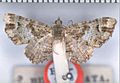
Holotype of Pasiphila bilineolata.
-
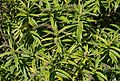
Larval host Veronica salicifolia.


