
Platymantis montanus facts for kids
Quick facts for kids Platymantis montanus |
|
|---|---|
| Conservation status | |
| Scientific classification | |
| Synonyms | |
|
Cornufer montanus Taylor, 1922 |
Platymantis montanus is a special kind of frog that belongs to the Ceratobatrachidae family. It's found only in one specific area: the southwestern part of Luzon, an island in the Philippines. This frog is known from places like Mount Banahaw and Mount Apoy.
Contents
What Does This Frog Look Like?
Adult male Platymantis montanus frogs are about 24–28 mm (0.9–1.1 in) long. Female frogs are a little bigger, measuring 26–29 mm (1.0–1.1 in) from their snout to their rear.
Their snout, which is like their nose area, is wide and rounded. They have clear eardrums, called a tympanum. Their finger pads are larger than their toe pads.
The toes of these frogs are webbed, helping them move around. Their fingers might also have some webbing at the base. Their back, or dorsum, is smooth and has a mix of gray and brown colors.
A wide, creamy yellow stripe runs down their back, from the tip of their snout all the way to their rear. Their legs have dull cream to white stripes. On their sides and near their hips, they have big, bright lemon-yellow spots. These spots are separated by thin brown lines. Their belly and chin are a pinkish-tan color, with brown spots.
Where Does This Frog Live and How Is It Protected?
Platymantis montanus is an arboreal species, meaning it lives in trees. You can find it in mossy and mountain rainforests. On Mount Banahaw, these frogs live at heights above 800 m (2,600 ft).
Life Cycle
These frogs lay their eggs in plants found in the shrub layer. They also use tree ferns, aerial ferns, and Pandanus plants for their eggs. What's cool is that their babies develop directly from the egg. This means they don't have a free-swimming tadpole stage like many other frogs.
Conservation
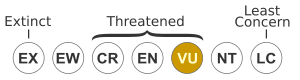
Platymantis montanus is very common on Mount Banahaw. It isn't facing immediate big threats. However, because it lives in such a small area, it is considered vulnerable. This frog lives inside the Mounts Banahaw–San Cristobal Protected Landscape. This protected area helps keep its home safe.
