
Purple-chested hummingbird facts for kids
Quick facts for kids Purple-chested hummingbird |
|
|---|---|
_(40281635472).jpg) |
|
| Conservation status | |
Scientific classification  |
|
| Kingdom: | Animalia |
| Phylum: | Chordata |
| Class: | Aves |
| Order: | Apodiformes |
| Family: | Trochilidae |
| Genus: | Polyerata |
| Species: |
P. rosenbergi
|
| Binomial name | |
| Polyerata rosenbergi Boucard, 1895
|
|
 |
|
| Script error: The function "autoWithCaption" does not exist. | |

Script error: No such module "Check for conflicting parameters".
The purple-chested hummingbird (Polyerata rosenbergi) is a small, colorful bird. It belongs to the hummingbird family, called Trochilidae. This special bird is known for its bright feathers.
You can find this hummingbird in two countries: Colombia and Ecuador. It lives in warm, wet places. These places include subtropical or tropical moist lowland forests. It can also be found in areas where forests used to be, but are now changed.
Contents
About the Purple-Chested Hummingbird
The purple-chested hummingbird is a beautiful creature. It gets its name from the shiny purple feathers on its chest. Like other hummingbirds, it has a long, thin beak. This beak helps it drink nectar from flowers. Hummingbirds are very fast flyers. They can even hover in one spot.
Where It Lives
This hummingbird makes its home in the northwestern part of South America. Specifically, it lives in parts of Colombia and Ecuador. It prefers forests that are low to the ground and very moist. These are often called lowland forests. It can also adapt to areas where forests have been cut down.
How Scientists Classify It
Scientists group living things into categories. This helps us understand how they are related. This is called Taxonomy. The purple-chested hummingbird was once in a group called Amazilia.
However, scientists used new methods to study these birds. They looked closely at their DNA. This research, done in 2014, showed that the Amazilia group was not quite right. It included birds that were not as closely related as once thought.
So, scientists decided to move the purple-chested hummingbird. It now belongs to an older group called Polyerata. This change helps make sure that each group contains only very closely related birds.
Its Conservation Status
The purple-chested hummingbird is currently listed as "Least Concern" (LC) by the IUCN. This means it is not in immediate danger of disappearing.
It is also listed under CITES Appendix II (CITES A2). CITES is an agreement that controls trade in wild animals and plants. Appendix II means that while the species is not threatened with extinction right now, its trade must be controlled. This helps make sure that using these birds does not become a threat to their future.
Images for kids
-
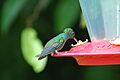
A purple-chested hummingbird resting.
-
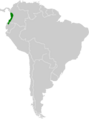
Map showing where the purple-chested hummingbird lives.
See also
 In Spanish: Amazilia del Chocó para niños
