
Rice-paddy eel facts for kids
Quick facts for kids Rice-paddy eel |
|
|---|---|
 |
|
| Conservation status | |
Scientific classification  |
|
| Kingdom: | Animalia |
| Phylum: | Chordata |
| Class: | Actinopterygii |
| Order: | Anguilliformes |
| Family: | Ophichthidae |
| Genus: | Pisodonophis |
| Species: |
P. boro
|
| Binomial name | |
| Pisodonophis boro (Hamilton, 1822)
|
|
| Script error: The function "autoWithCaption" does not exist. | |
| Synonyms | |
|
|

Script error: No such module "Check for conflicting parameters".
The rice-paddy eel (Pisodonophis boro) is a type of eel that looks a bit like a snake. It belongs to a family of eels called Ophichthidae, which are also known as worm-snake eels. This interesting creature was first described by a scientist named Francis Buchanan-Hamilton in 1822.
Contents
What is the Rice-Paddy Eel?
The rice-paddy eel is a fish that lives in warm, tropical waters. It can be found in many places across the Indo-West Pacific region. This includes countries like India, Australia, China, and many others.
Where Does It Live?
This eel is quite special because it can live in both fresh and salty water. It often lives in rice paddies during the rainy season, which is how it got its common name. It also likes to spend time in lagoons, estuaries (where rivers meet the sea), and coastal rivers. The eel makes its home by digging burrows in the mud at the bottom of these waters.
How Big Do They Get?
Male rice-paddy eels can grow up to 100 centimetres (about 3.3 feet) long. However, most of them are usually around 70 centimetres (about 2.3 feet) long.
Life Cycle and Habits
The rice-paddy eel has an interesting life cycle. It is an anadromous species. This means it lives mostly in saltwater but travels to freshwater to lay its eggs. This often happens in rice paddies when there is a lot of rain.
What Do They Eat?
The rice-paddy eel is a nocturnal animal, meaning it is most active at night. It hunts for its food in the dark. Its diet mainly consists of small bony fish and crabs.
Is It Endangered?
The IUCN redlist is a group that checks on how many animals are left in the wild. They currently list the rice-paddy eel as "Least Concern." This means there are still plenty of them around, even though they are spread out. However, the IUCN notes that pollution from farms can be a problem for these eels.
Images for kids
-
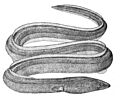
A rice-paddy eel in its natural habitat.
