
Second Street Cable Railway facts for kids
The Second Street Cable Railway was the first cable car system to open in Los Angeles. It started running in 1885. This railway went from Second and Spring Streets all the way to First Street and Belmont Avenue.
The entire railway was about 6,940 feet long, which is a bit more than a mile and a quarter. It had a power station built in the middle, at Boylston Street. This was a single-track system. It had special spots called "sidings" where a car going downhill could pass a car going uphill.
The route included the steepest hill on any street railway in North America! This was a very steep 27.7-degree hill along Second Street between Bunker Hill Avenue and Hope Street on Bunker Hill. The line first opened to Texas Street on October 8, 1885.
Contents
Why Was the Railway Built?
The railway was built to help sell land west of downtown Los Angeles. This area was known as Crown Hill. Henry Witmer, E.A. Hall, and Jesse Yarnell owned this land. They created the Los Angeles Improvement Company. Their plan was to divide the land into 1,400 lots and build the cable railway. This railway would connect the new lots to downtown Los Angeles.
Other important people also supported the project. These included downtown business owners like Isaac W. Lord and John Hollenbeck. They owned land close to where the railway started, at Second and Spring Streets.
Fun Spot to Attract Riders
To get more people to ride the cable car, a fun place was built. It was a beer garden resort called City Park. This park was located at the northeast corner of First and Lakeshore.
A Change in Ownership
In January 1888, a man named James McLaughlin bought the railway and the City Park. He paid $130,000 for them. This turned out to be a very bad decision for him.
By the spring of 1888, fewer people wanted to buy land lots. However, the Improvement Company had already sold almost all of its 1,400 lots. Also, John Hollenbeck had made his Hollenbeck Hotel bigger at Second and Spring. Henry Witmer and his friends had built the California Bank. The city had also built a new City Hall nearby.
Problems and Closure
The railway often had problems with its cables and pulleys. Flooding caused a lot of damage. In the winter of 1888, the railway had to close for several days. This happened because a broken cable needed to be replaced, but the muddy streets made it impossible to deliver a new one.
In March 1889, an agreement was made with McLaughlin's Cahuenga Valley Railroad. This other railway served a new area called Colegrove, near Hollywood. The idea was that people could transfer between the two railways at First and Belmont. This would allow passengers to travel from downtown all the way to Colegrove.
However, in late summer 1889, the Cahuenga Valley Railroad was stopped from operating inside Los Angeles city limits. On October 13, McLaughlin stopped the cable car operations "indefinitely." He tried to get permission to extend the railway, but the city council said no.
On December 24 of that year, another flood caused even more damage to the line. Because of all these problems, the Second Street Cable Railway was completely shut down in 1890. It became the first cable railway in the United States to go out of business.
Images for kids
-
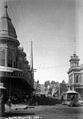
View west on 2nd at Spring, with a cable car of the 2nd St. Cable Railway. Coulter's in the Hollenbeck Block (left) when it was only two stories tall; 2nd City Hall (right), 1886
,_2nd_City_Hall_(right),_1886.jpg)
