
Shanu Lahiri facts for kids
Quick facts for kids
Shanu Lahiri
|
|
|---|---|
 |
|
| Born |
Shanu Mazumdar
23 January 1928 |
| Died | 1 February 2013 (aged 85) Kolkata, India
|
| Nationality | Indian |
| Education | Government College of Art & Craft, Kolkata. Académie Julian & École du Louvre, Paris |
| Occupation | Painter, art educator |
| Known for | Public art and graffiti art in Kolkata |
Shanu Lahiri (born January 23, 1928 – died February 1, 2013) was a famous painter and art teacher from Kolkata, India. She came from a very artistic and well-known family. Shanu Lahiri was one of the first modern artists in India after the country became independent.
She was also known as "the city's First Lady of Public Art." This is because she led many projects to paint murals and graffiti art across Kolkata. Her goal was to make the city more beautiful and cover up political messages on walls. You can find her paintings in important museums like the Salar Jung Museum and the National Gallery of Modern Art.
Contents
Shanu Lahiri's Early Life and School
Shanu Lahiri was born on January 23, 1928, in Calcutta (now Kolkata). She grew up in the Mazumdar family, which was famous for its artists. Her mother, Renukamoyee Mazumdar, loved to practice calligraphy at night, even though she couldn't read or write.
Shanu had two older brothers who were also very talented. One was Kamal Kumar Majumdar, a well-known writer. The other was Nirode Mazumdar, a great artist and one of the founders of "The Calcutta Group." Growing up, Shanu was surrounded by creativity. She later wrote about how this artistic environment shaped her.
Studying Art in India
Shanu Lahiri went to the Government College of Art & Craft in Calcutta. She was one of the first female students to join the college right after India gained independence in 1947. She learned from famous teachers like Atul Bose and Ramendranath Chakraborty.
She became a very skilled artist, especially in drawing. In 1951, she graduated and won a special gold medal for her amazing art. This was a big achievement for an undergraduate student. In 1955, she bravely held her first solo art show. Her paintings were displayed next to works by two senior artists, Gaitonde and Gade.
Studying Art in Paris
In 1956, Shanu Lahiri received a scholarship from the French Government. This allowed her to study art in Paris for two years, from 1956 to 1958. She studied art history at the École du Louvre and painting at the Académie Julian.
This experience in Paris was very important for her. It helped her move beyond the traditional art training she received in India. She was able to explore new styles and ideas from international art movements.
Her Artistic Style and Career

Shanu Lahiri started her art career when India was newly independent. She wanted to create new, modern art. Her time in Paris greatly influenced her. She learned from famous European artists like Picasso and Matisse.
Her unique style became well-known. She often painted human figures in a special way, using bold lines and bright colors. From the 1980s, her paintings became very large, almost like murals. She used her art to talk about social issues. While she often painted people, she also included animals in her works. Her first art exhibition was in 1950, and she had many more after that.
Teaching Art and Public Role
After returning from Paris, Shanu Lahiri held many art shows in India and other countries. In the late 1970s, she became a teacher at Rabindra Bharati University. She later became the dean of the visual arts department.
At the university, she encouraged students to study and copy the works of Rabindranath Tagore. She believed this would help them understand his style better. This idea was new and received some criticism.
In the 1980s, Shanu Lahiri became very active in public life. She was an educator, organizer, and art activist. She even designed the Durga idol for the Bakulbagan festival twice. This was a tradition started by her brother, Nirode Mazumdar, where artists created modern versions of the goddess.
In her later years, in the 1990s and 2000s, Shanu Lahiri continued to experiment. She tried new materials like enamel on acrylic sheets, painting on wood and ceramic, and etchings on X-ray plates. She also started making sculptures. Through all her art, Shanu Lahiri showed the real-life issues of society. She became a leading artist in Kolkata.
"The Group" of Women Artists
After World War II, many artist groups formed in India. However, women artists were often left out of these groups. In 1983, a special group called "The Group" was formed in Kolkata. It was made up of five women artists: Karuna Shaha, Shanu Lahiri, Meera Mukherjee, Santosh Rohatgi, and Shyamasree Basu.
This group faced some criticism for being only women. But the artists believed it was important to have a place where women artists could be taken seriously. They wanted to fight for equal chances in the art world. "The Group" held annual exhibitions at The Academy of Fine Arts. Their shows also traveled to New Delhi and Bombay, helping them reach more people.
Books and Writings
While working at Rabindra Bharati University, Shanu Lahiri studied the art of Rabindranath Tagore closely. She felt that when she read Tagore's poems, she saw pictures, but his paintings didn't always give her a lyrical feeling. This led her to write a book called Rabindra Chitra Chetana. This book shares her thoughts on Tagore's art.
In 2001, she published her autobiography, Smritir Collage (A Collage of Memories). In this book, she wrote about her childhood and growing up in her artistic family. To celebrate the book, she also held an exhibition of her brothers' works and other family members. She also wrote short stories about the animals around her family, which were collected in a book called Edo Goli Theke Beni Madhav.
Shanu Lahiri was also known for her cooking. She loved to experiment in the kitchen. After she passed away, her daughter Damayanti Lahiri published a book called Tabled. It contains Shanu Lahiri's recipes, paintings, and drawings. The book shows how she used both her artistic and cooking skills with joy. She also wrote poems under the name Hasna Banu.
Public Art Projects

Shanu Lahiri was very involved in public art and graffiti art projects in Kolkata. In the 1980s, she started her "Love Calcutta Project." She encouraged street children and students to paint on the city's walls. Her goal was to make the city more beautiful. Before this, the city walls were often covered with political posters and aggressive messages.
In 1984, she gathered students from La Martiniere Calcutta to paint colorful murals on their school wall. This idea spread, and she worked on similar projects in other parts of the city. These included areas like Jadu Babu's Bazaar, the fish market at Sreebhumi, and Fort William. She also created a statue called Parama on the Kolkata Bypass, inspired by traditional Bengali dolls.
In the 1980s, she moved to the Lake Town area. There, she formed a local group called bhavana. This group helped clean up garbage and painted neighborhood walls with art. Shanu Lahiri even had her own food stall at the local Durga Puja festival, selling kebabs.
Sadly, many of her murals have faded or been destroyed over time. Even her famous Parama statue was taken down. This shows how public art can sometimes be forgotten. She also helped design sets for plays and theater companies.
Later Years and Her Impact

Shanu Lahiri continued to work on public art projects even when she was in her eighties. In 2010, she organized a project in Hyderabad. She brought together students, children with HIV, and children with disabilities. They painted murals on the walls of the Lakshman Bagh temple. This was part of Rabindranath Tagore's 150th birthday celebration. Even 25 years after she started, some of her public art was still visible in Kolkata.
Shanu Lahiri passed away in Kolkata on February 1, 2013. She chose to donate her eyes. She is remembered for her strong spirit and creativity. She was a pioneering woman artist who helped open doors for others.
Awards and Recognition
Shanu Lahiri received many awards for her contributions to art:
- 1951: Won the AIFACS President Award for best oil painting.
- 1974: Received the Governor of West Bengal's best award.
- 1996: Received an award from The Lalit Kala Akademi, New Delhi.
- 1999: Chosen as 'Shatabdir Kanya' (Woman of the Millennium) by Naba Pratisruti.
- 2000: Selected as the 'Woman of the Millennium' by Biswa Bangla Sammelan. She also received the Nivedita Puraskar.
- 2002: Received the Bharat Nirman Award.
- 2003: Rabindra Bharati University gave her a D.Litt. degree for her huge contributions to visual arts.
- 2005: Received the Lifetime Award from the Street Exhibition Forum and the Michael Madhusudan Award.
- 2008: The Calcutta Chamber of Commerce Foundation gave her the Prabha Khaitan Puraskar.
Images for kids
-
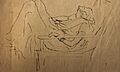
An early academic drawing by the artist from 1948

