
Siamese cat facts for kids
Quick facts for kids Siamese cat |
|
|---|---|

Lilac-point Siamese (Oriental)
|
|
| Common nicknames | Meezer, Mese, Sagwa = |
| Origin | Thailand |
| Domestic cat (Felis catus) | |
The Siamese cat (in Thai: Maeo Thai, Maeo Sayam, or Maeo Wichien Maat) is a very old and well-known type of cat from Asia. It comes from a natural group of cats called the Wichianmat in Thailand. Before 1939, Thailand was known as Siam. The Siamese cat was one of the first special cat breeds to become popular in Europe and North America in the 1800s.
Siamese cats are famous for their unique "colourpoint" coats. This means their fur is darker on cooler parts of their body. This special coloring happens because of a gene that is sensitive to temperature. They also have bright blue, almond-shaped eyes. Their heads are often triangular, with large ears. They have long, slender, and strong bodies.
There are two main styles of Siamese cats today. The "modern-style" Siamese has a very long, sleek body and a wedge-shaped head. The "old-style" Siamese has a rounder head and body. This older style is now often called the Thai cat. Both Siamese and Thai cats are carefully bred and have official family records. This means they are purebred cats with a known ancestry.
Siamese cats have also been used to create many other cat breeds. For example, they helped develop the Oriental Shorthair and Colourpoint Shorthair. These new breeds have even more coat patterns. When Siamese cats were bred with Persians, it led to the long-haired Himalayan. The long-haired Siamese itself is known as the Balinese cat. Siamese cats also played a role in creating breeds like the Cornish Rex, Sphynx, and Peterbald.
Contents
The Amazing Siamese Cat
A Look Back: Siamese History
From Ancient Thailand
The story of the Siamese cat begins in ancient Thailand. Descriptions and pictures of the Wichianmat (Siamese cat) are found in old books called the Tamra Maew. These "Cat-Book Poems" are believed to be from the Ayutthaya Kingdom, which existed from 1351 to 1767 AD. Many of these old manuscripts are now kept in the National Library of Thailand. Some have also been found in the British Library and the National Library of Australia.
There's a Thai legend about these cats. During a war in 1767, the Burmese army attacked the capital city. They took many treasures and people. A legend says that the King of Burma, Hsinbyushin, read a poem about Thai cats. The poem said these cats were as precious as gold. It also said that anyone who owned them would become rich. So, the king ordered his army to gather all the Suphalak cats and bring them back to Burma.
Arriving in the West
The unique "pointed" Siamese cat became known in the West for its special markings. These cats were first described in the "Tamra Maew" manuscripts, written between the 14th and 18th centuries. The first Siamese cat to reach the United States was named "Siam." It was sent from Bangkok to U.S. President Rutherford B. Hayes in 1878.
In 1884, Edward Blencowe Gould, a British official in Bangkok, brought a pair of Siamese cats, Pho and Mia, to Britain. He gave them as a gift to his sister, Lilian Jane Gould. Lilian later helped start the Siamese Cat Club in 1901. In 1885, Pho and Mia had three kittens: Duen Ngai, Kalohom, and Khromata. These kittens were shown with their parents at a big show in London. People were very interested in their unusual look and behavior. Sadly, all three kittens passed away soon after the show.
More Siamese cats were brought to the UK in 1886 by Eva Forestier Walker and her sister, Ada. These cats had long bodies, rounded heads with wedge-shaped muzzles, and large ears. Their unique coat pattern was new to Westerners. Over the next few years, more cats were imported. These cats became the starting point for all Siamese cats bred in Britain. Most Siamese cats in Britain today are thought to be related to about eleven of these first imports. In Britain, they were called the "Royal Cat of Siam." Some stories said they were only kept by Siamese royalty. However, research does not show proof of a royal breeding program in Siam.
-
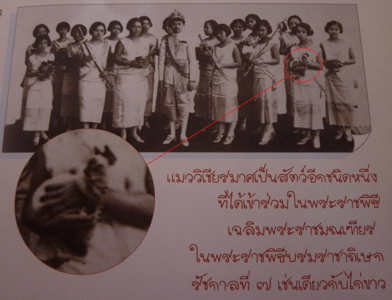
King Prajadhipok with a Thai cat after his coronation. The cat symbolizes "home life."
-
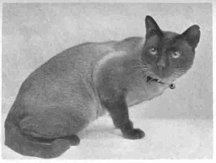
Wankee, born in 1895, was the first UK Siamese champion in 1898.
-
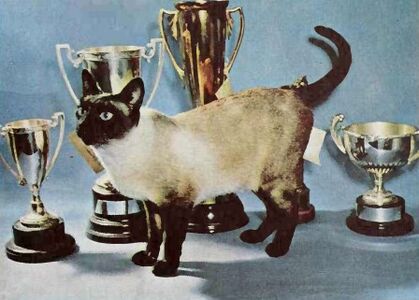
A show Siamese from 1960. It shows how the breed was starting to become more slender.
-
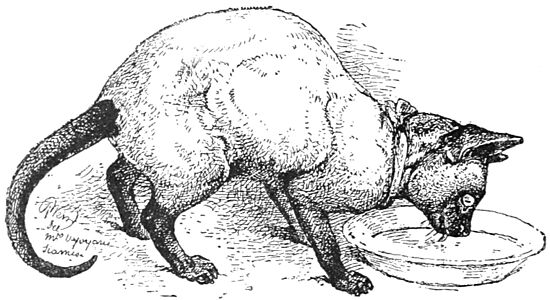
A classic seal point Siamese prize winner. Notice the darker colors on its face, ears, tail, and legs.


Old Style vs. Modern Look
In the 1950s and 1960s, Siamese cats became very popular. Many breeders and cat show judges started to prefer a more slender look. Through careful breeding over many years, breeders created cats that were longer, thinner, and had narrower heads. The modern show Siamese became very long and lean. It has a thin, tube-shaped body, long, slender legs, and a very long, thin tail. Its head is long and wedge-shaped, with very large, wide-set ears.
By the mid-1980s, the original, rounder style of Siamese cat was rarely seen at cat shows. However, some breeders, especially in the UK, continued to breed them. This led to the two types of Siamese we see today. There is the modern "show-style" Siamese and the "Traditional Siamese." Both come from the same distant ancestors. But they have few recent relatives in common and are almost like different sub-breeds.
Today, cat organizations like The International Cat Association (TICA) and the World Cat Federation (WCF) recognize the less extreme, traditional Siamese. Any wichianmat cat brought directly from Thailand can be registered under the new breed name Thai. Other names for the traditional type include "Old-style Siamese" and "Classic Siamese." In America, some call the traditional type "Applehead" Siamese.
-
Тайская кошка Синка Тайна Таун, WCF, окрас сил поинт.jpg
A traditional "applehead" Thai cat.
-
A classic seal point Siamese cat.jpg
A traditional seal point Thai cat.
-
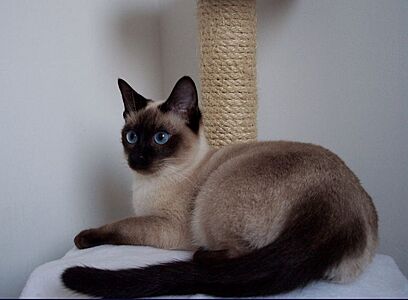
A traditional seal point Thai cat with a round head and strong body.
-
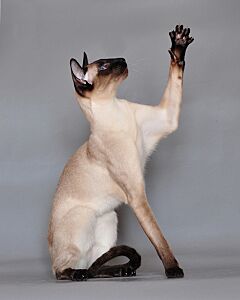
A modern seal point Siamese cat (side view) with a slim, "wedge head" and slender body.
-
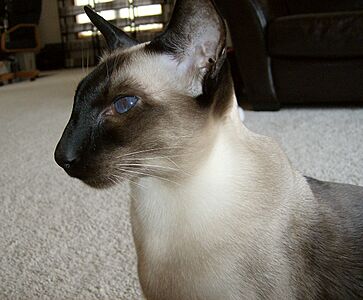
A modern "wedge head" seal point Siamese cat.
-
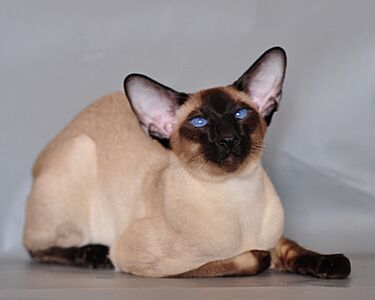
A modern seal point Siamese cat (front view) with very large, wide-set ears.


.JPG)

What Does a Siamese Cat Look Like?
Modern Siamese cats have a long, tube-shaped, and muscular body. Their head is triangular, forming a shape from the nose tip to each ear tip. Their eyes are almond-shaped and a bright light blue. The ears are large, wide at the base, and set towards the sides of the head. They have a long neck and a slender tail. Their fur is short, shiny, and fine, lying close to the body without a thick undercoat.
Their special pointed color and blue eyes set them apart from the Oriental Shorthair. The modern Siamese shares the pointed color with the Thai (traditional Siamese). However, their head and body shapes are different.
Their Special Coat Color
The pointed pattern on a Siamese cat is a type of partial albinism. This happens because of a change in a special enzyme called tyrosinase. This enzyme helps make melanin, which gives color to fur. The changed enzyme is sensitive to heat. It doesn't work well at normal body temperatures. But it becomes active in cooler areas of the skin.
This means the coolest parts of the cat's body get a dark color. These are usually the ears, face, paws, and tail. Siamese kittens are born cream or white. Their points start to show in the first few months as the cooler parts of their body develop color. By four weeks old, you can usually tell what color their points will be.
Siamese cats often get darker as they get older. Cats living in warm places usually have lighter coats than those in cool places. Originally, most Siamese cats had "seal points," which are very dark brown, almost black. But sometimes, kittens were born with "blue points" (a cool grey), "chocolate points" (lighter brown), or "lilac points" (pale warm grey). At first, these colors were not as popular. But over time, they were accepted and became more common through special breeding programs.
Later, by mixing with other breeds, Siamese-mix cats developed points in other colors and patterns. These include red and cream points, lynx (tabby) points, and tortoise-shell ("tortie") points.
In the United Kingdom, all pointed Siamese-style cats are considered part of the Siamese breed. However, the Cat Fanciers' Association only recognizes four original fur colors as true Siamese:
- seal point,
- blue point,
- chocolate point, and
- lilac point.
Other pointed cats are called Colourpoint Shorthair in that registry. The World Cat Federation also uses this idea, seeing the Colourpoint Shorthair as a separate breed.
Many Siamese cats from Thailand used to have a kink in their tails. But breeders have mostly removed this trait over the years. However, you can still see kinked tails on street cats in Thailand.
-
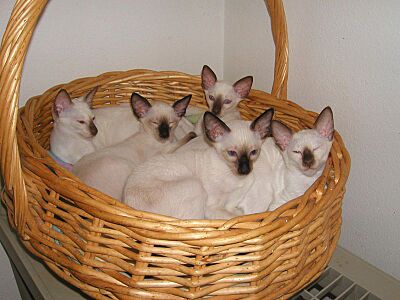
Seal point and chocolate point Siamese kittens.
-
Eson6sema.jpg
A blue point Siamese kitten.
-
Siam blue point.jpg
Another blue point Siamese kitten.
-
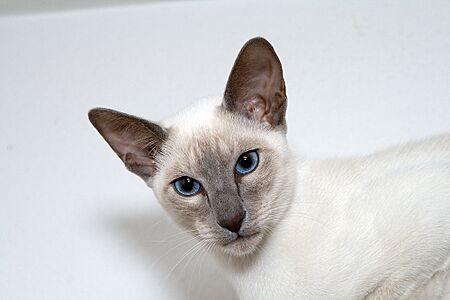
A lilac point Siamese cat.
-
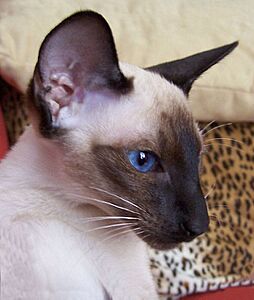
Side view of a modern Seal point adult's head.


Personality and Temperament
Siamese cats are known for being very loving and smart. They are famous for being social and enjoy being with people. Many people describe them as "extroverts" because they are so outgoing. They often form a very strong bond with one person. They tend to be more active during the day and like to stay close to their owners.
Keeping Siamese Cats Healthy

Studies in Sweden showed that Siamese cats and related breeds might have a slightly shorter lifespan than other cats. About 68% lived to 10 years or more, and 42% lived to 12.5 years or more. Most deaths were due to certain types of growths, especially in the mammary glands. Siamese cats also have a higher chance of some health issues. They are more likely to have certain growths and stomach problems. However, they have a lower risk of bladder or kidney problems. A UK study found their average lifespan was about 11.69 years, similar to the overall average for cats.
Siamese cats can sometimes have an eye condition called progressive retinal atrophy.
The same gene that gives them their special colored points can also affect their eyes and brain. This can cause their eyes to be cross-eyed. This trait was once common, but breeders have worked to reduce it. Unlike many other blue-eyed white cats, Siamese cats usually have normal hearing.
Siamese cats can also be prone to some skin and fur conditions, such as hair loss around the ears or eyes. Young Siamese cats can sometimes get certain skin growths. They are also one of the breeds more likely to have a rare genetic condition called gangliosidosis 1.
Other Cat Breeds from the Siamese
The Siamese cat has been a key part of creating many other wonderful cat breeds. Here are some of them:
- Balinese – This is a long-haired version of the Siamese cat. It came about naturally. In some registries, it only comes in the four traditional Siamese colors. Other groups recognize more colors.
- Birman – After many Birman cats were lost during World War II, breeders used Siamese cats to help rebuild the breed. Modern Birmans now have the pointed coat pattern from the Siamese.
- Burmese – This breed started with a cat named Wong Mau from Burma in 1930. She was bred with a Siamese cat, leading to the Burmese breed.
- Havana Brown – This breed was created by mixing a chocolate-point Siamese with a black cat.
- Colourpoint Shorthair – These are Siamese-type cats with pointed coats in colors other than the original four Siamese colors. They were developed by mixing with other short-haired cats. Some groups see them as part of the Siamese breed, while others consider them a separate breed.
- Himalayan – This long-haired breed came from mixing Persians with Siamese cats. This brought the point markings and colors like chocolate and lilac to the Persian type. In Europe, they are called colorpoint Persians.
- Javanese – In some groups, this is a long-haired version of the Colourpoint Shorthair.
- Neva Masquerade – This breed developed in Russia. It came from mixing Siberian cats with Siamese or related colorpoint cats. It has the Siamese colorpoint gene.
- Ocicat – This spotted cat was first created by mixing a Siamese and an Abyssinian.
- Oriental Shorthair – This is a Siamese-style cat but with solid, tabby, silver, smoke, or tortoise-shell coat patterns instead of points.
- Oriental Longhair – This is a long-haired version of the Oriental Shorthair.
- Ragdoll – This breed was carefully developed from local cats in the USA. It also carries the Siamese colorpoint gene.
- Savannah – This is a hybrid cat breed, a mix between a serval and a domestic cat. The first Savannah was bred with a Siamese.
- Snowshoe – This cream and white breed has blue eyes and some points. It was created in the 1960s by mixing Siamese and bi-colored American Shorthair cats.
- Thai Cat – Also known as the Wichian Mat or Old-Style Siamese. This is the original type of Siamese cat brought from Thailand in the 1800s. It is still bred in Thailand today.
- Tonkinese – This breed was originally a mix between a Siamese cat and a Burmese. Tonkinese kittens can have Burmese, Siamese, or Tonkinese (mink) patterns.
- Toybob – A cat breed from Russia that carries the Siamese colorpoint gene.
- Mekong Bobtail (Thai Bobtail)
See also
 In Spanish: Gato siamés para niños
- Hae Nang Maew, a traditional Siamese cat procession in Southeast Asia
- Thai cat, also known as Old-style Siamese or Traditional Siamese
- Colourpoint Shorthair
- List of cat breeds
