
Smelt Monument facts for kids

Smelt Monument
|
|
| Coordinates | 54°04′25.57″N 04°39′10.44″W / 54.0737694°N 4.6529000°W |
|---|---|
| Location | Castletown, Isle of Man |
| Designer | John Welch |
| Type | Commemorative column |
| Beginning date | 1836 |
| Completion date | 1837 |
| Opening date | 1837 |
| Dedicated to | Cornelius Smelt |
The Smelt Monument is a special monument in Castletown, Isle of Man. It was built to remember Cornelius Smelt, who was the very first Lieutenant Governor of the Isle of Man to be chosen by the King or Queen. He passed away in 1832.
Work on the monument started in 1836 and finished the next year. It was designed by John Welch and cost about £180. The monument is a tall column built in the Grecian Doric style using local stone. John Thomas was the builder. In 1984, it was officially listed as a Registered Building of the Isle of Man.
Building the Monument

The Smelt Monument stands where an old market cross used to be. After Cornelius Smelt died in 1832, his friend Sir William Hillary suggested building a memorial for him.
A meeting was held in Douglas on August 18, 1835. Everyone decided that a column should be built. Money for the project came from funds that were meant for a painting of Smelt. An extra £200 was also raised.
John Welch, an architect, drew two designs. One was for a tall, pointed obelisk, and the other was for a Grecian Doric column. After thinking it over, they chose the Grecian Doric design. John Thomas was given the job to build it for £180.
Choosing the Location
At another meeting in Castletown, they first decided to put the monument near Hango Hill. However, Deemster John Christian strongly disagreed with this spot.
Deemster Christian suggested placing the monument in front of King William's College or on The Parade. In the end, they chose The Parade in Castletown, so it would face Castle Rushen.
John Welch was a well-known architect to Sir William Hillary. Welch had also designed the famous Tower of Refuge. The committee asked Welch to provide costs for two columns, each costing no more than £200. One was to be a Grecian Doric column, and the other an obelisk.
They planned a special ceremony for Sir William to lay the first stone. But there were so many delays that the builder, John Thomas, had to start work without it. By late October 1836, part of the column was already built. No official stone-laying ceremony ever happened. The monument was fully finished in early January 1837.
The Idea for a Statue
There have been many stories about putting a statue of Cornelius Smelt on top of the monument. One popular rumor was that they ran out of money for a statue.
However, a letter from Sir William Hillary to John McHutchin, the Clerk of the Rolls, tells a different story. In his letter from December 17, 1836, Sir William explained his idea for a statue.
He wrote that the monument looked good, but it still needed something to be complete. He thought a statue of Cornelius Smelt would be much better than an urn. He believed a statue would help people remember Smelt for many generations.
Sir William had asked Mr. Welch to find out how much a statue would cost. He learned that a statue, a bit larger than life-size and carved from strong stone by a skilled artist, would cost about £40.
He hoped that Smelt's friends would help raise this money through a separate collection. Sir William himself was ready to donate between £1 and £5. He also asked for a good picture of Smelt to help the artist make a true likeness.
Sir William suggested the statue should look simple but strong. He imagined Smelt wearing a military cloak, with one hand resting on the Sword of State. The other hand would hold a scroll of paper, showing his role in government. He also wanted to show Smelt's "fine open forehead," as he looked before wearing a wig.
He thought the statue should be about 7 feet tall to fit the column well. Sir William did not get enough support for his plan to add a statue. The "portrait in the possession of Capt. Bacon" that he mentioned was a painting of Cornelius Smelt by Thomas Barber.
Besides the Smelt Monument, John Welch designed many other buildings on the Isle of Man. Two of his most famous works are the Tower of Refuge and King William's College.
Images for kids
-
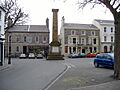
Smelt Monument
-
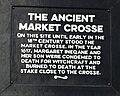
The old market cross site in Castletown.
