
South Island telegraph frog facts for kids
Quick facts for kids South Island telegraph frog |
|
|---|---|
| Conservation status | |
Scientific classification  |
|
| Kingdom: | Animalia |
| Phylum: | Chordata |
| Class: | Amphibia |
| Order: | Anura |
| Family: | Eleutherodactylidae |
| Genus: | Eleutherodactylus |
| Species: |
E. audanti
|
| Binomial name | |
| Eleutherodactylus audanti Cochran, 1934
|
|
| Script error: The function "autoWithCaption" does not exist. | |
| Synonyms | |
|
Eleutherodactylus neodreptus Schwartz, 1965 |
|
Script error: No such module "Check for conflicting parameters".
The South Island telegraph frog (scientific name: Eleutherodactylus audanti) is a small, fascinating frog. It belongs to a large family of frogs known as Eleutherodactylidae, which are often called "rain frogs" or "robber frogs." This special frog is found only in one particular part of the world, the island of Hispaniola. This means it is endemic to Hispaniola, making it a unique treasure of the island's wildlife.
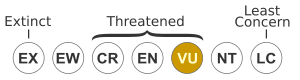
It lives in the mountainous regions of Hispaniola, specifically in the Massif de la Hotte and Massif de la Selle in Haiti, and in the Sierra de Baoruco in the Dominican Republic. Sadly, this frog is currently listed as Vulnerable by the IUCN (International Union for Conservation of Nature), meaning it faces a high risk of becoming endangered in the wild.
Contents
Discovering the South Island Telegraph Frog
This interesting frog was first officially described by a scientist named Doris Mable Cochran in 1934. When scientists describe a new species, they give it a unique scientific name. The second part of its scientific name, audanti, was chosen to honor Mr. André Audant. He was a Haitian entomologist, which is a scientist who studies insects. Mr. Audant helped collect the very first example of this frog that scientists studied, known as the holotype.
Where Does This Frog Live?
The South Island telegraph frog makes its home in the beautiful, high-up forests of Hispaniola. You can find it in forests where the trees grow very close together, creating a thick canopy overhead. It also likes to live along the edges of these woodlands. These frogs are quite secretive! They often hide under rocks and fallen leaves or other natural debris on the forest floor. This helps them stay safe from predators and keeps their skin moist.
Protecting the Telegraph Frog's Home
Even though the South Island telegraph frog can be found in good numbers in places where its habitat is healthy, it is facing a big challenge. Its biggest threat is habitat loss. This means that the forests where it lives are being destroyed or changed by human activities. When forests are cut down for farming, building, or other reasons, these frogs lose their homes and places to find food and shelter.
Protecting these unique forests is super important to ensure the South Island telegraph frog continues to thrive. Conservation efforts focus on preserving these natural areas so that this special frog and many other animals can continue to live safely in their natural environment.
See also
 In Spanish: Eleutherodactylus audanti para niños
