
St Brigid's Convent, Red Hill facts for kids
Quick facts for kids St Brigid's Convent, Red Hill |
|
|---|---|
.jpg)
St Brigid's Convent, 2009
|
|
| Location | 9-17 Upper Clifton Terrace, Red Hill, City of Brisbane, Queensland, Australia |
| Design period | 1900 - 1914 (early 20th century) |
| Built | 1902 - 1923 |
| Architect | Eaton & Bates |
| Architectural style(s) | Gothic |
| Official name: St Brigid's Convent, Convent of the Annuciation, Red Hill Convent | |
| Type | state heritage (landscape, built) |
| Designated | 28 March 2003 |
| Reference no. | 601078 |
| Significant period | 1900s-1920s (historical) ongoing (social) 1900s-1920s (fabric) |
| Significant components | chapel, views from, terracing, garden/grounds, views to, convent/nunnery |
| Lua error in Module:Location_map at line 420: attempt to index field 'wikibase' (a nil value). | |
St Brigid's Convent is a special old building in Red Hill, Brisbane, Australia. It was built for the Roman Catholic Sisters of Mercy. The building was designed by architects Eaton & Bates. It was built between 1902 and 1923.
This historic convent is also known as the Convent of the Annunciation or Red Hill Convent. It was added to the Queensland Heritage Register in 2003. This means it is a very important building that needs to be protected.
Contents
A Look Back: History of St Brigid's Convent
St Brigid's Convent was built in 1902-1903. It was made for the Sisters of Mercy, a group of Catholic nuns. The convent stands where an older house called Kenilworth used to be.
Early Days in Red Hill
The land for the convent was first measured and sold in 1865. Back then, Red Hill was not very populated. The steep hills made it hard for people to settle there. But by the 1870s, more people started moving to the area. This was because it was close to the city. Also, land was cheap, and a tram service was added later.
In 1877, the first St Brigid's Church was built nearby. In 1881, the Sisters of Mercy started a school at St Brigid's Church. They traveled to Red Hill every day. The Sisters also helped people in the community. A new St Brigid's School opened in 1901. This showed that more families were moving to Red Hill.
How the Sisters Got the Land
The land for the convent was bought by Lydia Pigott in 1873. She was a widow. She later married William Horsley. They lived in a house called Kenilworth on the property. You can still see the old terraces on the land. These were likely part of Kenilworth's gardens.
The Horsleys lived there until about 1900. The Sisters of Mercy bought the property in May 1902. They paid £1610 for it.
The Architects: Eaton and Bates
The Sisters hired Eaton and Bates to design their new convent. This company was a very popular and busy architectural firm. They had offices in Brisbane, Rockhampton, and Townsville.
George T Eaton and Albert Edmund Bates started their partnership around 1894. They designed many different buildings. These included hotels, shops, homes, and hospitals. They also designed many buildings for the Catholic Church. This included churches, convents, and schools. Their designs often included verandahs and pavilions. These features helped keep buildings cool in Queensland's warm climate.
Building and Life at the Convent
In 1902, Eaton and Bates asked for bids to build the new brick convent. The building was finished and ready in 1903. Sister M Thecla Kelleher was the first leader there. The convent cost over £3100 to build. Furnishing it cost another £500.
At first, the north verandah had only one floor. A pretty picket fence was at the front of the property. There were also some large pine trees in the front yard.
In 1906, the Sisters bought more land next to the convent. This helped make the convent grounds bigger. The northern upper floor verandah might have been added in 1923. This addition cost £1140.
At its busiest, St Brigid's Convent probably housed 8 or 9 Sisters. They did not have student boarders. The Sisters continued to help people in the area. In later years, some rooms were used to shelter homeless people. St Brigid's School closed in the mid-1980s. But some Sisters stayed at the convent until 1999.
What St Brigid's Convent Looks Like
.jpg)
St Brigid's Convent sits high up on Red Hill. It looks over the city of Brisbane. The building is on a steep slope. This means it is very noticeable on the Red Hill skyline. You can see it from Musgrave Road, which is a main road. From the back verandahs, you get an amazing view of the city.
Building Structure and Roof
The building has two main floors. It also has a large basement at the back. It is made of brick. The outside is covered with a smooth finish. The inside walls are plastered. The roof is made of galvanised iron. It used to have decorative metal pieces on top, but these are gone now.
Verandahs and Windows
Both the front and back of the building have a gabled section. These stick out from the verandahs. The front gabled section has three tall, narrow windows. These are called lancet windows. Below them, there is another section that holds the chapel's special area. This wall has a small space with a statue. It is believed to be a statue of Mary. The back gabled section also has three lancet windows on both floors.
The verandah roofs are separate from the main roof. The front and side verandahs have pretty cast-iron columns. They also have decorative railings and valances. These designs include shapes like lancet and rose windows. The back verandahs used to have similar decorations. But the railing on the upper verandah has been removed. It has been closed in with modern windows.
The north side verandah used to have only one floor. Now, the lower part has the same cast-iron work. But the upper part is enclosed with timber and windows from the 1920s. The basement at the back has a row of lancet-shaped arches.
Inside the Convent
The main entrance is on one side. It has leadlight glass and wooden panels. It opens into a wide entry area. A rounded arch with a glass screen separates this from the hallway. A door on the right leads to a small front room.
Beyond the screen, there is a staircase to the upper floor. A long hallway runs from here. It leads to the chapel and the original dining room. This hallway also leads to other rooms. One of these was a back room with a fireplace. This room is now a dining room. The back wall of this room has been opened up. This connects it to the enclosed back verandah, which is now a kitchen.
The chapel has leadlight lancet windows. A wooden door opens into a small room called a vestry. The chapel is next to the original dining room. Folding wooden doors can open up to make the chapel bigger. The old dining room has a beautiful marble fireplace.
The walls on the ground floor are made of brick. They are plastered and painted. The first floor is similar. But some rooms have been divided with wooden panels. This created small bedrooms or "cells" and bathrooms. A tall archway upstairs leads to the enclosed north verandah. This was added around the 1920s. This opening was originally a window.
A narrow wooden staircase connects all floors. It is in the northeast corner of the verandah. The basement has the original kitchen and pantries. Part of the basement has been used for temporary housing. Part of the pantry has been made into a bathroom.
All the wooden parts inside are made of cedar. Some of it has been painted. The ground floor ceilings have decorative metal panels. The first floor ceilings have narrow wooden boards. The front rooms on the ground floor have special windows that can open wide.
Gardens and Grounds
The building sits on a large, grassy block of land. It has terraces that follow the steep slope. There are some large eucalypt trees on the lower part of the land. There is also a small garden at the front. A brick fence is along the front of the property. There is also a small carport in the front yard.
Behind the building, you can see the old foundations of a small building. This building was taken down recently. There are also some concrete steps that are part of the old terraces.
Why St Brigid's Convent is Important
St Brigid's Convent was added to the Queensland Heritage Register in 2003. This means it is very important for several reasons.
Showing Queensland's History
The convent was built in 1902-1903. It shows how Red Hill grew as a suburb of Brisbane. Many people moved there in the late 1800s and early 1900s.
A Special Type of Building
St Brigid's Convent is a great example of a Catholic convent from that time. It was built to suit Queensland's warm climate. It shows how religious women lived and worked in the past. It is also a good example of the work of the famous architects Eaton and Bates.
Beautiful and Recognizable
The convent is one of many important Catholic buildings in Brisbane. These buildings were often built on hilltops. This made them stand out and look impressive. The convent still has its large original grounds. It also offers amazing views of the city. This makes it a distinctive part of the Red Hill skyline. It has been there for almost a century.
Important to the Community
The convent has a special connection with the Sisters of Mercy. They did important work in education and helping people. They served the Red Hill and Petrie Terrace areas from the 1880s.
Images for kids
-
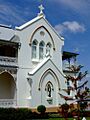
St Brigid's Convent, 2009
-
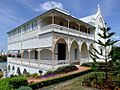
St Brigid's Convent, 2009
