
Catholic Church facts for kids
Quick facts for kids  Catholic Church |
|
|---|---|
| Ecclesia Catholica | |

St. Peter's Basilica in Vatican City, the largest Catholic church building in the world
|
|
| Classification | Catholic |
| Scripture | Catholic Bible |
| Theology | Catholic theology |
| Polity | Episcopal |
| Governance | Holy See and Roman Curia |
| Pope | Leo XIV |
| Particular churches sui iuris |
Latin Church and 23 Eastern Catholic Churches |
| Dioceses |
|
| Parishes | 221,700 approx. |
| Region | Worldwide |
| Language | Ecclesiastical Latin and native languages |
| Liturgy | Latin and Eastern |
| Headquarters | Vatican City |
| Founder |
|
| Origin | 1st century Roman Empire |
| Separations |
|
| Members |
|
| Clergy |
|
| Hospitals |
|
| Nursing homes | 16,000 |
| Primary schools | 95,200 |
| Secondary schools | 43,800 |
Script error: No such module "Check for conflicting parameters".
The Catholic Church (Latin: Ecclesia Catholica), also known as the Roman Catholic Church, is the largest Christian church in the world. It has about 1.4 billion members globally. The Church is made up of 24 different parts, including the Latin Church and 23 Eastern Catholic Churches. These are organized into nearly 3,500 areas called dioceses, each led by a bishop. The Catholic Church has played a big role in shaping Western civilization throughout history. Catholic communities are found all over the world. Most Catholics live in places like Africa, Asia, and Latin America.
Catholic beliefs are based on the Nicene Creed. The Church teaches that it was founded by Jesus Christ. Bishops are seen as the successors of Jesus' first followers, the apostles. The pope, who is the bishop of Rome, is considered the successor of Saint Peter. He has a special role in leading the Church. The current pope is Pope Leo XIV. The Holy See in Vatican City is the central governing body of the Church. Catholic teachings come from the Bible and sacred tradition. These are explained by the Church's teaching authority, called the magisterium. Catholic worship includes different liturgical traditions, like the Roman Rite and Eastern rites. Many religious groups and lay movements also contribute to Catholic life around the world.
One of the most important ceremonies is the Eucharist, also called Mass. Catholics believe that during Mass, the bread and wine become the body and blood of Christ. The Virgin Mary is highly respected as the Mother of God. Special beliefs about her include the Immaculate Conception and the Assumption. The Church also teaches about caring for the poor, the sick, and those who are often left out. It runs many schools, hospitals, and charitable organizations worldwide. It is the largest non-government provider of education and health care.
Over time, there have been some major divisions within Christianity. The separation between the Catholic Church and Eastern Orthodox churches happened gradually. This was due to theological and political disagreements, especially about the pope's authority. The Protestant Reformation in the 16th century led to the creation of new Christian traditions. In recent times, the Church has faced discussions about some of its teachings and practices.
The Catholic Church: A Global Community
What is the Catholic Church?
The word "Catholic" comes from a Greek word meaning "universal." It was first used to describe the Church in the early 100s AD. Saint Ignatius of Antioch wrote a letter around 100 AD. In it, he used the phrase "the catholic church." He meant that wherever the bishop is, the people are there, just as the universal Church is wherever Jesus is. Later, in 380 AD, Emperor Theodosius I made Nicene Christianity the official religion of the Roman Empire. This further emphasized the idea of a "Catholic Church."
After a big split in 1054, the Eastern Orthodox Church started using the name "Orthodox." The Latin Church became known as "Catholic." This name also described those who followed the Holy See after the Protestant Reformation in the 1500s. People who disagreed with the pope became known as Protestants.
Sometimes, people use "Roman Catholic Church" to describe the whole Church. This term became common in English after the Protestant Reformation. It helps to tell the difference between the Latin Church and the Eastern Catholic Churches. Official Church documents, like the Catechism of the Catholic Church, use the name "Catholic Church" for the entire Church.
A Look at Catholic History
Early Beginnings and Leaders
.jpg)

The New Testament tells us about Jesus' life and teachings. It also describes how he chose his Twelve Apostles. He told them to continue his work. The book of Acts of Apostles explains how the Christian Church began. It shows how its message spread across the Roman Empire. The Catholic Church believes its public work started on Pentecost. This was 50 days after Jesus was believed to have risen from the dead. On Pentecost, the apostles received the Holy Spirit. This prepared them to lead the Church. The Church teaches that its bishops, led by the bishop of Rome, are the successors of these apostles.
In the Gospel of Matthew, Jesus calls Peter the "rock" on which his Church would be built. The Catholic Church believes the bishop of Rome, the pope, is Peter's successor. Some historians believe Peter was the first bishop of Rome. Others say the pope's role doesn't depend on Peter being a bishop in Rome.
The Church in the Roman Empire

The Roman Empire helped new ideas spread with its roads and safety. But Christians had to give up all other gods, like in Judaism. Because Christians would not join in pagan festivals, they were sometimes treated badly. This changed in 313 AD when Emperor Constantine the Great made Christianity legal. He was the first Roman emperor to become a Christian. In 380 AD, Christianity became the official religion of the Roman Empire.
During this time, five main centers of Christianity grew: Rome, Constantinople, Alexandria, Antioch, and Jerusalem. These were formalized by Emperor Justinian I in the 500s. The bishops of Rome, or popes, slowly gained more authority. They often helped leaders during disagreements about beliefs.
Later, Germanic tribes invaded the Roman Empire. Many of them became Christian, but in a way that the Church considered incorrect. In 497 AD, Clovis I, the Frankish ruler, became a Catholic. This helped unite Germanic rulers and Catholic people. Other groups like the Visigoths and Lombards also became Catholic.
The Church, especially through its monasteries, helped save many classical writings and art. Benedict of Nursia started Western monasticism. His rules greatly influenced European culture. Monks helped preserve ancient knowledge. Places like Ireland became centers of learning. Irish missionaries spread Christianity and built monasteries across Europe.
Middle Ages and New Ideas

From ancient times to the modern age, the Catholic Church had a huge impact on Western culture. It supported many art styles like Romanesque, Gothic, and Renaissance. Famous artists like Michelangelo and Leonardo da Vinci created works for the Church. Historians say the Church was key to developing Western values, ideas, science, and laws.
Monks started the first universities in Europe. Older cathedral schools became universities in the 11th century. These included the University of Oxford and the University of Paris. These schools taught many subjects, not just for church leaders.
In the mid-600s, Islamic invasions led to long struggles between Christianity and Islam. Battles in places like Tours stopped Islamic advances in the West. In 751, the Byzantine Empire lost control of parts of Italy, including Rome. This meant the pope needed new protection. The Frankish king Pepin the Short helped the pope and gave him lands. This started the Papal States. In the 800s, there were disagreements between Rome and the Byzantine East.
In the 11th century, Pope Gregory VII helped create the College of Cardinals to elect new popes. This system is still used today. He also worked to make the clergy more independent from rulers. This led to conflicts over who could appoint bishops.
In 1095, the Byzantine emperor asked Pope Urban II for help against Muslim invasions. This led to the First Crusade. Its goal was to help the Byzantine Empire and take back the Holy Land. In the 11th century, tensions between the Greek and Latin Churches grew. This led to the East–West Schism, a major split. The Fourth Crusade, where crusaders attacked Constantinople, made this split permanent.
In the 13th century, new religious groups called mendicant orders were founded. These included the Franciscans and Dominicans. Their schools helped turn church schools into important universities. Thinkers like Thomas Aquinas studied and taught there. His book, Summa Theologica, combined ancient Greek ideas with Christian beliefs.
The 1300s saw more conflicts between the Church and rulers. For a time, seven popes lived in Avignon, France. This was called the Avignon Papacy. Later, a period called the Western Schism began. There were different people claiming to be pope at the same time. This was mostly resolved at the Council of Constance in 1414-1418. In 1438, the Council of Florence tried to reunite the Catholic and Orthodox churches. Many Eastern churches did reunite, forming the Eastern Catholic Churches.
Exploring New Worlds and Changes
.jpg)

The Age of Discovery in the 1400s saw European nations explore the world. Catholic countries like Spain and Portugal spread Catholicism to the Americas, Asia, and Oceania. Explorers and missionaries helped people in these new lands become Catholic. For example, in 1521, Ferdinand Magellan helped make the first Catholic converts in the Philippines. Missionaries like Francis Xavier also spread the faith in India, China, and Japan.
In 1415, Jan Hus was executed for his beliefs. Later, in 1517, Martin Luther in Germany questioned some Catholic teachings. He wrote the Ninety-five Theses. This started the Reformation, which led to many Protestant churches. Other reformers like Huldrych Zwingli and John Calvin also criticized Catholic teachings. In England, King Henry VIII separated from the Pope. He created the Church of England.

The Reformation led to conflicts in Europe. The Council of Trent (1545–1563) was the Catholic Church's response. It reaffirmed many core Catholic beliefs. It also emphasized the importance of good works and faith for salvation. In the centuries that followed, Catholicism continued to spread globally through missionaries. However, its influence in Europe lessened as new ideas from the Enlightenment grew.
Modern Times and Global Growth
From the 17th century, the Enlightenment challenged the Church's power. Writers like Voltaire criticized religion. The French Revolution in 1789 also changed things. It shifted power to the state and led to the destruction of churches. Later, Napoleon brought the Catholic Church back to France. After the Napoleonic Wars, the Church saw a revival. The Papal States were also restored.
In 1854, Pope Pius IX declared the Immaculate Conception as a core belief. In 1870, the First Vatican Council affirmed the idea of papal infallibility. This means the pope is protected from error when making certain official statements. This led to a group called the Old Catholic Church separating.
The Italian unification in the 1860s took over the Papal States. This included Rome itself in 1870. This ended the pope's rule over land. The Lateran Treaty in 1929 resolved this issue. The Holy See recognized Italy's rule. In return, Italy recognized Vatican City as an independent state.
Catholic missionaries also played a role in the European expansion into Africa in the late 1800s. They helped spread Christianity there.
20th and 21st Centuries: Change and Unity


In the 20th century, the Church continued to grow globally. This happened even with the rise of anti-Catholic governments. During the World Wars, Popes Benedict XV and Pius XII tried to stay neutral. They worked as peace brokers and helped war victims. In the 1960s, Pope John XXIII called the Second Vatican Council. This brought big changes to Church practices. It allowed Mass to be said in local languages. It also encouraged people to participate more actively in worship. The Council aimed to connect the Church more closely with the modern world. It also improved relations with other Christian groups and non-Christian religions.
The Council's changes led to some discussions. Some felt it didn't go far enough. Others believed it changed too much. The Church's teaching on marriage and family life also remained a topic of discussion.
In 1978, Pope John Paul II became the first non-Italian pope in 455 years. His long time as pope helped bring about the fall of communism in Europe. He traveled more than any other pope, visiting 129 countries. He used television and radio to share Church teachings. He also spoke about the importance of fair wages and safe working conditions. He emphasized Church teachings on the value of human life.
Pope Benedict XVI, elected in 2005, focused on traditional Christian values. He also allowed more use of older forms of the Mass. In 2013, he resigned due to old age. He was the first pope to do so in almost 600 years.
Pope Francis became pope in 2013. He was the first pope from the Americas and outside Europe in a very long time. Pope Francis worked to improve relations with Eastern churches. He met with leaders of the Eastern Orthodox Church. In 2017, he re-established mutual recognition of baptism with the Coptic Orthodox Church.
In 2025, Pope Leo XIV was elected as Pope. He is the first Augustinian pope and the first North American pope. He was born in Chicago and has Peruvian citizenship.
How the Catholic Church is Organized
The Catholic Church is led by bishops. They have received a special ceremony called holy orders. Bishops oversee specific areas called dioceses. There are three main levels of clergy:
- Bishops: They lead dioceses.
- Priests: They are ordained by bishops and work in local dioceses or religious groups.
- Deacons: They help bishops and priests in many ways.
The entire Catholic Church is led by the bishop of Rome, known as the pope. His area of authority is called the Holy See.
Alongside the diocesan structure, there are many religious institutes. These groups, like monks and nuns, often have their own rules. They usually answer directly to the pope. Lay members (people who are not clergy) also help with many church activities. The Catholic Church is often called the oldest global organization.
The Pope and Vatican City
.png)
The pope, currently Pope Leo XIV, leads the Catholic Church. He was elected in 2025 by a special meeting of cardinals called a papal conclave. The Church believes Jesus started the papacy by giving special authority to Saint Peter. The pope's authority is called the Holy See. The Roman Curia is the central group that helps the pope manage the Church's daily work.
The pope is also the leader of Vatican City. This is a tiny independent state inside Rome. The pope acts as head of the Holy See when dealing with other countries.
Cardinals are special church leaders chosen by the pope. They advise and help the pope. When a pope dies or resigns, cardinals under 80 years old meet to elect a new pope.
Church Laws and Traditions
Catholic canon law is the system of rules and principles that guide the Catholic Church. These laws help organize the Church and direct Catholics in their mission. The Latin Church has its own set of laws. The 23 Eastern Catholic Churches also have their own traditions and laws.
These church laws are based on divine law and natural law. They get their authority from the pope or other church leaders. Canon law covers many aspects of church life. It includes rules for worship, sacraments, and how the Church is governed. It is different from civil law, which is made by governments.
The current laws for the Latin Church are in the 1983 Code of Canon Law. The Eastern Catholic Churches follow the Code of Canons of the Eastern Churches.
Different Kinds of Catholic Churches
In the first 1,000 years of Christianity, different ways of practicing the faith grew in the East and West. Today, 23 Eastern Catholic Churches are part of the Catholic Church. They follow Eastern traditions and are in full communion with the pope. The largest and most well-known is the Latin Church. It has over 1 billion members worldwide.
The Latin Church is led by the pope and local bishops. It follows Western Christian traditions. The Eastern Catholic Churches follow the traditions of Eastern Christianity. They have their own ways of worship and cultural influences. These churches have always been in full communion with the Catholic Church. Or they have rejoined it after earlier divisions.
The pope recognizes these Eastern Catholic Churches. They have their own leaders, like patriarchs or major archbishops. Each church has authority over its own worship styles and spiritual practices. This is all under the pope's authority.
Local Churches and Communities
Individual countries, regions, and cities have local churches. These are called dioceses in the Latin Church or eparchies in the Eastern Catholic Churches. Each is led by a bishop. As of 2021, there are 3,171 dioceses globally. Bishops in a country often work together in a national conference.
Dioceses are divided into parishes. Each parish has one or more priests, deacons, or lay ministers. Parishes are where sacraments are celebrated daily. They also provide care for the local community. As of 2016, there were about 221,700 parishes worldwide.
Catholic men can become deacons or priests through a special ceremony. Men and women can also serve in other roles. These include helping with Holy Communion or reading during services.
Catholics can also choose a consecrated life. This means dedicating their lives to God. They might become a hermit or join a religious institute. These groups, like the Benedictines or Franciscans, take special promises. They promise to live a life of chastity, poverty, and obedience.
The Catholic Church is the largest non-government provider of education and health care in the world.
Who Belongs to the Catholic Church?
As of 2020, Catholicism is the second-largest religious group in the world. It makes up about half of all Christians. In 2023, there were 1.406 billion baptized Catholics. This was 17.4% of the world's population. The number of Catholics has grown by almost 11% under Pope Francis. Most of this growth has been in Africa.
Brazil has the largest Catholic population. Mexico, the Philippines, and the United States also have many Catholics.
The number of Catholics around the world is changing. In 2023, 47.8% were in the Americas. 20.4% were in Europe. 20.0% were in Africa. 11.0% were in Asia. 0.8% were in Oceania.
Catholic ministers include priests, deacons, and missionaries. As of 2023, there were over 463,000 ordained clergy. This included 5,430 bishops, 406,996 priests, and 51,433 deacons. Many lay people also serve as catechists and missionaries.
Many Catholics commit to religious life. This includes 49,414 male religious and 589,423 women religious (nuns) as of 2023. They are not ordained but dedicate their lives to God.
What Catholics Believe
Catholic beliefs have grown over many centuries. They reflect the teachings of early Christians. They also include official definitions of beliefs by church councils and popes. The Church believes it is always guided by the Holy Spirit. It is protected from making mistakes in its core teachings.
The Church teaches that God is the source of all revelation. This revelation comes through two ways: the Bible and Sacred Tradition. The Catholic Bible has 73 books. Sacred Tradition includes teachings passed down since the time of the Apostles. These two together are called the "deposit of faith." The Magisterium (the Church's teaching authority) interprets them. The Catechism of the Catholic Church summarizes Catholic beliefs.
God, Jesus, and the Holy Spirit

The Catholic Church believes in one eternal God. This God exists as three "persons": God the Father, God the Son (Jesus Christ), and God the Holy Spirit. Together, they are called the "Holy Trinity."
Catholics believe Jesus Christ is the "Second Person" of the Trinity. Through the Incarnation, God became human in Jesus. This happened when Christ was conceived in the womb of the Blessed Virgin Mary. Jesus is seen as both fully divine and fully human. His mission was to teach people and show them how to live. Jesus lived without sin. He allowed himself to be executed by crucifixion. This was a sacrifice to bring humanity back to God. This event is called the Paschal Mystery. The name "Christ" means "anointed one." It refers to the belief that Jesus' death and resurrection fulfill ancient prophecies.
The Church teaches that the Holy Spirit comes from the Father and the Son. This belief is expressed in the Filioque clause. It was added to the Latin version of the Nicene Creed.
The Church's Role
The Catholic Church teaches it is the "one true church." It is seen as the way to salvation for all people. The Nicene Creed describes the Church as "one, holy, catholic, and apostolic." These are called the Four Marks of the Church. The Church believes Jesus Christ founded it. The New Testament describes Jesus choosing his apostles. He told them to continue his work after his resurrection. The coming of the Holy Spirit on Pentecost is seen as the start of the Church's public work. The Church teaches that bishops are successors of the apostles. The Bishop of Rome (the pope) is the successor of Simon Peter. He has a special leadership role.
Catholics believe the Church is "the continuing presence of Jesus on earth." It offers the full means of salvation. Through Jesus' suffering and crucifixion, he made a sacrifice to God the Father. This brought humanity back to God. His Resurrection of Jesus means he is the first to rise from the dead. By following Christ, people can enter the Kingdom of God. The Church's worship and sacraments help strengthen a person's relationship with Christ. They also help overcome sin.
Life After Death
The Catholic Church teaches that after death, each person's soul receives a special judgment from God. This is based on their actions and relationship with Christ. The Church also believes in a final judgement for all humanity. This will mark the end of human history. It will begin a new heaven and earth ruled by God.
After death, a soul may enter one of three states:
- Heaven: This is an unending union with God. It is an eternal life where the soul sees God in perfect happiness.
- Purgatory: This is a temporary state. Souls here are purified before entering Heaven. They are not fully free from sin yet. Prayers from people on earth and saints can help souls in Purgatory.
- Final Damnation: Those who choose to reject God and die in serious sin go to hell. This is an everlasting separation from God. The Church teaches that no one is sent to hell without choosing to reject God. God's mercy allows people to repent at any time before death.
The Church teaches that it offers the full means of salvation. However, it also recognizes that the Holy Spirit can work through other Christian groups. These groups can help people find salvation. The Church believes anyone saved is saved through the Catholic Church. But people can also be saved outside the usual ways. This can happen through a sincere desire for baptism or by dying for their faith. It can also happen if they truly seek God without knowing about Christ or the Church.
Honoring Saints and Mary
A saint is a person known for great holiness or closeness to God. Canonization is when the Church officially declares someone a saint. The first saints were martyrs, people who died for their faith. Later, "confessors" (those who suffered for their faith) were also honored.
In the Catholic Church, only the pope can declare someone a saint. This happens after a long process. It requires proof that the person lived a very holy life. Being declared a saint means the person is in Heaven. It also means they can be publicly honored and mentioned in Church prayers.
Devotions are special prayers and practices. They are not part of the official worship but are popular among Catholics. These include honoring saints, especially the Virgin Mary. Other devotions include the Stations of the Cross and the Rosary. The Church encourages devotions that fit with the official worship.

Catholic Mariology includes beliefs and teachings about Mary, mother of Jesus. Mary is highly honored. She is called the Mother of God. It is a belief that she remained a virgin throughout her life. Other beliefs include the Immaculate Conception (Mary's own conception without original sin) and the Assumption of Mary (her body being taken directly into heaven). These were declared official beliefs by popes after consulting with bishops worldwide. Eastern Catholic churches celebrate the Dormition of the Mother of God on the same date as the Assumption.
Devotions to Mary are part of Catholic prayer. They are different from the worship of God. These practices include prayers like the Hail Mary and the Rosary. Many feast days honor Mary throughout the year. She is known by many titles, like Queen of Heaven. Pope Paul VI called her Mother of the Church. This is because she gave birth to Christ. Many Catholics also go on pilgrimages to places where Mary is believed to have appeared. Examples include Lourdes and Fátima.
Important Catholic Ceremonies (Sacraments)
.jpg)
The Catholic Church teaches that Jesus Christ gave it seven sacraments. These were defined by church councils. The sacraments are: baptism, confirmation, the Eucharist, penance (confession), anointing of the sick, holy orders, and holy matrimony. Sacraments are visible rituals. Catholics see them as signs of God's presence. They are channels of God's grace for those who receive them with a good heart. The Catechism of the Catholic Church groups sacraments into three types: initiation, healing, and service. These groups reflect different stages of life.
The ceremonies of the sacraments are very important to the Church. The Catechism says that every liturgical action, especially the Eucharist and sacraments, is an encounter with Christ. It brings God's children together in the Body of Christ.
For sacraments to be valid, they need the right form, matter, and intention. Church laws also guide who can celebrate and receive sacraments. Catholics who are aware of serious sin should go to confession before receiving the Eucharist. Non-Catholics are usually not able to receive the Eucharist.
Becoming a Member: Baptism and Confirmation

Baptism is the first of three sacraments that initiate someone into Christianity. It washes away all sins, both original sin and personal sins. It makes a person a member of the Church. Baptism is a free gift from God. It is given even to children, who need it because of original sin.
If a newborn child is in danger of death, anyone can baptize the child. They just need to intend to baptize and use the Trinitarian baptismal formula. Baptism marks a person permanently and cannot be repeated.
The sacrament of confirmation completes the grace given in baptism. When adults are baptized, confirmation usually happens right after. In Eastern Catholic Churches, even babies are confirmed after baptism. In the West, children are confirmed when they are old enough to understand. Those receiving confirmation should be in a state of grace. This means they should have confessed any serious sins. They should also intend to receive the sacrament and live as Christians.
The Eucharist: Holy Communion
.jpg)
For Catholics, the Eucharist is the sacrament that completes Christian initiation. It is called "the source and summit of the Christian life." The first time a Catholic receives the Eucharist is called First Communion.
The Eucharistic celebration is also called the Mass. It includes prayers and readings from the Bible. Bread and wine are brought to the altar. The priest then performs a special prayer. Through this, the bread and wine become the body and blood of Jesus Christ. This change is called transubstantiation.
The words used reflect Jesus' words at the Last Supper. There, he offered his body and blood to his Apostles. The sacrament makes Jesus' sacrifice on the cross present again. It gives grace that unites believers with Christ and each other. It also helps forgive smaller sins and avoid serious sins.

Healing and Forgiveness: Penance and Anointing
The sacrament of penance (also called Reconciliation or Confession) is for those who have sinned after baptism. It involves the person examining their conscience and being truly sorry for their sins. They must also intend not to sin again. Then, they confess their sins to a priest. The priest gives them a task to make up for the harm caused by sin. Finally, the priest gives absolution, forgiving the sins.
Serious sins should be confessed at least once a year. It is also important to confess them before receiving the Eucharist. Confessing smaller sins is also recommended. Priests must keep everything said in confession absolutely secret. This is called the "seal of confession."
A different oil is used by a priest or bishop to bless a Catholic who is seriously ill or elderly. This sacrament is called anointing of the sick. It is believed to bring comfort, peace, and courage. It can also forgive sins if the person cannot make a confession.
This sacrament is also known as unction. In the past, it was called extreme unction. It is one of the three sacraments that make up the last rites. The others are Penance and Viaticum (Eucharist for the dying).
Serving Others: Holy Orders and Marriage
The Catechism says there are two sacraments for serving others: priesthood and marriage. These sacraments dedicate people to specific missions among God's people. Men receive holy orders to serve the Church through teaching and grace. Spouses marry so their love can be strengthened to fulfill their duties.
The sacrament of holy orders dedicates some Christians to serve as bishops, priests, and deacons. The Church has rules about who can be ordained. In the Latin Church, priests are generally unmarried men. Bishops are always unmarried men. In some Eastern Catholic churches, married men can become priests. Married men can also become deacons in the Latin Church. After becoming a Catholic priest, a man cannot marry unless he leaves the priesthood.
All clergy can preach, teach, baptize, witness marriages, and lead funeral services. Only bishops and priests can administer the Eucharist, reconciliation, and anointing of the sick. Only bishops can administer the sacrament of Holy Orders.

The Catholic Church teaches that marriage is a special bond between a man and a woman. A Catholic marriage, or any marriage between baptized Christians, is seen as a sacrament. Once a sacramental marriage is complete, it cannot be ended except by death. The Church requires certain conditions for a marriage to be valid. These include free consent. The Church also has specific rules for Catholics to follow.
The Church does not recognize divorce as ending a valid marriage. It allows civil divorce only to protect the property and well-being of the family. However, a church court can declare a marriage invalid. This is called an annulment. It means that the marriage was not valid from the beginning. If a marriage is declared invalid, a person can remarry in the Church.
Ways of Worship in the Church

The 24 different Catholic Churches have many ways of worship. These are called rites. They show the different histories and cultures of these churches. They do not mean differences in belief. A rite includes the worship, beliefs, spirituality, and rules of a particular group of people.
The main worship service of the Catholic Church is the Eucharist. It is called the Mass in the West and Divine Liturgy in the East. This is because it is seen as the sacrifice of Christ himself. The Eastern Catholic Churches have their own rites. The ways they celebrate the Eucharist and other sacraments vary. This reflects their different theological traditions.
Western Church Traditions
The Roman Rite is the most common way of worship in the Catholic Church. It uses the Ordinary Form of the Roman Rite of the Mass. This rite started in Rome and spread throughout Europe. It influenced and eventually replaced local ways of worship. The current form of Mass in the Roman Rite is usually celebrated in the local language. It uses approved translations from the original Latin text.
This form was made official by Pope Paul VI in 1969. It was later revised by Pope John Paul II in 2001. In some cases, an older form of the Roman Rite from 1962 is still allowed.
There are also other Latin Church rites. These include the Ambrosian Rite (used in the Archdiocese of Milan) and the Mozarabic Rite. Some religious groups also have their own rites. These older rites were allowed to continue if they existed for at least 200 years before 1570.
Eastern Church Traditions

The Eastern Catholic Churches share similar traditions and worship styles with other Eastern Christian churches. These include churches that developed in Russia, the Middle East, India, and other regions. Eastern Catholic Churches are groups that have always been in full communion with the pope. Or they have rejoined communion after past divisions.
The liturgical rites of the Eastern Catholic Churches include the Byzantine Rite, the Alexandrian Rite, the West Syrian Rite, the Armenian Rite, and the East Syriac Rite. Eastern Catholic Churches can set their own worship forms. They must protect their traditional ways of worship.
In the past, some Eastern Catholic rites adopted some Western practices. In recent years, Eastern Catholic Churches have returned to their traditional Eastern ways. Each church also has its own liturgical calendar.
Caring for the World and Others
Helping Those in Need
.jpg)
Catholic social teaching focuses on helping the poor, the sick, and those who suffer. This reflects Jesus' concern for these groups. The Church teaches that we should always prioritize the poor. Church law says that Christians must promote social justice. They must also help the poor. This teaching began with Pope Leo XIII's letter Rerum novarum in 1891. It supported the rights of workers and their right to form unions.
Education and Health Services

The Catholic Church is the largest non-government provider of education and medical services globally. In 2010, the Church reported managing 26% of the world's health care facilities. These include hospitals, clinics, and orphanages.
The Church has always been involved in education. It founded the first universities in Europe. Today, it runs thousands of schools, colleges, and universities worldwide. It operates the largest non-governmental school system.
Women in religious orders have been very important in health and education. Groups like the Sisters of Mercy and the Missionaries of Charity have done great work. Mother Teresa of Calcutta, India, who founded the Missionaries of Charity, won the Nobel Peace Prize in 1979 for her humanitarian work. Bishop Carlos Filipe Ximenes Belo also won the award in 1996 for his work in East Timor.
The Church also helps with international aid and development. Organizations like Catholic Relief Services and Caritas Internationalis provide assistance. Groups like the Jesuit Refugee Service help refugees. The Saint Vincent de Paul Society helps local communities.
Roles for Men and Women in the Church
Women and men in religious life serve in many ways. They engage in prayer, teaching, health care, and missionary work. Catholic women have always played diverse roles in the Church. Religious groups for women have given them formal ways to participate. Convents have provided spaces for their leadership and prayer. Religious sisters and nuns have been very important in building and running the Church's global health and education networks.
In the Catholic Church, only men can receive Holy Orders to become priests or bishops. The Church teaches that it is not authorized to admit women to priestly ordination.
Protecting Our Planet
The Church also cares about protecting the natural environment. It connects this to other social and religious teachings. In his letter Laudato si' in 2015, Pope Francis talked about caring for our common home. He criticized consumerism and irresponsible development. He also spoke about environmental degradation and climate change. The pope said that the warming planet is a sign of a bigger problem. He noted that some developed countries are not paying enough attention to the planet's destruction. This happens as people seek short-term economic gains.
Images for kids
-
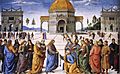
A painting from the 1480s showing Jesus giving the "keys of heaven" to Saint Peter.
-
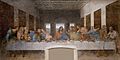
Leonardo da Vinci's famous painting, The Last Supper, shows Jesus' final meal with his twelve apostles.
-
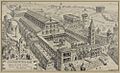
An old drawing of Old St. Peter's Basilica, built in 318 AD by Emperor Constantine the Great.
-
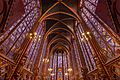
The beautiful Sainte-Chapelle in Paris, France, finished in 1248. Many Gothic churches were built for the Catholic Church during the Middle Ages.
-
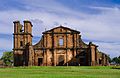
Ruins of the Jesuit mission of São Miguel das Missões in Brazil.
-
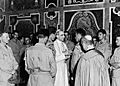
Members of the Canadian Army's Royal 22nd Regiment meeting with Pope Pius XII in 1944. This was after the Battle of Anzio, which freed Rome during World War II.
-
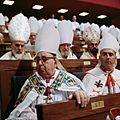
Bishops listening during the Second Vatican Council in the early 1960s.
-
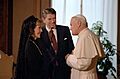
Pope John Paul II and U.S. President Ronald Reagan (with his wife Nancy) meeting in 1982. Both were important in the fall of communism.
-
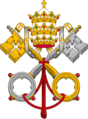
The crossed keys of the Holy See represent Simon Peter. The triple crown symbolizes the pope's roles. The gold cross represents Jesus' sovereignty.
-
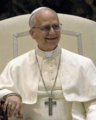
Pope Leo XIV is the current pope of the Catholic Church. He is also the leader of Vatican City. He was elected in 2025.
-
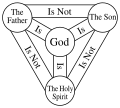
This diagram shows the Shield of the Trinity. It helps explain the belief in one God in three Persons.
-
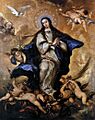
The Blessed Virgin Mary is highly respected in the Catholic Church. She is called Mother of God and is believed to be free from original sin.
-
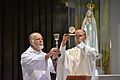
Holy Mass at the Sanctuary of Our Lady of Fátima, Portugal. The bread and wine are shown to the people after they become the Holy Body and Blood of Christ.
-
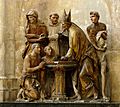
A sculpture in Troyes Cathedral (1549) showing the baptism of Augustine of Hippo.
-
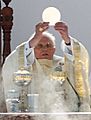
Pope Benedict XVI celebrates the Eucharist in Brazil in 2007.
-
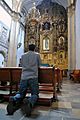
A Catholic prays in a church in Mexico.
-
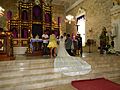
A wedding Mass in the Philippines.
-
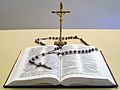
Catholic religious objects: the Holy Bible, a crucifix, and a rosary.
-
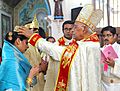
An East Syrian Rite wedding crowning. This is celebrated by a bishop of the Syro-Malabar Catholic Church in India. This is one of the 23 Eastern Catholic Churches.
-
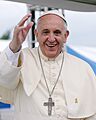
Pope Francis issued Laudato si' in 2015. This important letter discusses caring for our planet and helping others.
-
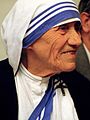
Saint Teresa of Calcutta helped the sick, poor, and needy. She won the Nobel Peace Prize in 1979.
See also
 In Spanish: Iglesia católica para niños
- Catholic Church and politics
- Catholic Church and race
- Catholic art
- Catholic culture
- Catholic peace traditions
- Glossary of the Catholic Church
- List of Catholic religious institutes
- Liturgical year of the Catholic Church
- Lists of Catholics
- List of popes
- Role of Christianity in civilization
- Society of Jesus
