
Styre facts for kids
Quick facts for kids 'Styre' |
|
|---|---|
 |
|
| Species | Malus domestica |
| Origin |  England, before 1600s. England, before 1600s. |
The Styre apple, also called the Forest Styre, was a very old type of cider apple from England. It was once common in a place called the Forest of Dean. People today think this apple might be extinct, meaning it no longer exists. However, some hope it could still be found in old apple farms or gardens.
Contents
What is the Styre Apple?
The Styre apple was known for making a special kind of apple drink called cider. It was famous for being very tasty and strong. The Styre apple tree itself was quite large and grew tall. Its fruit was small with pale yellow skin and a red blush where the sun hit it.
History of the Styre Apple
The Styre apple first grew in the Forest of Dean. It grew well in the local thin limestone soil. This apple was so old that its name might even come from the Old English language.
In 1708, a writer named John Philips wrote about the Styre apple in his poem Cyder. He called it "Stirom, firmest fruit" and said it made a smooth, strong drink that lasted a long time.
Why Did the Styre Apple Decline?
Over time, the Styre apple started to become less common. In the early 1800s, people noticed that the trees were not producing as many apples. One reason might be that the Styre apple was a triploid apple. This means it needed specific other apple trees nearby to help it make fruit. If those other trees weren't there, it wouldn't fruit well. Also, very old apple types can sometimes get viruses that make them weaker.
By the mid-1800s, the Styre apple was becoming rare. Newer types of apples were taking its place. In 1858, H. G. Nicholls wrote that cider from the Styre apple used to be common, but the fruit was "long been extinct."
However, the Forest Styre apple did survive longer in some areas. The last known tree was cut down in 1968. Today, experts are still looking for any surviving Styre apple trees.
Characteristics of the Styre Apple
The Styre apple had small fruits with pale yellow skin. They also had a red blush on the side that faced the sun. The fruit grew on a very short stem. This apple was likely a "bittersharp" type, meaning it had a lot of tannin and acid. These qualities are good for making cider.
Even though the fresh apple was acidic, if you stored it, the flesh would become sweet and taste like honey. This made it good for eating too. The tree itself grew very tall and strong.
Images for kids
-
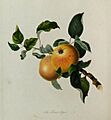
A drawing of the Styre apple.
 | Sharif Bey |
 | Hale Woodruff |
 | Richmond Barthé |
 | Purvis Young |
