
Sunglasses facts for kids

Sunglasses are special glasses that protect your eyes from bright sunlight. People also call them shades or sunnies. They stop strong light and harmful rays from hurting your eyes. Some sunglasses also help you see better, with lenses that are colored, polarized, or dark. Long ago, in the early 1900s, some people called them "sun cheaters."
Since the 1930s, sunglasses have been a cool fashion accessory, especially at the beach. Eye doctors suggest wearing sunglasses that block ultraviolet (UV) light. This is important whenever you are in the sun. UV and blue light can cause serious eye problems. Sunglasses are also needed after some eye surgeries. It's important to know that dark sunglasses that don't block UV light can actually be worse for your eyes. They make your pupils open wider, letting in more harmful rays.
Contents
The History of Sunglasses
Early Eye Protection

Long ago, people found ways to protect their eyes. Around the 13th century, the Inuit people in cold regions made special snow goggles. These goggles were made from materials like walrus ivory. They had narrow slits to look through. This design helped block the sun's harsh glare from snow and ice. These early goggles didn't make the light less bright. Instead, they limited how much light reached the eyes.
Ancient Times and Early Ideas
The Roman emperor Nero supposedly watched gladiator fights through polished emeralds. These might have worked like mirrors. The first known sunglasses were used in China around the 12th century. They were flat pieces of smoky quartz called Ai Tai, meaning "dark clouds." These didn't fix vision but did reduce glare. Judges in ancient Chinese courts used them to hide their feelings.
In 1459, Nuno Fernandes asked for glasses to protect his eyes from snow glare while riding. King Louis XIV's court used a telescope with a smoky glass filter to watch a solar eclipse in 1706. By the 1700s, people in Venice wore tinted, mirror-like glasses. These "gondola glasses" protected their eyes from the bright reflections off the water.
Around 1752, James Ayscough experimented with tinted lenses. He thought blue or green tints could help with vision problems. He wasn't focused on sun protection.

A scientist named Antoine Lavoisier was shown wearing tinted glasses in 1772. He worked with strong sunlight. By the 1800s, tinted glasses were common for railway travelers. Soldiers in the American Civil War (1861–1865) used "shell spectacles" for sun protection. By 1895, sunglasses even appeared in advertisements.
Modern Sunglasses Emerge
In 1899, Rodenstock GmbH made what might be the first sunglasses for UV protection. Before this, glasses mostly just reduced glare. In 1913, Crookes lenses were invented. These glass lenses contained cerium and blocked all ultraviolet light.
In the early 1920s, sunglasses became popular, especially with movie stars. In 1929, Sam Foster started making affordable sunglasses from celluloid. He sold them on the beaches of Atlantic City, New Jersey. By 1938, Life magazine noted that sunglasses were a "new fad" in cities. They reported 20 million pairs sold in the US in 1937.
Sunglasses also became important for pilots. This helped make them popular. In 1936, Edwin H. Land created the first polarized sunglasses. He used his special Polaroid filter. By 2008, Xiamen, China, became the world's biggest producer. Its port exported 120 million pairs of sunglasses each year.
How Sunglasses Work
Clear Vision and Comfort

Sunglasses make seeing more comfortable and clear. They protect your eyes from harsh glare.
Polarized sunglasses have special lenses. They reduce glare that bounces off shiny surfaces like water. This helps people see into water or reduces glare from wet roads while driving.
Protecting Your Eyes

Sunglasses protect your eyes from too much light. This includes both visible and invisible light rays.
The most important protection is against ultraviolet radiation. UV rays can cause eye problems like photokeratitis (snow blindness), cataracts, and even eye cancer. Eye doctors recommend sunglasses that block 99% or more of UVA and UVB light. These are often labeled "UV400." This means they block rays up to 400 nm.
High-energy visible light (HEV), or blue light, can also harm your eyes. It may contribute to age-related macular degeneration. Some glasses are designed to block blue light. Sunglasses are extra important for children. Their eyes let in more HEV light than adult eyes.
Checking Your Sunglasses' Protection

You can't tell how much protection sunglasses offer just by looking at them. Dark lenses don't always mean better UV protection. In fact, dark lenses without good UV protection can be worse. They make your pupils open wider, letting in more harmful rays.
The best way to know is to check the label. Look for "UV400" or a standard like the CE mark in Europe. The color of the lens doesn't guarantee protection either. Blue-blocking lenses are usually yellow or brown. However, not all yellow or brown lenses block enough blue light.
Expensive sunglasses don't always offer better protection. Studies have shown that affordable pairs can sometimes protect just as well. Make sure your sunglasses fit well. They should be close to your face to block light from the sides.
Other Reasons to Wear Sunglasses
People wear sunglasses for many reasons beyond eye protection. They are often worn indoors or at night.
Sunglasses can help you hide your eyes. This can make eye contact difficult, which some people find cool. They can also hide emotions, like blinking or tears. This is useful in games like poker, where players want to hide their "tells."

Fashion trends are another big reason. Designer sunglasses from top brands are very popular. Sunglasses can be a key part of a stylish outfit. They are often linked to a cool lifestyle, especially beach life.

People might also wear sunglasses to hide how their eyes look. This can be for people with severe vision problems. It can also hide things like exophthalmos (bulging eyes) or a black eye.
Sunglasses Standards
The international standard for sunglasses is ISO 12312. It has parts for general use and for special uses like observing the sun.
.svg)
In Europe, the EN 1836:2005 standard sets rules for sunglasses. Products meeting this standard get a CE mark. This mark means the glasses offer a certain level of sun protection. Sunglasses are grouped into categories from 0 to 4 based on how much light they let through. Category 4 is for very intense sun, like in high mountains, and should not be used for driving.
In the United States, sunglasses follow ANSI Z80.3-2001 safety standards. They must also meet Food and Drug Administration (FDA) rules. This standard sets limits on how much UVB and UVA light can pass through the lenses.
Special-Use Sunglasses
Driving with Sunglasses
When driving, especially fast, bright glare can be dangerous. Sunglasses can help reduce this glare. It's important that the lenses aren't too dark. They must let enough light in for safe driving.
Some lenses change tint when exposed to UV light. However, car windshields block UV light. This can make these lenses not work well for driving. They might stay too light or too dark.

For daytime driving, lenses that let 18% to 43% of light through (Category 2) are often recommended. Polarized lenses are great for reducing glare from wet roads. Lenses that are too dark (Category 4) are not safe for driving at any time.
Sunglasses for Pilots
Pilots need sunglasses that protect against strong UV radiation. UV light is more intense at higher altitudes. Polarized glasses are usually not good for pilots. They can make aircraft windshields look strange. They can also make some instrument screens dim or disappear.
Sports Sunglasses

Sunglasses for sports need to be tough. Their lenses should be shatterproof and impact-resistant. They often have a strap or cushion to keep them in place.
For water sports, "water sunglasses" are designed for rough water. They might float if they fall off. They also have vents to prevent fogging.
.jpg)
Mountain climbing or glacier travel needs extra eye protection. Sunlight is stronger at high altitudes. Snow and ice reflect even more light. Glacier glasses are popular for this. They have very dark, round lenses. They also have leather pieces on the sides to block light.
-
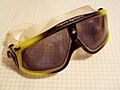
Swimming goggles
-
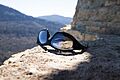
Sports sunglasses for mountain climbing and hiking


Sunglasses in Space
_head.jpg)
Space travel requires very special eye protection. Sunlight in space is much more intense and harmful than on Earth. Astronauts need protection from strong UV and infrared radiation. Inside the spacecraft, they wear sunglasses with dark lenses and a thin gold coating. During space walks, their helmet visors act as powerful sunglasses. These visors also have a gold coating.
Sunglasses for space must be flexible and durable. They need to stay put in zero-gravity. This is very important inside a spacesuit. If glasses slip, an astronaut can't adjust them for hours. The frames must also be designed so no small parts can break off and float around. Many astronauts wear glasses in space, even if they don't need them on Earth. Zero-gravity can temporarily affect their vision.
The first sunglasses used on the Moon were pilot sunglasses from American Optical. Apollo 11 astronauts wore them in 1969. NASA scientists also developed special lenses for space. These lenses used colored dyes and zinc oxide. This is the same ingredient found in sunscreen lotions.
-

1969 on board the Eagle: Buzz Aldrin stows his sunglasses before the Moon landing.
-
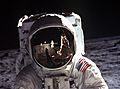
1969: Helmet visor protecting Aldrin's eyes on the Moon


How Sunglasses Are Made
Lenses

Sunglass lenses come in many colors. For everyday use, gray, green, or brown are often suggested. These colors help keep colors looking natural. This is important for safety, like when driving.
- Gray and green lenses show true colors.
- Brown lenses can change colors slightly but make things look sharper.
- Yellow lenses make objects stand out. They are popular with skiers and pilots.
- Blue or purple lenses can increase contrast.
Some sunglasses have polarized lenses. These lenses reduce glare from shiny surfaces like water. This is helpful for fishing.

A mirrored coating can be added to lenses. This coating reflects some light away, which is good for very bright conditions. Mirrored coatings can be any color for style. The mirror color doesn't change the lens color.
Sunglass lenses are made from glass, plastic, or special materials like SR-91. Glass lenses are very clear and scratch-resistant. However, they are heavier and can break. Plastic lenses are lighter and shatter-resistant. Polycarbonate plastic lenses are the lightest and almost unbreakable. CR-39 is a common plastic lens material.
Frames

Frames are usually made from plastic, nylon, or metal. Nylon frames are light and flexible. They are often used for sports. Metal frames are stiffer. Some metal frames have spring hinges for a better fit. The parts that go over your ears are usually curved. Some brands use straight "earstems."
In recent years, some frames are made from different types of wood. Materials like bamboo, ebony, and walnut are used. These wooden frames are often made by hand. They are usually more expensive and need more care.
Frames can hold lenses in different ways:
- Full frame: The frame goes all around the lenses.
- Half frame: The frame goes around only half the lens, usually the top.
- Frameless: There is no frame around the lenses. The ear pieces attach directly to the lenses.
Some sports sunglasses have interchangeable lenses. You can easily swap lenses for different colors. This is useful when light conditions change. It's also cheaper than buying many pairs of glasses.
Nose Bridge
The nose bridge supports the sunglasses on your face. It also prevents pressure marks. The size and shape of the nose bridge can vary. This helps sunglasses fit different nose shapes comfortably.
Popular Sunglass Styles
Aviator Sunglasses

.jpg)
Aviator sunglasses have large, teardrop-shaped lenses. They have a thin metal frame with a double or triple bridge. This style was first made in 1936 for US military aviators.
Aviators became popular in the 1940s when Douglas MacArthur wore them. They became a big fashion trend in the late 1960s with the hippie movement. Many celebrities wore them in the 1970s. Their popularity grew again in the 1980s, especially after being featured in movies like Top Gun. They saw another comeback around 2000.
Browline Sunglasses
Browline glasses have thick plastic or horn-rimmed tops and arms. The bottom part of the frame is thin wire. This classic style was adapted into sunglasses in the 1980s. They have been popular on and off since then.
Oversized Sunglasses

Oversized sunglasses have very large frames and lenses. They were fashionable in the 1980s. Today, moderately oversized sunglasses are a popular fashion trend.
"Onassis glasses" or "Jackie O's" are a type of oversized sunglasses. They are named after Jacqueline Kennedy Onassis, who famously wore them. Celebrities often use them to avoid paparazzi. Oversized sunglasses also offer more protection from sunburn because they cover more skin.
Shutter Shades
Shutter shades became popular in the early 1980s and again in the 2010s. Instead of tinted lenses, they have horizontal slats, like tiny window shutters. They reduce sun exposure by blocking some light. If they don't have lenses behind the shutters, they offer very little UV protection.
Teashades

Teashades are round, wire-rimmed sunglasses. They were very popular with the 1960s counterculture. Pop icons like John Lennon and Ozzy Osbourne wore them. The original design had medium-sized, perfectly round lenses. Later versions had colored or mirrored lenses and larger sizes. Today, teashades are mostly found at costume shops.
Wayfarer Sunglasses

The Ray-Ban Wayfarer is a famous plastic-framed sunglass style. It was introduced in 1952. The lenses are wider at the top than the bottom. Famous people like James Dean and Elvis Presley wore them.
Wayfarers were very popular in the late 1950s and 1960s. Their popularity returned in the 1980s. This was helped by movies like The Blues Brothers and The Breakfast Club. They became popular again in the 2000s and have been a top seller since 2012.
Wrap-around Sunglasses
Wrap-around sunglasses are curved to fit closely around the face. They often have a single curved lens that covers both eyes. This style gives a wide field of vision. They first appeared in the 1960s as a version of Aviators. Modern wrap-arounds became very popular in the 1980s and 1990s.
Types of Sunglasses
Clip-on Sunglasses

Clip-on glasses are tinted lenses that you can clip onto your regular eyeglasses. They offer sun protection without needing a separate pair of prescription sunglasses.
Gradient Lenses

Gradient lenses are darker at the top and lighter at the bottom. This means they offer more sun protection when you look up. They offer less protection when you look down. This can be useful for pilots or drivers. It allows them to see instrument panels clearly while still reducing glare from above.
Flip-up Sunglasses
Flip-up sunglasses are like clip-ons. They have tinted lenses that can be flipped up when you don't need them. This is handy for going indoors.
Mirrored Lenses

Mirrored lenses have a shiny, reflective coating on the outside. This coating deflects some light away from the lens. This makes them good for very bright conditions. Mirrored coatings come in many colors for different styles.
Other Names for Sunglasses
People use many different names for sunglasses:
- Shades (common in North America)
- Glares (popular in India)
- Sunnies (used in Australia, South Africa, and New Zealand)
- Dark glasses (a general term)
- Solar shields (often for large lenses)
- Cooling glasses (used in Southern India and the Middle East)
See also
 In Spanish: Gafas de sol para niños
- Eye patch
- Goggles
- Photochromic lens
