
Tanzanian woolly bat facts for kids
Quick facts for kids Tanzanian woolly bat |
|
|---|---|
| Conservation status | |
Scientific classification  |
|
| Kingdom: | Animalia |
| Phylum: | Chordata |
| Class: | Mammalia |
| Order: | Chiroptera |
| Family: | Vespertilionidae |
| Genus: | Kerivoula |
| Species: |
K. africana
|
| Binomial name | |
| Kerivoula africana Dobson, 1878
|
|
| Script error: The function "autoWithCaption" does not exist. | |
Script error: No such module "Check for conflicting parameters".
The Tanzanian woolly bat (Kerivoula africana) is a small bat that lives only in Tanzania, a country in Africa. People in Tanzania sometimes call it "popo" or "tunge." This bat is part of the Vespertilionidae family, which includes many common bats found around the world.
Contents
Discovering the Tanzanian Woolly Bat
This special bat was first described in 1878 by an Irish zoologist named George Edward Dobson. He studied a bat specimen that another zoologist, Achille Raffray, had collected in 1875 from Zanzibar, an island off the coast of Tanzania. The bat's scientific name, africana, simply means "African," showing where it comes from.
What Does the Tanzanian Woolly Bat Look Like?
The Tanzanian woolly bat is quite small. When it was first described, it was the smallest known bat in its group, the Kerivoula genus.
- Ears: Its ears and the small flap inside its ear (called a tragus) look similar to another bat called Hardwicke's woolly bat.
- Fur: It has no fur between its eyes, but it does have longer hairs around its lips. The fur on its back is two-toned: dark brown at the bottom and grayish-brown at the tip. The fur on its belly is also two-toned but lighter.
- Size: Its head and body are about 3.4 cm (1.35 inches) long. Its tail is also about 3.4 cm (1.35 inches) long. Its ear is about 1.3 cm (0.5 inches) long, and its forearm (the main bone in its wing) is about 2.8 cm (1.1 inches) long.
- Teeth: This bat has 38 teeth in total.
Where the Tanzanian Woolly Bat Lives
This bat is found only in Tanzania, specifically along the eastern coast of the country. It likes to live in warm, wet lowland forests. These are forests that are close to the sea and get a lot of rain.
Why the Tanzanian Woolly Bat Needs Help
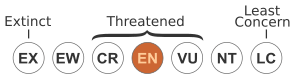
The Tanzanian woolly bat is currently listed as an endangered species by the International Union for Conservation of Nature (IUCN). This means it is at a very high risk of disappearing forever.
Threats to Their Home
One of the biggest problems for these bats is habitat loss. Their forest homes are being destroyed for different reasons:
- Farming: Coastal wetlands are being turned into farms to grow food.
- Logging: Forests are cut down for wood by the timber industry and for local use.
Other Dangers
Sadly, the Tanzanian woolly bat also faces another threat. Some people in the Sukuma community believe that burning the bat's body and breathing in the smoke can help treat certain illnesses. This practice puts the bat's population at even greater risk.
Conservation Efforts
The IUCN has considered this bat endangered since 2004. For a while, from 1988 to 1996, scientists even thought it might be extinct (gone forever)! Luckily, it was rediscovered in 2000. Protecting its forest home and educating people about its importance are key steps to help this unique bat survive.
